

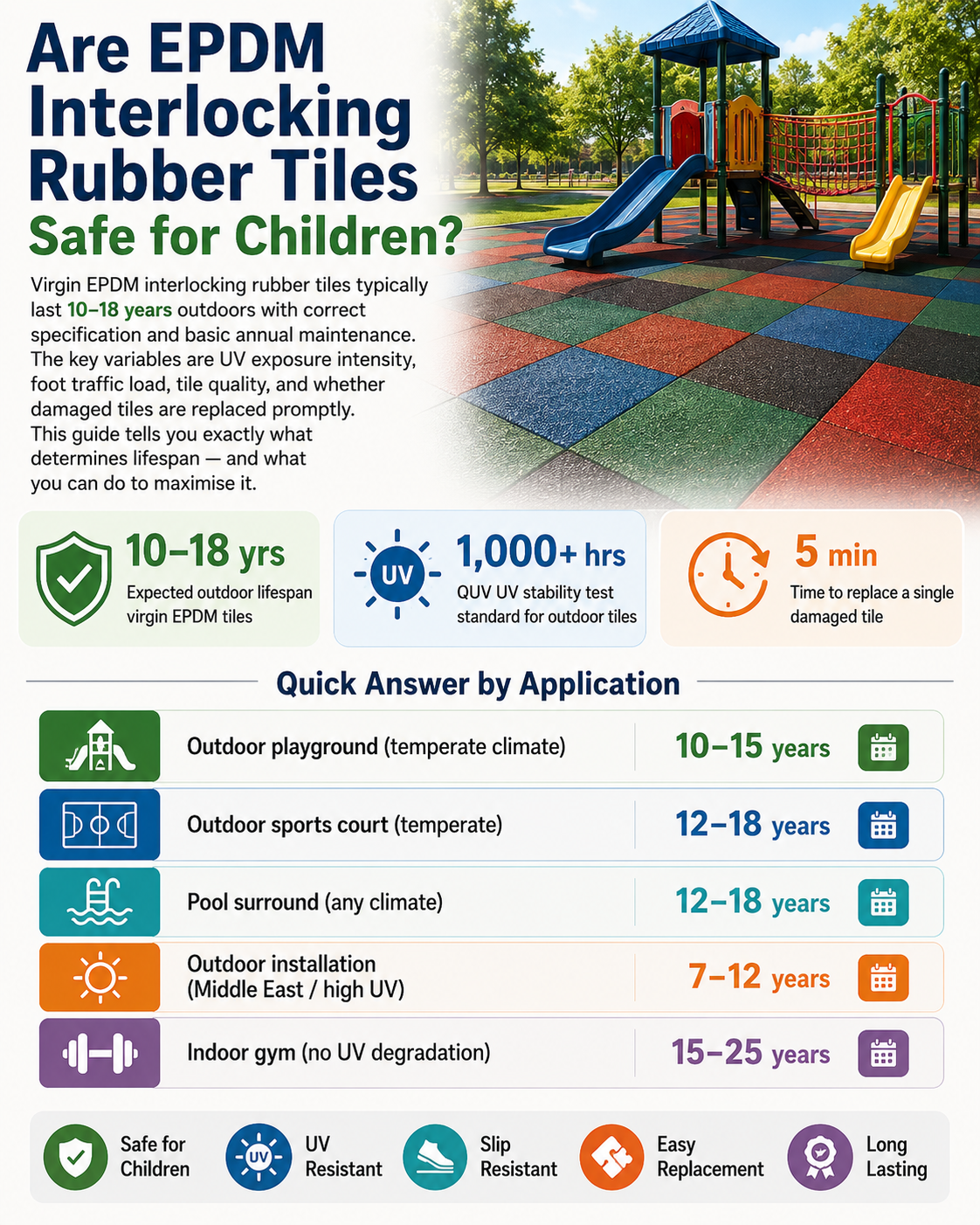
Virgin EPDM interlocking rubber tiles typically last 10–18 years outdoors with correct specification and basic annual maintenance. The key variables are UV exposure intensity, foot traffic load, tile quality, and whether damaged tiles are replaced promptly. This guide tells you exactly what determines lifespan — and what you can do to maximise it.
Expected outdoor lifespan
virgin EPDM tiles
QUV UV stability test
standard for outdoor tiles
Time to replace a single
damaged tile
Outdoor playground (temperate climate): 10–15 years.
Outdoor sports court (temperate): 12–18 years.
Pool surround (any climate): 12–18 years.
Outdoor installation (Middle East / high UV): 7–12 years.
Indoor gym: 15–25 years (no UV degradation).
For the full buyer’s guide including materials, pricing, and supplier selection, see our EPDM Interlocking Rubber Tiles Complete Buyer’s Guide.
What Determines How Long EPDM Tiles Last Outdoors?
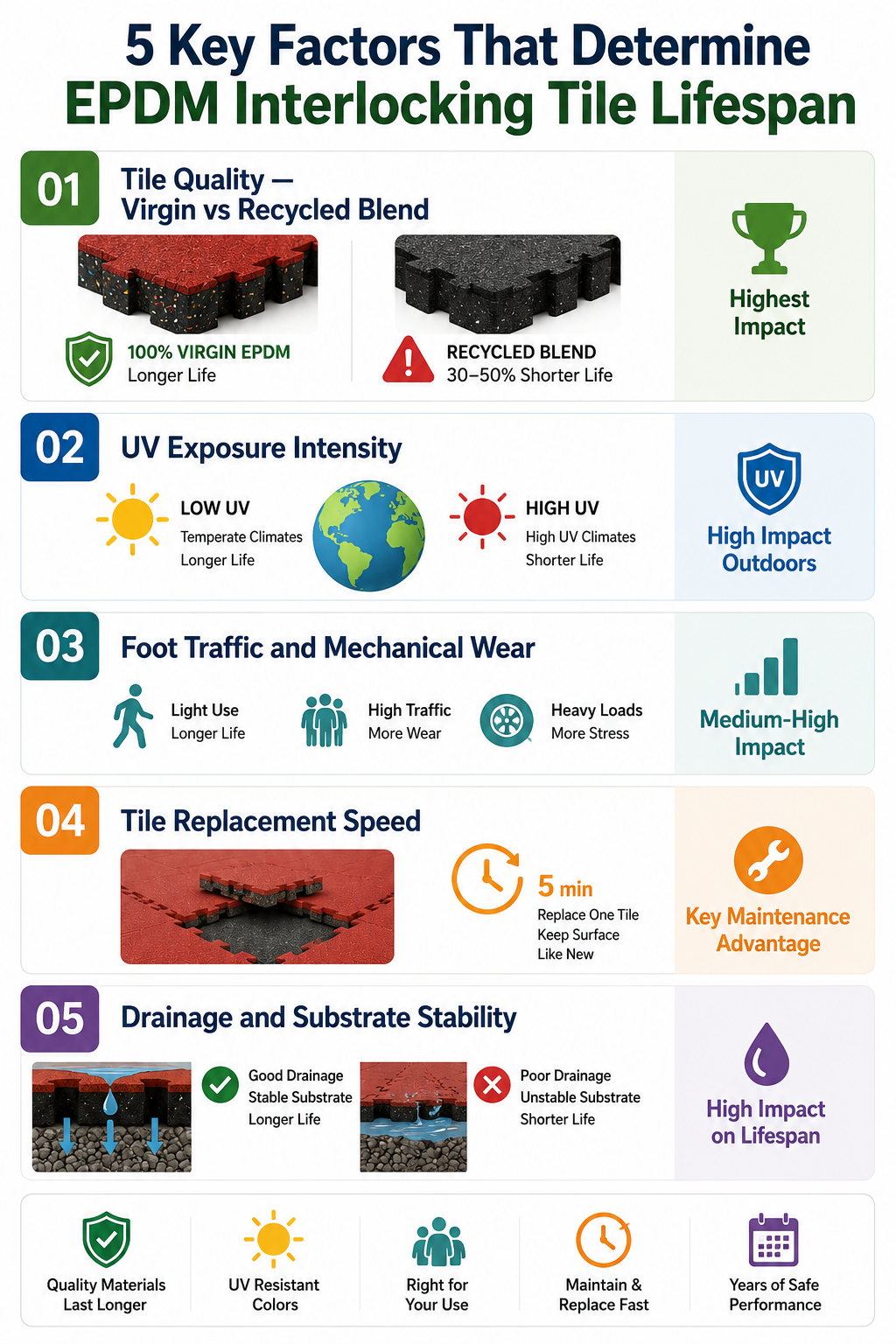
The single biggest lifespan variable. Virgin EPDM tiles contain 100% fresh synthetic polymer with integral UV-stable pigmentation — engineered specifically for outdoor durability. Recycled-blend products age 30–50% faster in the same environment. If your tiles are priced significantly below market and the supplier cannot provide a material composition certificate, the lifespan you will actually experience will be far shorter than marketed. Always verify virgin content before purchasing outdoor tiles.
Highest Impact
UV radiation is the primary outdoor degradation mechanism for EPDM tiles. Installations in temperate climates (UK, Germany, Northern USA) experience significantly less UV than high-UV environments (Middle East, South Asia, Australia, Mediterranean). A tile system rated for 15 years in the UK may reach end of usable life at 8–10 years in Saudi Arabia. Always request QUV test data for your specific color — and for high-UV installations, specify iron oxide-based colors (dark red, dark green) which have the best UV stability of any EPDM pigment system.
High Impact Outdoors
A lightly used rooftop terrace will outlast a heavily trafficked school playground by 5–8 years with identical tiles. High-frequency spike traffic (athletics, football boots) accelerates surface texture wear. Heavy wheeled equipment causes localised compression. For high-traffic outdoor installations, specify slightly thicker tiles — a 25mm tile under heavy pedestrian traffic will outlast a 20mm tile in the same position by approximately 3–5 years.
Medium-High Impact
This is the unique lifespan advantage of interlocking tiles over poured systems. When an individual tile shows significant wear, cracking, or surface degradation — replace it immediately. A single damaged tile left in place creates stress on adjacent connections, allows moisture infiltration, and accelerates degradation of surrounding tiles. The ability to replace one tile in 5 minutes, without disrupting the rest of the surface, means that a well-maintained interlocking tile system can maintain near-new performance indefinitely through selective replacement.
Key Maintenance Advantage
Poor drainage beneath tiles accelerates degradation. Standing water at tile edges promotes algae growth and freeze-thaw cycling damage to connection profiles. An unstable substrate that moves or settles differentially stresses tile connections, causing premature separation. Correct drainage falls and a stable, well-prepared substrate are prerequisites for achieving the upper end of the expected lifespan range.
Medium Impact
Expected Lifespan by Application and Climate
| Application | Climate | Traffic Level | Expected Lifespan | Key Limiting Factor |
|---|---|---|---|---|
| School Playground | Temperate | High | 10–15 years | UV + foot traffic |
| Public Park Playground | Temperate | Medium-High | 12–16 years | UV + seasonal use |
| Outdoor Sports Court | Temperate | High | 12–18 years | UV + surface wear |
| Pool Surround | Temperate | Medium | 12–18 years | Chemical exposure + UV |
| Rooftop Terrace | Temperate | Low-Medium | 13–18 years | UV + thermal cycling |
| Outdoor Fitness Park | Temperate | Medium-High | 10–15 years | UV + equipment impact |
| Any outdoor application | High UV (Middle East) | Any | 7–12 years | Extreme UV degradation |
| Indoor Gym | Indoor (no UV) | High | 15–25 years | Mechanical abrasion only |
Annual Maintenance Routine to Maximise Lifespan
Pressure wash the entire tile surface at low pressure using a pH-neutral cleaner to remove winter debris, algae, and organic material. After cleaning, inspect every tile: look for cracking, surface chalking (UV degradation indicator), connection loosening, or tiles that rock (substrate movement indicator). Photograph any damaged tiles and log their position for repair scheduling.
Replace any tiles identified in the spring inspection while the surface is dry and warm. Summer replacement allows the new tile to fully seat and acclimatise before winter temperature cycling. Check your spare tile stock — if spare tiles are running low, reorder from the same supplier and batch while the product is still actively manufactured.
Check that drainage channels around the tile perimeter are clear before winter rainfall. Inspect tile connections at the perimeter and around high-traffic zones — loose connections should be reset and, if repeatedly loosening, secured with perimeter anchor tape. Clear leaf and organic debris accumulation regularly — retained moisture accelerates algae growth and freeze damage to connection profiles.
For playground applications, commission an EN 1177 in-situ test every 3–5 years to verify the surface still meets Critical Fall Height requirements. EPDM tiles harden slightly with age — CFH performance decreases over time as the rubber becomes less elastic. Regular re-testing documents ongoing compliance and protects site owners from liability.
Lifespan Comparison: Virgin EPDM vs Recycled-Blend Tiles
✅ UV stabilisers fully active — consistent with QUV test data
✅ Integral pigment throughout — color stable for 10–15 years outdoors
✅ Consistent polymer quality — predictable aging behaviour
✅ Connection profiles maintain dimensional accuracy for tile lifetime
✅ 10–18 year outdoor lifespan achievable with annual maintenance
⚠ Variable UV stabiliser content — may show significant fading within 3–5 years
⚠ Color surface dulls — looks aged within a few seasons outdoors
⚠ Inconsistent polymer — unpredictable aging, early brittleness
⚠ Connection profiles may become loose or brittle as polymer degrades
⚠ Realistic outdoor lifespan 5–8 years — 40–50% shorter than virgin
Frequently Asked Questions
Summary: Maximising EPDM Interlocking Tile Lifespan
Article #9 · Series: best EPDM interlocking rubber tiles · ← Back to Buyer’s Guide
Long-Lasting Virgin EPDM Interlocking Tiles
We supply 100% virgin EPDM interlocking tiles with full UV stability data (QUV test results per color) and material composition documentation. Built for 12+ year outdoor performance.