

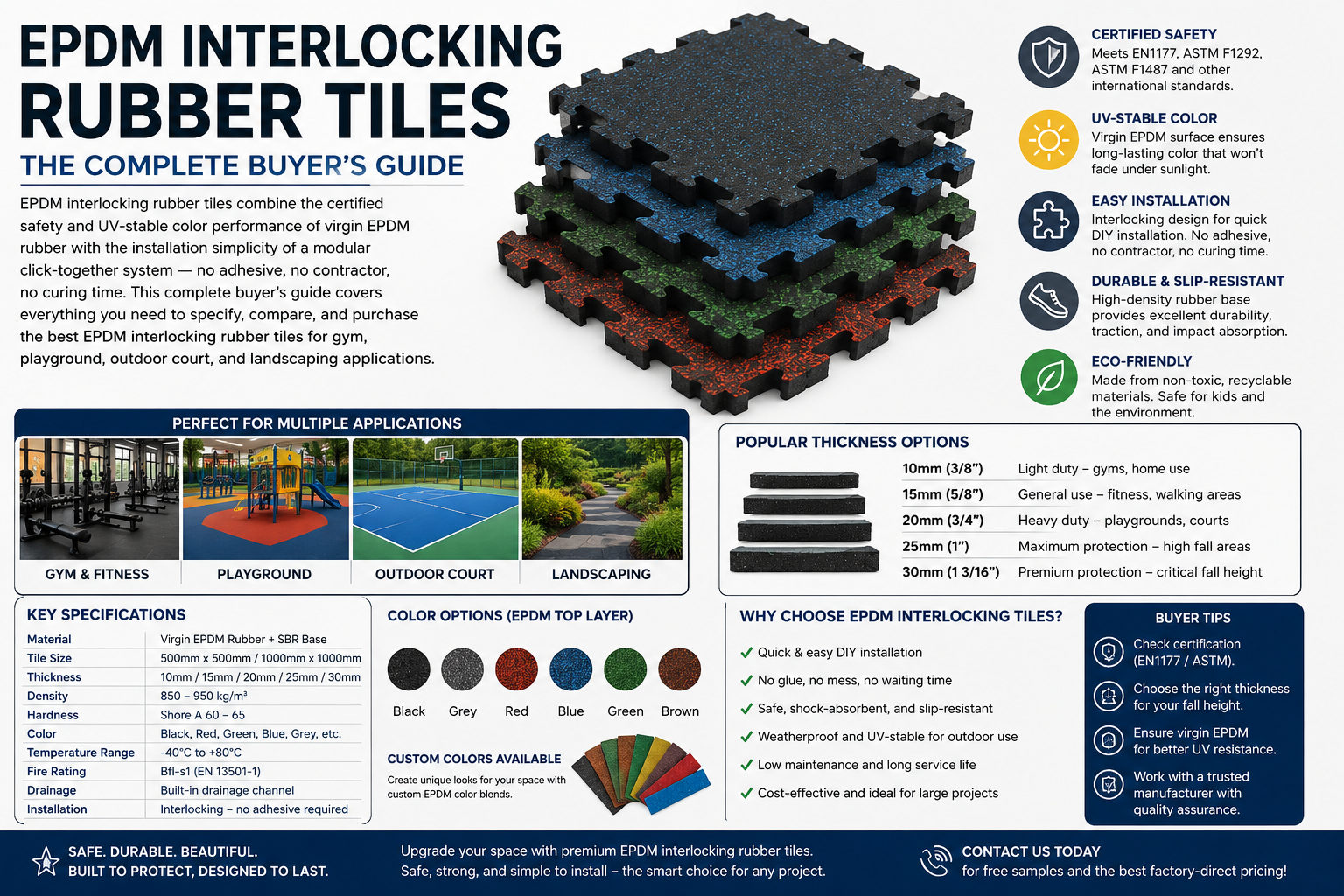
EPDM interlocking rubber tiles combine the certified safety and UV-stable color performance of virgin EPDM rubber with the installation simplicity of a modular click-together system — no adhesive, no contractor, no curing time. This complete buyer’s guide covers everything you need to specify, compare, and purchase the best EPDM interlocking rubber tiles for gym, playground, outdoor court, and landscaping applications.
Outdoor lifespan
virgin EPDM tiles
Standard color options
UV-stable integral pigment
Typical install time
per 20m² — no tools
EPDM interlocking rubber tiles are modular flooring panels made from virgin EPDM (Ethylene Propylene Diene Monomer) rubber — the same certified, UV-stable material used in premium wet-pour playground and sports surfaces — formed into precision-dimensioned tiles with an interlocking edge system. They snap together without adhesive or tools, creating a seamless-appearance surface that can be installed, reconfigured, or replaced tile-by-tile. Available in 20+ colors with full EN 1177, PAH, and REACH certification options.
Contents — Jump to Any Section
1. What Are EPDM Interlocking Rubber Tiles?

EPDM interlocking rubber tiles are a modular flooring system that brings together two proven technologies: virgin EPDM rubber — the global standard for certified playground and sports surfacing — and a precision interlocking edge system that allows tiles to connect without adhesive, tools, or specialist installation.
Unlike recycled rubber (SBR) interlocking tiles, EPDM tiles are manufactured from 100% virgin synthetic rubber with integral color pigmentation — the color is embedded throughout the tile, not applied as a surface coating. This gives EPDM interlocking tiles their defining advantages: vibrant, stable colors that do not fade for 10–18 years outdoors, combined with the certified chemical safety profile required for children’s playgrounds and public sports areas.
The interlocking edge system — typically a loop-and-tab or tongue-and-groove mechanism — allows tiles to snap together firmly on any flat, stable substrate. Any individual tile can be lifted and replaced in minutes without disturbing the surrounding surface, making EPDM interlocking tiles the preferred choice for installations where flexibility, easy maintenance, and long-term color performance are all required.
EPDM Interlocking Tiles vs Wet-Pour EPDM: The Key Difference
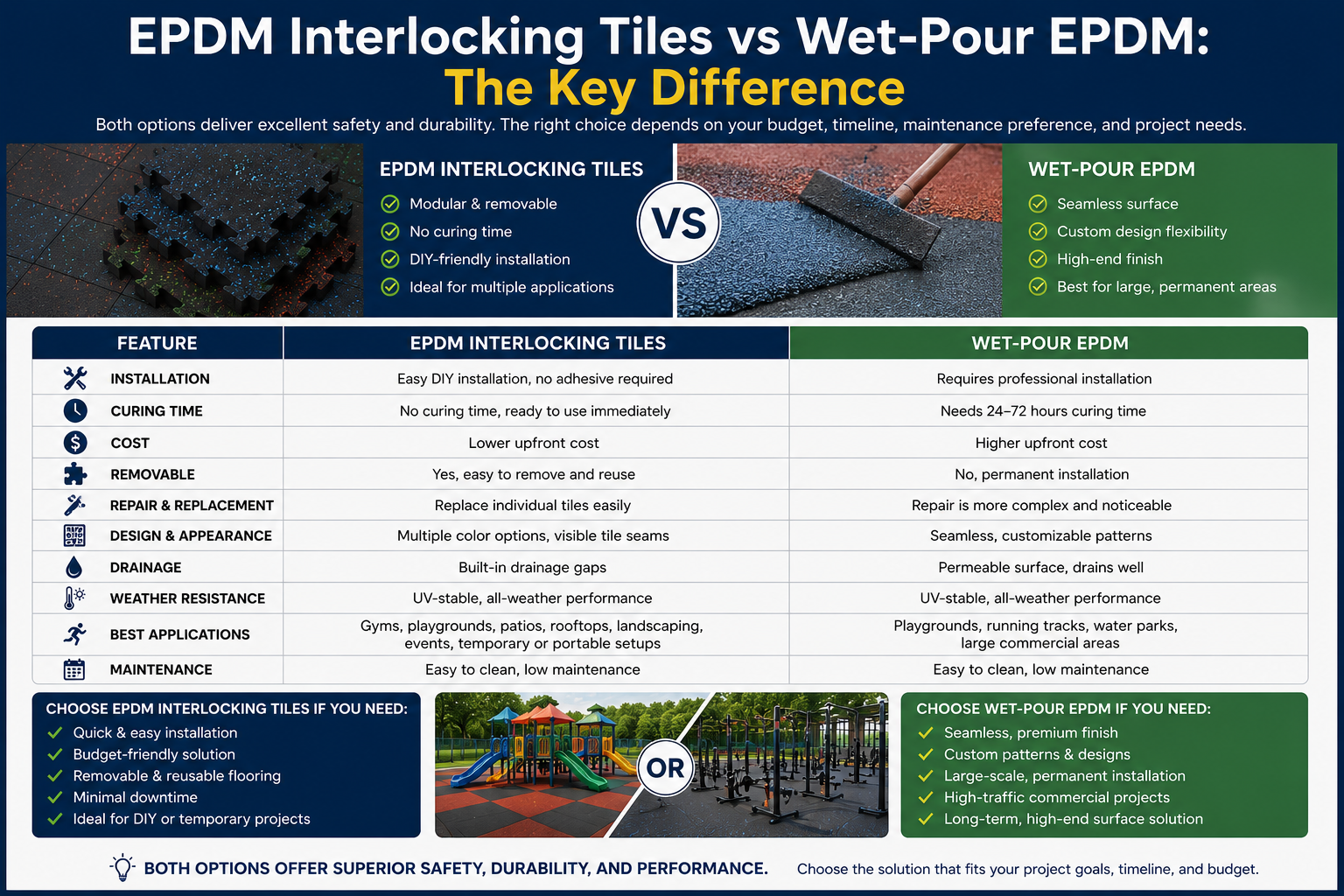
Both products use the same virgin EPDM rubber material — the difference is the installation system. Wet-pour EPDM is mixed with PU binder and poured on-site by a professional installer, creating a seamless surface that is permanent once cured. EPDM interlocking tiles are factory-formed into precision tiles that any facility manager can install without specialist skills. The tile system offers installation flexibility and individual tile replaceability that the poured system cannot match.
2. EPDM vs SBR Rubber Interlocking Tiles: Key Differences
The most important material decision in interlocking rubber tile procurement is choosing between virgin EPDM and recycled SBR. They look similar on specification sheets but perform very differently in real-world applications.
| Factor | EPDM Interlocking Tiles | SBR Recycled Rubber Tiles | Advantage |
|---|---|---|---|
| Material Source | 100% virgin EPDM polymer | Recycled tire rubber | EPDM — no recycled content |
| Color Range | 20+ standard colors | Black / dark grey only | ✅ EPDM — full color choice |
| UV Resistance | Excellent — 10–18 yrs outdoor | Moderate — fades 5–8 yrs | ✅ EPDM — longer color life |
| PAH Safety | Below ZEK 01.4-08 limits (certified) | Requires testing — may exceed limits | ✅ EPDM — safer for children |
| REACH Compliance | Standard for virgin EPDM | Verify per product | ✅ EPDM — chemical safety assured |
| EN 1177 Playground | Available — certified systems | Available — certified systems | 🤝 Both available |
| Price Range | $18–$50/m² | $8–$20/m² | ✅ SBR — lower cost |
| Child Skin Contact | ✅ Safe when PAH certified | ⚠ Verify PAH certification | ✅ EPDM — safer default |
| Outdoor Appearance | Maintains color for 10+ years | Limited to black — no color concern | ✅ EPDM — color applications |
| Best For | Playgrounds, premium gyms, outdoor courts, pool surrounds | Indoor gyms, garages, weight rooms | Application-dependent |
Choose EPDM interlocking tiles when: color is required (any color other than black); the surface will be outdoors with UV exposure; children will have direct skin contact (playground, sensory play); or chemical safety certification (PAH, REACH) is a project requirement. Choose SBR when: the surface is indoor only, black color is acceptable, and budget is the primary constraint.
3. EPDM Interlocking Tiles vs Wet-Pour EPDM: Which Is Right?
| Factor | EPDM Interlocking Tiles | Wet-Pour EPDM (Poured) | Advantage |
|---|---|---|---|
| Installation | DIY — no tools, no curing | Professional contractor required | ✅ Tiles — simpler, faster |
| Installation Time | Hours | Days (including cure time) | ✅ Tiles — immediate use |
| Surface Finish | Tile joints visible | Completely seamless | ✅ Wet-pour — premium finish |
| Repair | Replace individual tile — minutes | Patch repair — specialist needed | ✅ Tiles — easier maintenance |
| Reconfiguration | Fully reconfigurable | Permanent once installed | ✅ Tiles — flexible layout |
| Color Design Complexity | Standard tile colors and patterns | Complex multi-color designs possible | ✅ Wet-pour — creative freedom |
| Upfront Cost | Lower — no contractor needed | Higher — material + installation | ✅ Tiles — lower investment |
| Lifespan | 10–18 years | 10–20 years | ✅ Wet-pour — marginally longer |
| Temporary Use | ✅ Fully removable | ❌ Permanent | ✅ Tiles — only viable option |
| Substrate Requirement | Any flat stable surface | Prepared, drained substrate | ✅ Tiles — more flexible |
Choose EPDM interlocking tiles when installation must be rapid, DIY, or temporary; when individual tile replacement is important for maintenance; or when the layout needs to be reconfigurable. Choose wet-pour EPDM when a completely seamless surface is required; when complex multi-color graphic designs are specified; or when maximum long-term lifespan is the priority.
4. Key Technical Specifications
When evaluating EPDM interlocking rubber tiles, request test data for each of the following parameters from your supplier before ordering.
| Parameter | Typical Range | Test Method | Why It Matters |
|---|---|---|---|
| Tile Thickness | 10 / 15 / 20 / 30 / 40 / 50mm | Physical measurement | Impact absorption and fall protection |
| Tile Size | 500×500mm / 1000×1000mm | Physical measurement | Installation speed and wastage |
| EPDM Content | ≥85% virgin EPDM polymer | Material composition certificate | Confirms virgin content — no SBR blend |
| Shore A Hardness | 45–65 Shore A | ISO 7619-1 | Surface softness and impact absorption |
| Tensile Strength | ≥4.0 MPa | ISO 37 | Resistance to tearing under load |
| Elongation at Break | ≥180% | ISO 37 | Flexibility and crack resistance |
| UV Resistance | ΔE <3 after 1,000hrs QUV | ASTM G154 / ISO 4892-3 | Color retention outdoors |
| Critical Fall Height | Up to 3.0m (EN 1177) | EN 1177 system test | Playground safety compliance |
| PAH Content | Below ZEK 01.4-08 limits | GC-MS 18-PAH analysis | Child safety — skin contact surfaces |
| Dimensional Tolerance | ±0.5mm (tile size) ±0.3mm (thickness) | Caliper measurement | Consistent interlocking fit across area |
| Temperature Range | −30°C to +80°C | Cold flex / heat aging | All-climate dimensional stability |
5. Main Applications of EPDM Interlocking Rubber Tiles
EPDM interlocking tiles serve six primary application categories — each benefiting from the specific combination of virgin EPDM’s color performance and UV stability with the installation flexibility of the modular tile system.
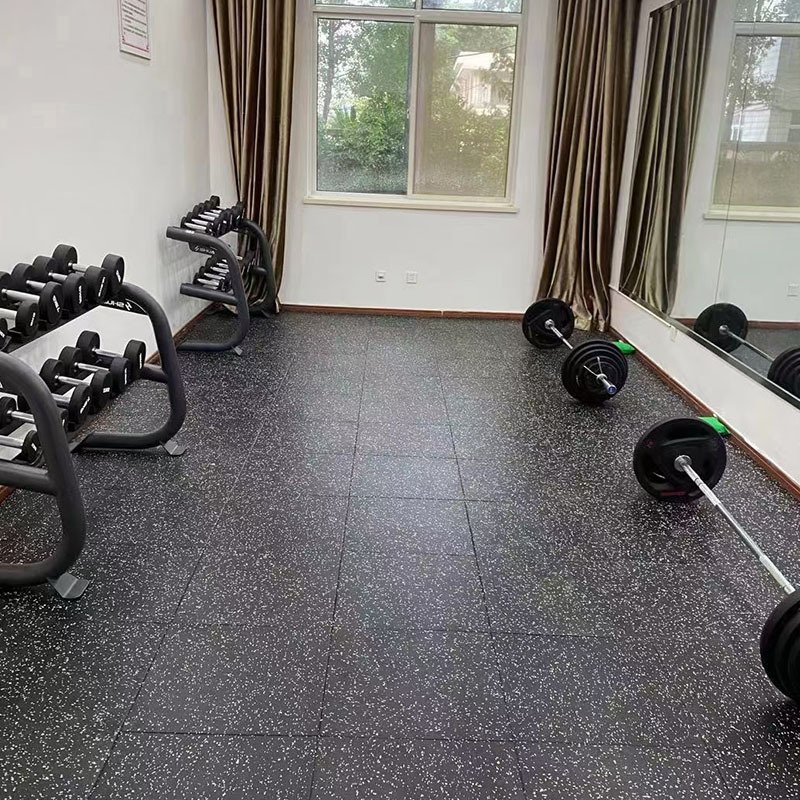
Commercial gyms, hotel fitness suites, CrossFit facilities, and home gyms. EPDM tiles offer color-coded zone design not possible with black SBR tiles — enabling visual separation of cardio, weights, and stretching areas. 20mm for general zones, 40mm for free weight areas. Color options allow brand identity integration and zone-specific visual communication.
Color Zoning Advantage
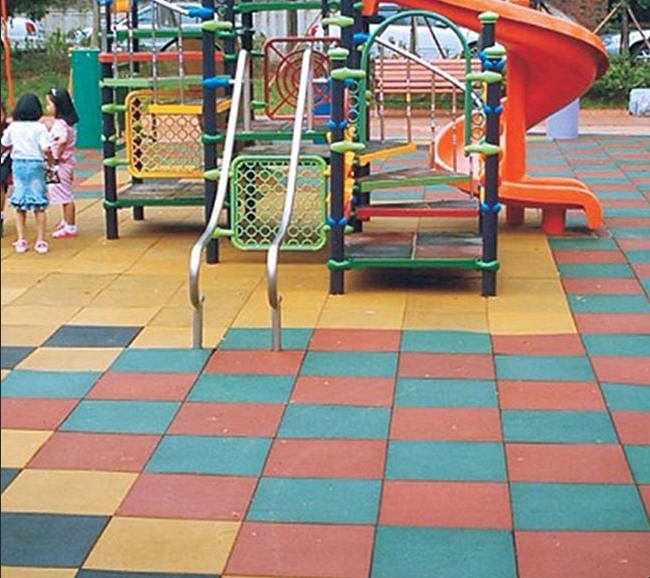
School playgrounds, park play areas, and children’s recreational zones. EN 1177 certified EPDM tiles provide impact attenuation compliance with the installation flexibility to replace individual damaged tiles. 40–50mm thickness for equipment zones. Vibrant colors and PAH-certified safety make EPDM the only appropriate tile material for public playground use.
EN 1177 + PAH Required
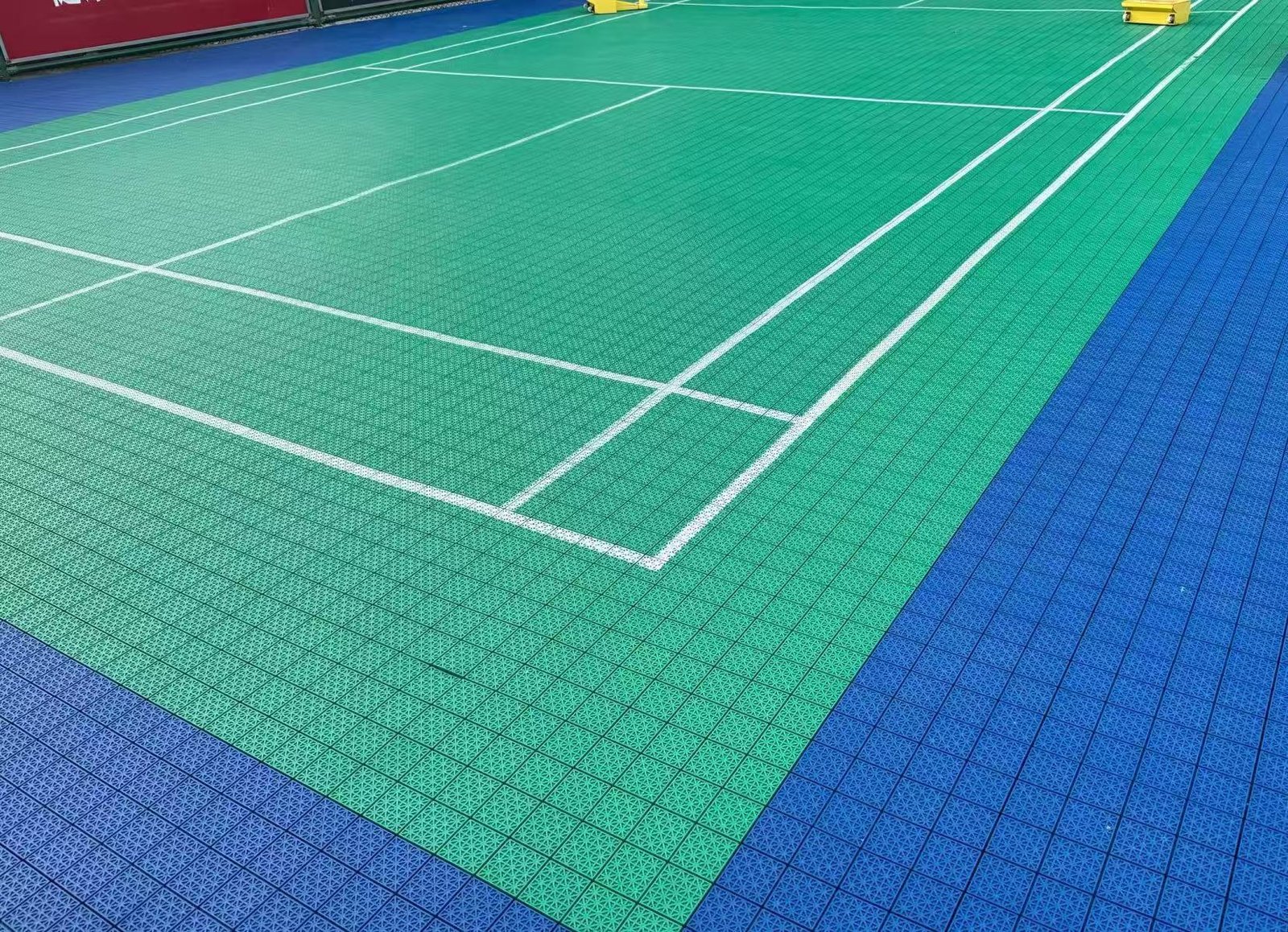
MUGA courts, basketball areas, tennis practice zones, and multi-sport surfaces. EPDM tiles provide UV-stable court colors (green, blue, red) that maintain their appearance for 10+ years outdoors. 20–25mm for court surfaces. The interlocking system allows courts to be reconfigured or expanded without disrupting the existing surface.
UV Stability Critical
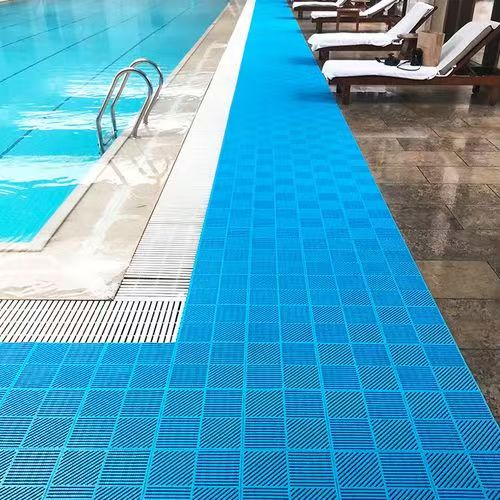
Swimming pool decks, splash pad surrounds, and changing room floors. EPDM’s non-slip surface texture, chemical resistance to pool water, and availability in light colors (keeping surface temperatures safe for barefoot use) make it ideal for aquatic environments. 15–20mm for pool surround areas.
Non-Slip + Chemical Resistant
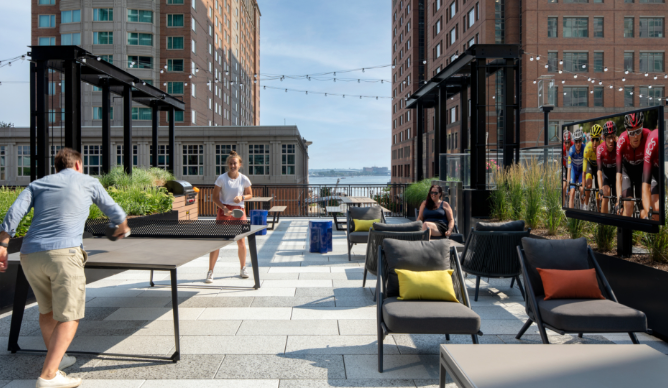
Hotel rooftop terraces, residential amenity decks, and urban public spaces. EPDM interlocking tiles require no adhesive — protecting rooftop waterproofing membranes — and are lightweight enough for most structural load constraints. 20–30mm in architectural earth tones and neutrals. Fully removable for membrane access or layout redesign.
No Adhesive — Membrane Safe
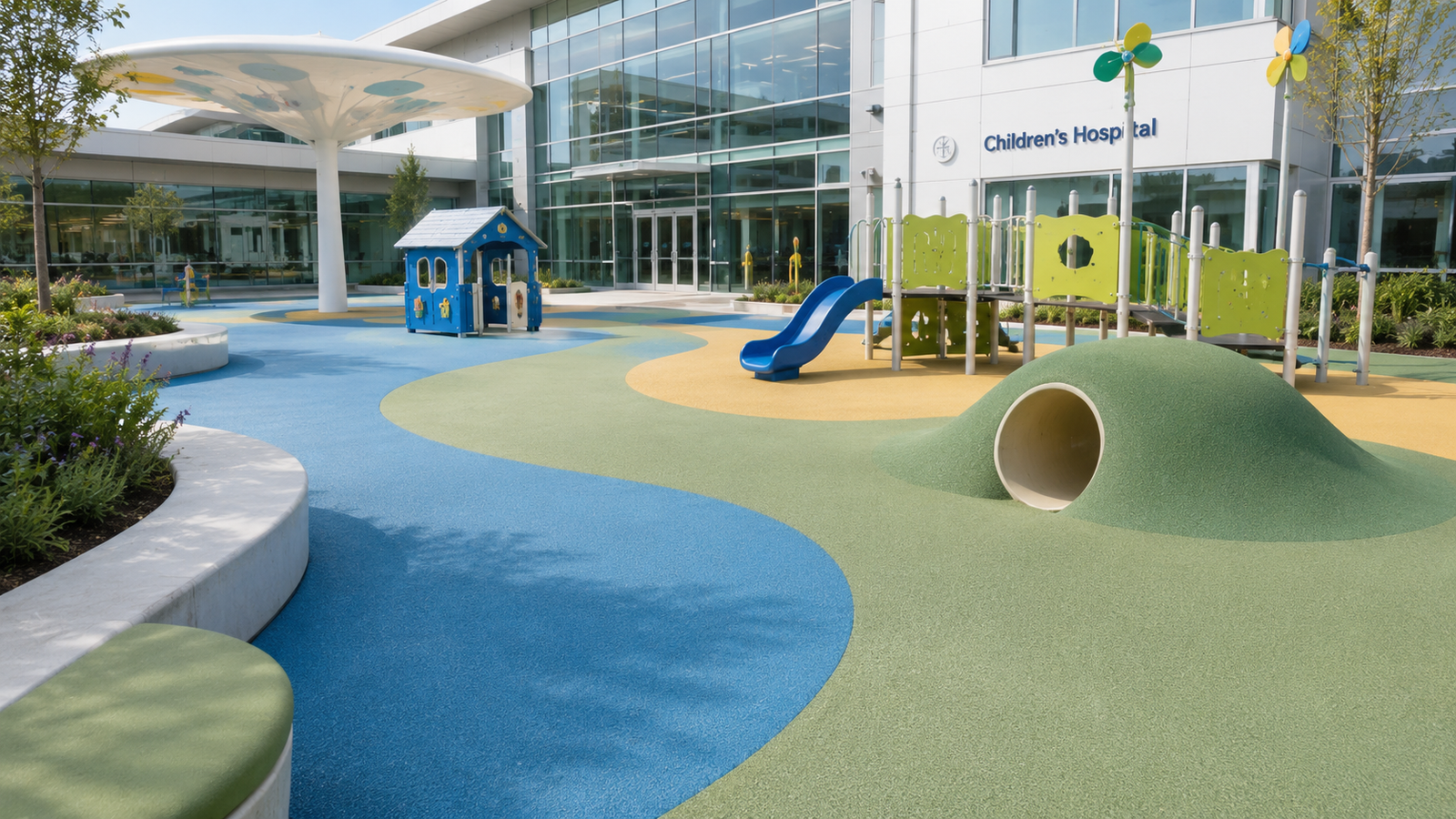
Children’s hospital outdoor areas, sensory gardens, and SEND school surfaces. Fine-texture EPDM tiles with full PAH-per-batch certification and therapeutic color palettes meet the strictest healthcare procurement requirements. 40mm fine-grade EPDM tiles with DDA-compliant installation for wheelchair access.
PAH Per Batch + RoHS Required
6. Installation Guide: How to Install EPDM Interlocking Rubber Tiles
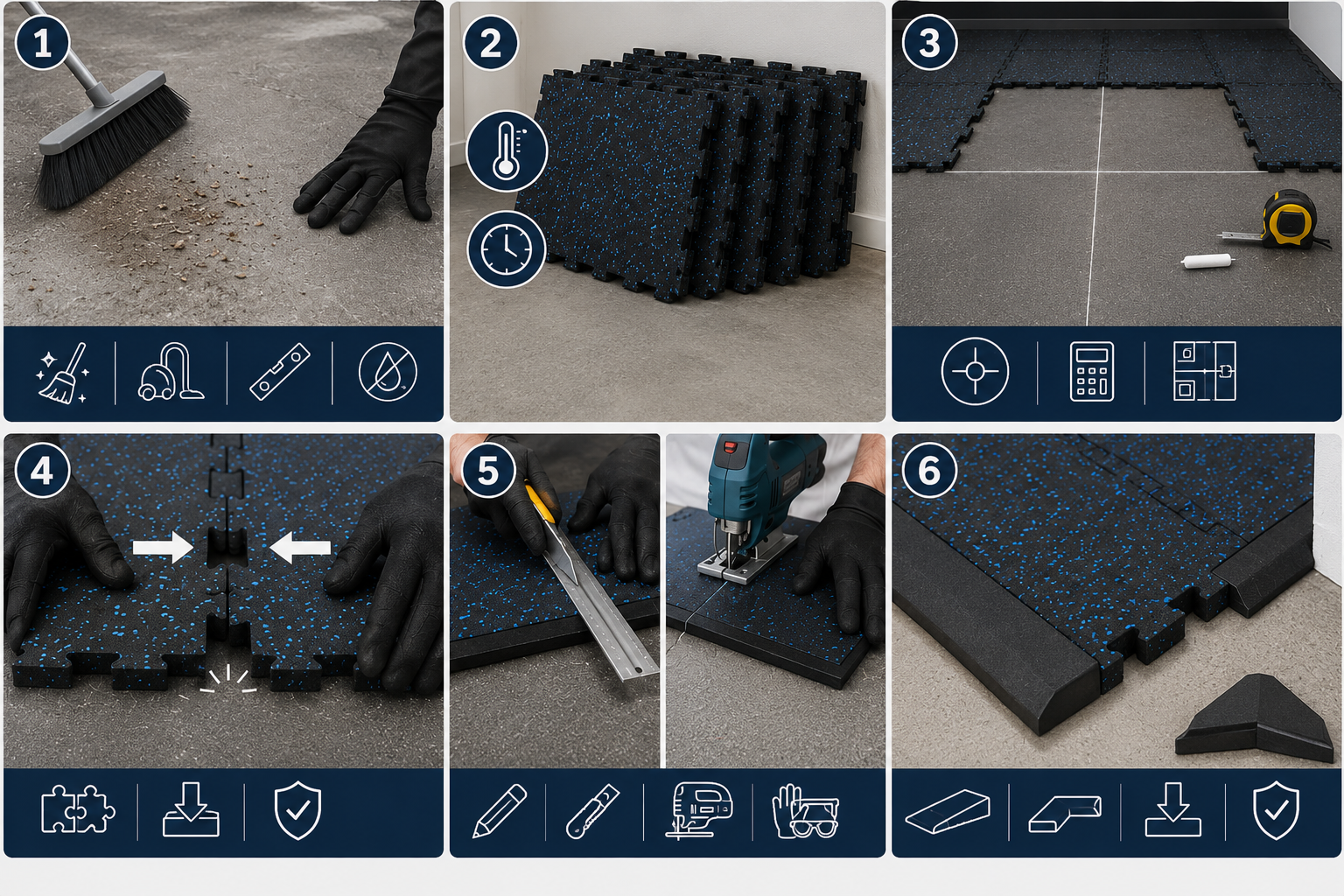
EPDM interlocking tiles are designed for tool-free installation by facility managers, maintenance teams, or end users — no contractor or specialist equipment required in most applications.
Clean the substrate thoroughly — remove dust, debris, oil, and standing water. Check flatness: the substrate must be within ±5mm over 2 metres. Fill cracks and depressions — EPDM tiles conform to the substrate and will telegraph any unevenness into the installed surface. No primer or adhesive is required for standard floating installations. For outdoor installations, confirm drainage falls are in place before tiling over.
Allow tiles to acclimatise at the installation site for 24–48 hours before laying — particularly important for outdoor installations and in cold weather. EPDM expands slightly in warm conditions and contracts in cold. Tiles installed cold will expand slightly once warmed, potentially buckling if no expansion gap is left. Leave a 3–5mm expansion gap around fixed perimeter walls and obstacles.
For rectangular spaces, measure and mark the centre point of both dimensions — start tiling from the centre outwards for equal cuts at both perimeter sides. For gym zones, plan color boundaries before starting — snap chalk lines marking the transition between zones. Calculate your tile count: area (m²) ÷ tile area (m²) × 1.08 waste factor = tiles needed per color.
Align adjacent tiles and press the interlocking edges together firmly until the connection engages. For loop-and-tab systems, you will feel and hear a distinct click when correctly engaged. Work in rows — complete each row before starting the next. Check alignment regularly using a straight edge — small misalignments compound across large areas and become difficult to correct later.
Mark cut lines with chalk and a straight edge. Cut EPDM rubber tiles with a sharp utility knife (up to 20mm thickness) or jigsaw with a fine-tooth blade (above 20mm). Always cut on the face side for the cleanest visible edge. Wear appropriate PPE — safety gloves and eye protection when cutting rubber tiles. Keep cut offcuts as potential repair pieces.
Install matching EPDM edge ramp strips along all exposed tile perimeters to create a safe, bevelled transition to the surrounding floor. Use corner pieces at 90° transitions. Edge strips connect using the same interlocking system as the tiles — confirm edge strip profile matches your tile system before ordering. A completed installation without edge ramps is both an unfinished appearance and a trip hazard.
7. Price Guide: How Much Do EPDM Interlocking Rubber Tiles Cost? (2025)
EPDM interlocking tile pricing varies by thickness, tile size, color, and order volume. The following ranges apply to virgin EPDM tiles from Asian manufacturers on a FOB basis as of 2025.
| Thickness | Standard Colors (FOB Asia) | Custom Colors | Best Application |
|---|---|---|---|
| 10mm | $10–$16/m² | $15–$22/m² | Light gym, yoga, indoor sports |
| 15mm | $14–$20/m² | $18–$28/m² | Pool surrounds, cardio zones |
| 20mm | $18–$28/m² | $24–$36/m² | General gym, outdoor courts |
| 30mm | $26–$38/m² | $32–$48/m² | Free weights, CrossFit |
| 40mm | $34–$50/m² | $42–$62/m² | Playground EN 1177, heavy gym |
| 50mm | $42–$62/m² | $52–$75/m² | Olympic lifting, max CFH playground |
EPDM interlocking tile material cost per m² is typically 20–40% higher than equivalent wet-pour EPDM granules. However, total installed cost is often lower — because interlocking tiles require no professional contractor, no PU binder, and no curing time. For projects where DIY installation is viable, interlocking tiles frequently deliver a lower total project cost than wet-pour systems of equivalent quality.
8. Certifications to Look For
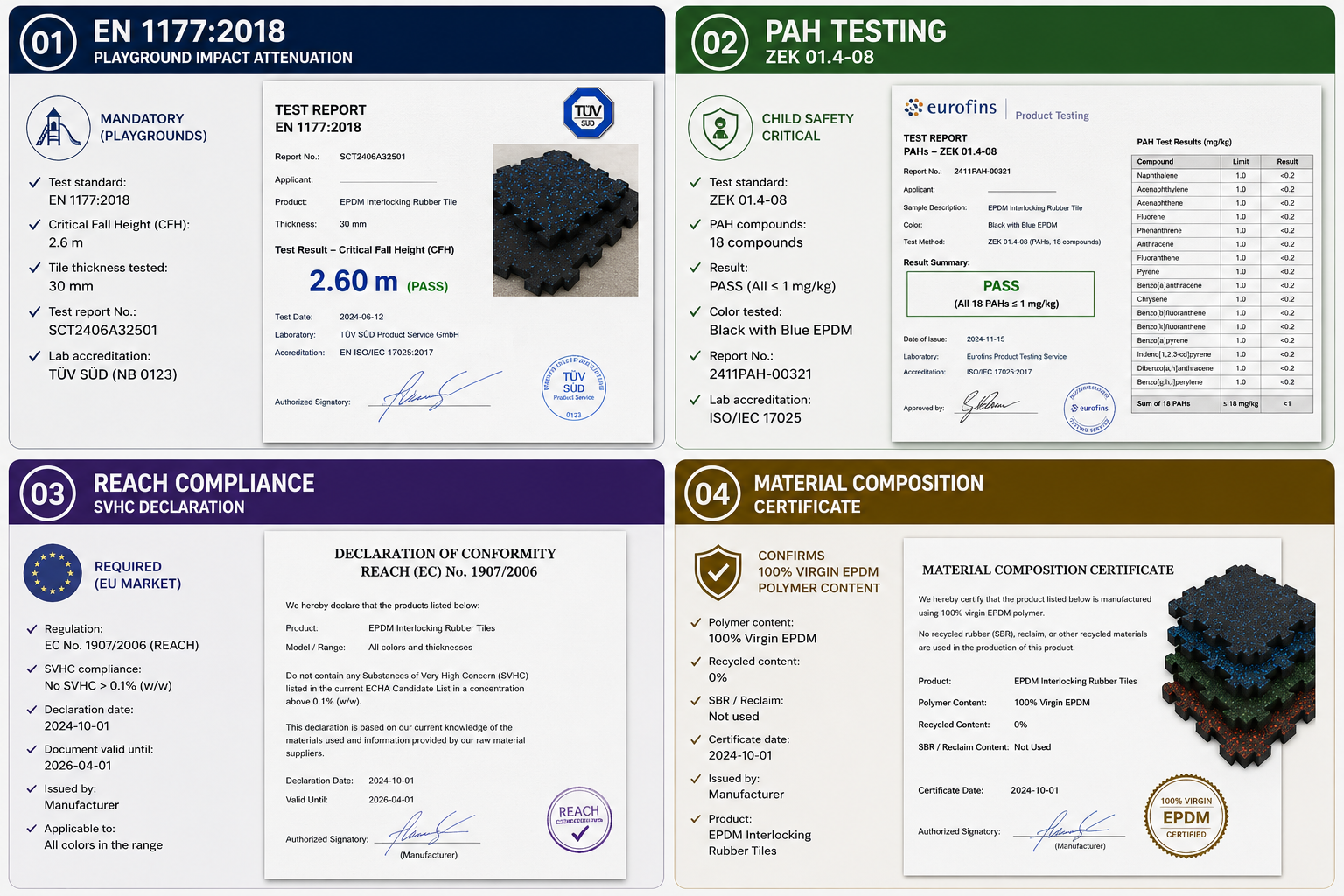
EPDM interlocking tiles used in playgrounds, public sports areas, or children’s facilities require the same certification standards as wet-pour EPDM surfaces. Never purchase tiles for these applications without verifying all three core certifications.
Mandatory in Europe for any playground surface. For interlocking tiles, the EN 1177 certification covers the specific tile product at a specific thickness — confirming the Critical Fall Height achieved. Request the full test report showing CFH value, tile thickness tested, and issuing laboratory accreditation. A tile supplier claiming “meets EN 1177” without a system-specific test report is not compliant.
Mandatory (Playgrounds)
Full 18-compound PAH test from an ISO/IEC 17025 accredited laboratory. Critical for any tile with children’s direct skin contact. Must be color-specific — a PAH report for one color does not cover other colors in the range. For healthcare and hospital applications, request PAH testing per production batch rather than per product line.
Child Safety Critical
Required for all products entering the European market. Confirms no Substances of Very High Concern are present above threshold limits. Request a current Declaration of Conformity — reject documents older than 18 months or issued before the most recent SVHC candidate list update.
Required (EU Market)
Written confirmation from the manufacturer of 100% virgin EPDM polymer content — no recycled SBR blend. This is the single document that distinguishes genuine EPDM interlocking tiles from lower-grade recycled rubber products marketed under the EPDM label. Request this before any other discussion of price or lead time.
Virgin Content Verification
9. Color Options & UV Stability
Color is the defining advantage of EPDM interlocking tiles over SBR rubber alternatives. Virgin EPDM’s integral pigmentation system — where color is embedded throughout the tile, not surface-applied — delivers color stability that SBR cannot match.
| Color Family | UV Stability | Best Application | Notes |
|---|---|---|---|
| Dark Red / Terracotta | ⭐⭐⭐⭐⭐ Excellent | Athletics, sports courts | Iron oxide pigment — most durable |
| Dark Green | ⭐⭐⭐⭐⭐ Excellent | Sports courts, landscaping | Iron oxide / chrome pigment |
| Black | ⭐⭐⭐⭐⭐ Excellent | Gym floors, industrial | Carbon black — highest UV stability |
| Standard Red / Blue / Green | ⭐⭐⭐⭐ Very Good | Playgrounds, gyms, courts | Phthalocyanine pigments |
| Yellow / Orange | ⭐⭐⭐ Good | Playground accents, zone markers | Organic pigments — good for accents |
| White / Light Beige | ⭐⭐ Fair | Indoor preferred | TiO₂ pigment — yellows outdoors over time |
Always request QUV accelerated weathering test results showing ΔE values per color. Accept only ΔE <3 after 1,000 hours as a minimum for outdoor applications. For high-UV environments (Middle East, South Asia, Australia), request 1,500-hour test data and specify iron oxide-based colors (dark red, dark green) for maximum longevity.
10. Frequently Asked Questions
Summary: Key Takeaways for EPDM Interlocking Tile Buyers
EPDM interlocking rubber tiles combine the certified performance of virgin EPDM with the installation flexibility of a modular tile system. The right specification depends on your application, thickness requirement, and certification needs.
Pillar Article · Focus keyword: best EPDM interlocking rubber tiles
Ready to Source EPDM Interlocking Rubber Tiles?
We supply premium EPDM interlocking rubber tiles in 10–50mm thickness, 20+ standard colors, with full EN 1177, PAH, REACH, and material composition documentation. Free physical samples. Competitive FOB pricing from 50m² per color.