

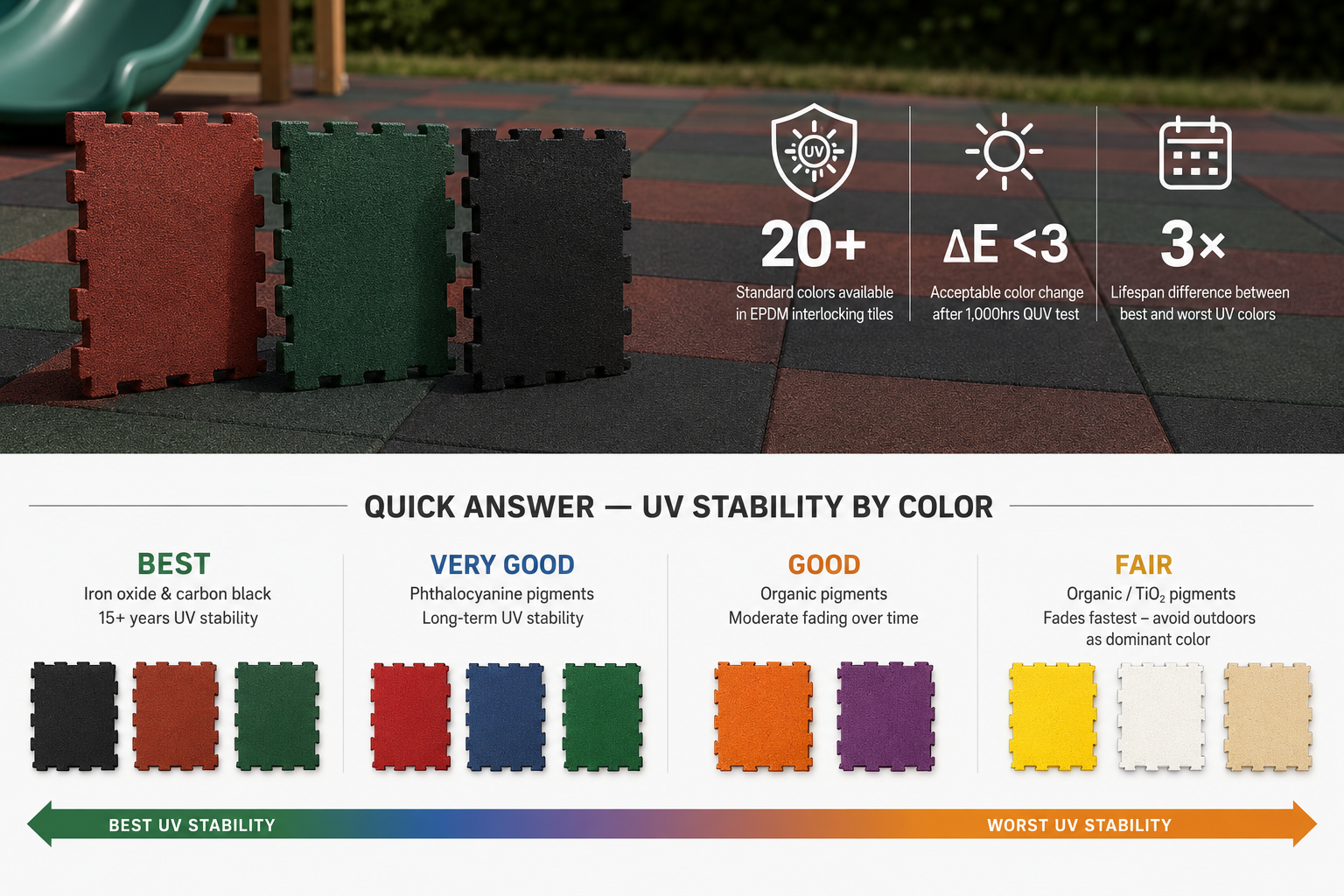
The best UV-stable colors for EPDM interlocking tiles are dark red, dark green, and black — all using iron oxide or carbon black pigments that resist fading for 15+ years outdoors. Bright yellows, oranges, and white tiles fade significantly faster. Color choice in EPDM tiles is not just aesthetic — it directly determines how long your installation looks good and how soon replacement becomes necessary.
Standard colors available
in EPDM interlocking tiles
Acceptable color change
after 1,000hrs QUV test
Lifespan difference between
best and worst UV colors
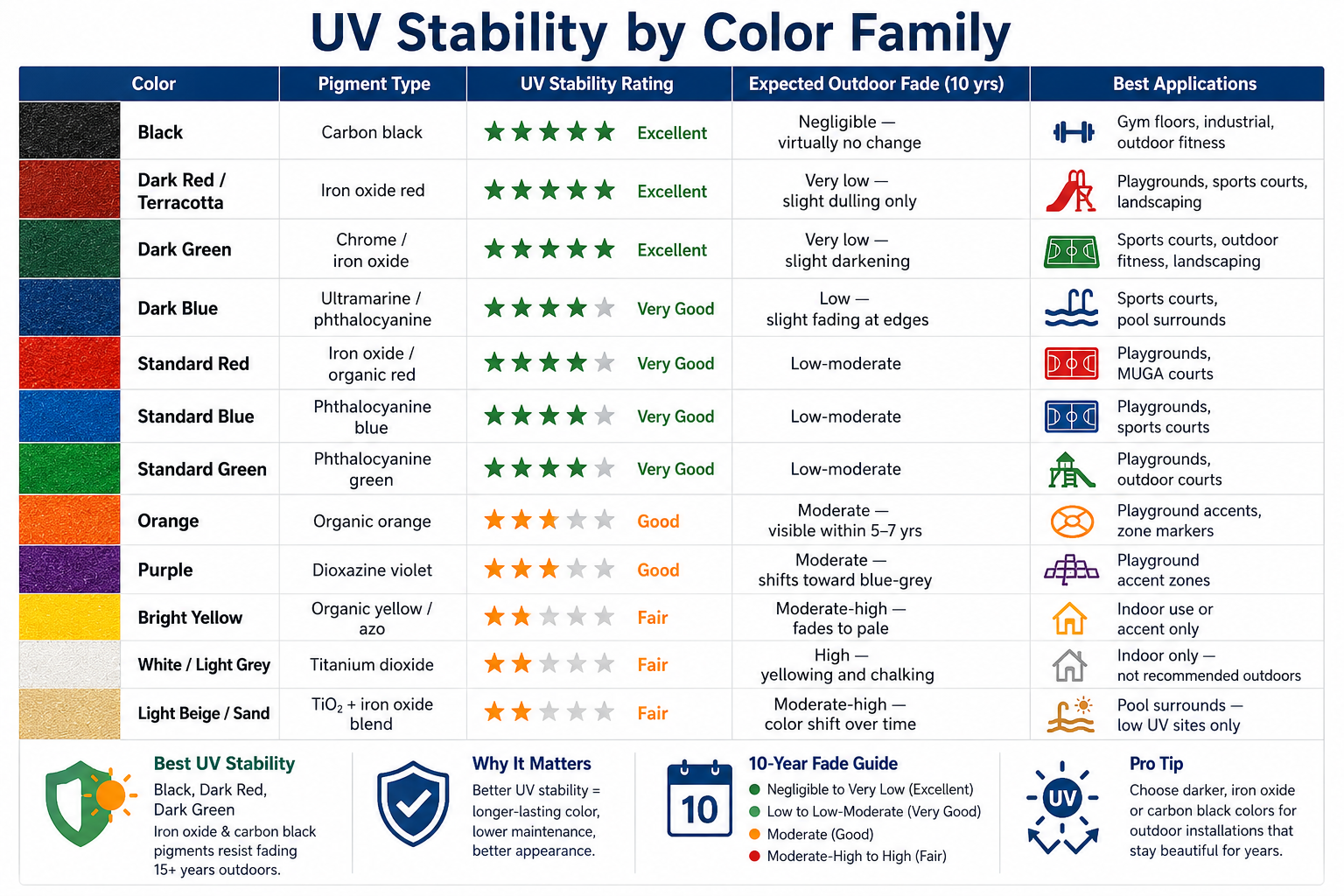
Best UV stability: Black, Dark Red/Terracotta, Dark Green — iron oxide and carbon black pigments.
Very good: Standard Red, Standard Blue, Standard Green — phthalocyanine pigments.
Good: Orange, Purple — organic pigments, moderate fading over time.
Fair (avoid outdoors as dominant color): Bright Yellow, White, Light Beige — organic/TiO₂ pigments fade fastest.
For the complete buyer’s guide including pricing, certifications, and supplier selection, see our EPDM Interlocking Rubber Tiles Complete Buyer’s Guide.
How to Read QUV UV Stability Test Data
Delta E measures total color change after UV exposure — it is the single number that tells you how much a tile color will fade. The scale is perceptually calibrated: ΔE <1 = imperceptible change; ΔE 1–3 = slight change visible on close inspection; ΔE 3–6 = noticeable fading visible to the eye; ΔE >6 = obvious fading visible from a distance. The standard for acceptable outdoor EPDM tile color stability is ΔE <3 after 1,000 hours of QUV testing.
Key Number to Request
QUV accelerated weathering uses high-intensity UV lamps to compress outdoor aging. Approximately 1,000 QUV hours ≈ 3–5 years outdoor exposure in temperate climates (UK, Northern Europe, Northern USA). For high-UV climates (Middle East, Australia, Mediterranean), 1,000 QUV hours corresponds to approximately 2–3 years outdoor exposure. For high-UV installations, request 1,500-hour test data to get meaningful long-term performance data.
Context for Interpretation
QUV test reports specify the UV lamp type used. UVA-340 lamps are the correct standard for outdoor weathering simulation — they accurately replicate the UV spectrum of natural sunlight. Reports using UVB-313 lamps are more aggressive and less representative of real outdoor conditions — they produce artificially high ΔE values that overstate fading in normal outdoor use. When requesting UV test data, specify UVA-340 lamp results.
Specification Detail
Color Recommendations by Application
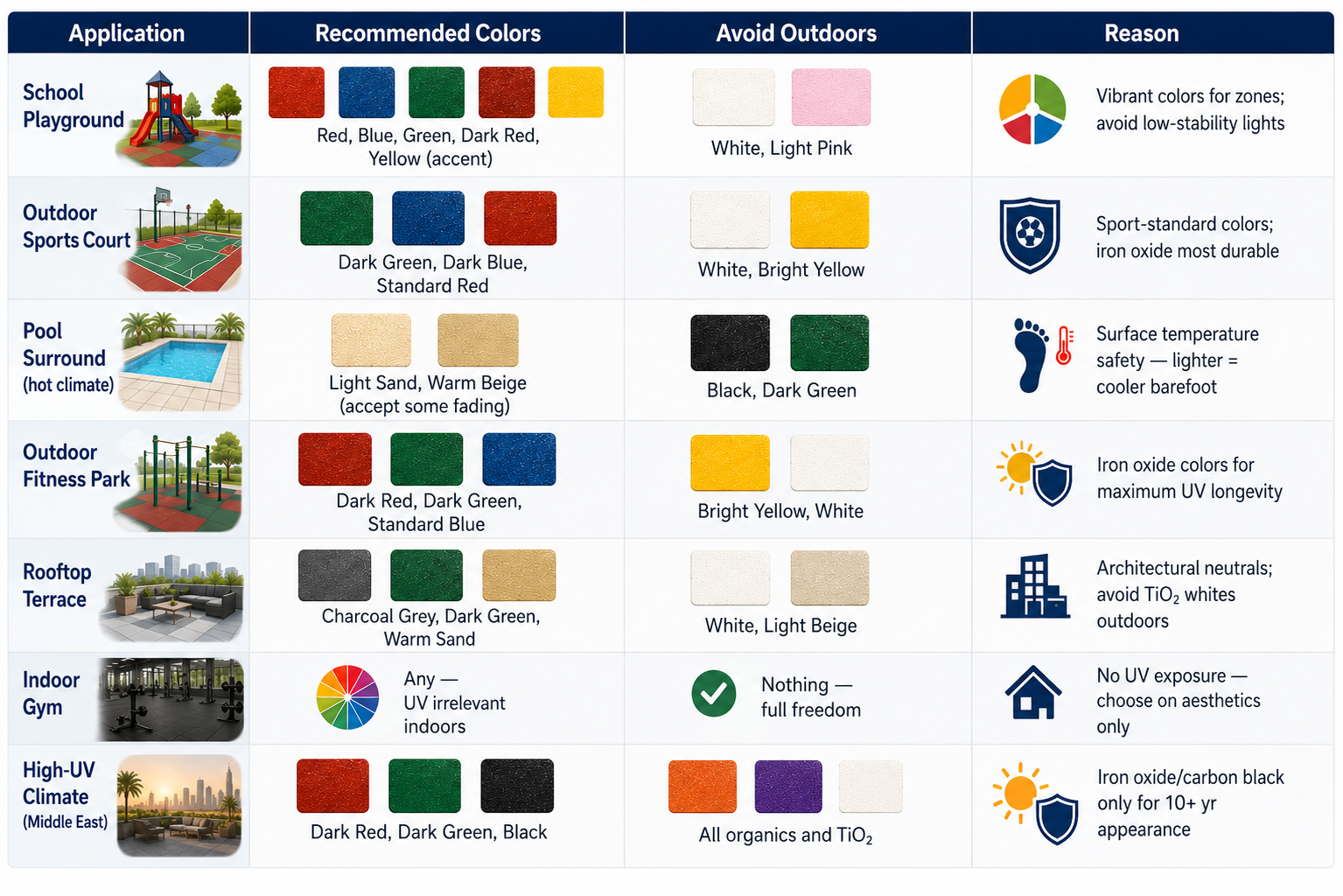
| Application | Recommended Colors | Avoid Outdoors | Reason |
|---|---|---|---|
| School Playground | Red, Blue, Green, Dark Red, Yellow (accent) | White, Light Pink | Vibrant colors for zones; avoid low-stability lights |
| Outdoor Sports Court | Dark Green, Dark Blue, Standard Red | White, Bright Yellow | Sport-standard colors; iron oxide most durable |
| Pool Surround (hot climate) | Light Sand, Warm Beige (accept some fading) | Black, Dark Green | Surface temperature safety — lighter = cooler barefoot |
| Outdoor Fitness Park | Dark Red, Dark Green, Standard Blue | Bright Yellow, White | Iron oxide colors for maximum UV longevity |
| Rooftop Terrace | Charcoal Grey, Dark Green, Warm Sand | White, Light Beige | Architectural neutrals; avoid TiO₂ whites outdoors |
| Indoor Gym | Any — UV irrelevant indoors | Nothing — full freedom | No UV exposure — choose on aesthetics only |
| High-UV Climate (Middle East) | Dark Red, Dark Green, Black | All organics and TiO₂ | Iron oxide/carbon black only for 10+ yr appearance |
Surface Temperature by Color: The Barefoot Safety Factor
For outdoor applications where barefoot use is expected — pool surrounds, playground surfaces in hot climates — color choice directly affects surface temperature safety.
| Color | Surface Temp (35°C air, direct sun) | Barefoot Safety |
|---|---|---|
| Black | 65–75°C | 🚩 Not recommended for barefoot outdoor areas |
| Dark Red / Dark Green | 55–65°C | ⚠ Caution in extreme heat climates |
| Standard Red / Blue / Green | 50–60°C | ⚠ Monitor in high-UV climates |
| Light Sand / Warm Beige | 38–45°C | ✅ Comfortable — best for pool surrounds |
| White / Light Grey | 35–42°C | ✅ Coolest — but UV stability trade-off outdoors |
For pool surrounds and playgrounds in the Middle East, Mediterranean, or Southern Asia, the ideal color approach is: use light sand or warm beige for the primary surface (cooler barefoot, acceptable UV stability with iron oxide blend) and reserve darker accent colors for shaded zones or equipment surrounds. Avoid black or very dark tiles for any outdoor barefoot surface in climates where summer air temperatures exceed 35°C.
Multi-Color Design Guidelines for Interlocking Tiles
Nominally identical colors from different manufacturers — or different production batches from the same manufacturer — can look noticeably different when installed side by side. For multi-color playground or gym zone designs, order all colors in a single order from the same supplier and confirm they come from production batches with compatible colorimetric measurements.
Mixing a very UV-stable color (dark red, iron oxide) with a less stable color (bright yellow, organic pigment) in the same design creates differential fading — within 5–7 years, the design looks increasingly mismatched as one color fades and the other does not. Select all colors from the same UV stability tier, or accept that accent colors will need more frequent replacement.
Digital color charts and screen representations cannot accurately show how EPDM tile colors look in natural light — or how they look together. Request physical tile samples of all colors in your design and lay them together outdoors in natural daylight before confirming your color scheme. What looks harmonious on screen may clash in reality, and vice versa.
Frequently Asked Questions
Summary: Color Selection for Long-Lasting EPDM Interlocking Tiles
Article #10 · Series: best EPDM interlocking rubber tiles · ← Back to Buyer’s Guide
Request Free Color Samples with QUV Test Data
We supply 20+ standard colors with QUV UV stability test reports (ΔE per color), physical sample packs, and competitive pricing. Custom colors available from 100m².