

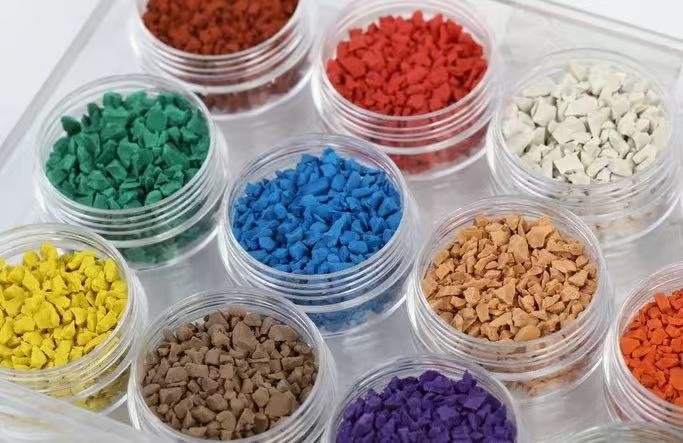
EPDM granules are the global standard for playground surfacing, running tracks, sports flooring, and landscaping — delivering 10–20 years of outdoor performance, 100+ color options, and certified child safety. This complete buyer’s guide covers everything you need to source, specify, and purchase EPDM granules from the best supplier for your project.
Outdoor lifespan
with correct specification
Starting price FOB Asia
(10,000kg+ bulk orders)
Standard colors available
from leading manufacturers
EPDM (Ethylene Propylene Diene Monomer) granules are virgin synthetic rubber particles, typically 1–5mm in size, used as the wear layer in wet-pour rubber surfaces. Bound with polyurethane (PU) binder, they create seamless, impact-absorbing, UV-stable surfaces for playgrounds, athletics tracks, sports courts, gym floors, pool surrounds, and landscaping. Virgin EPDM granules — containing no recycled SBR rubber content — are the correct specification for any surface where color retention, chemical safety, and long-term durability are required.
Contents — Jump to Any Section
1. What Are EPDM Granules?
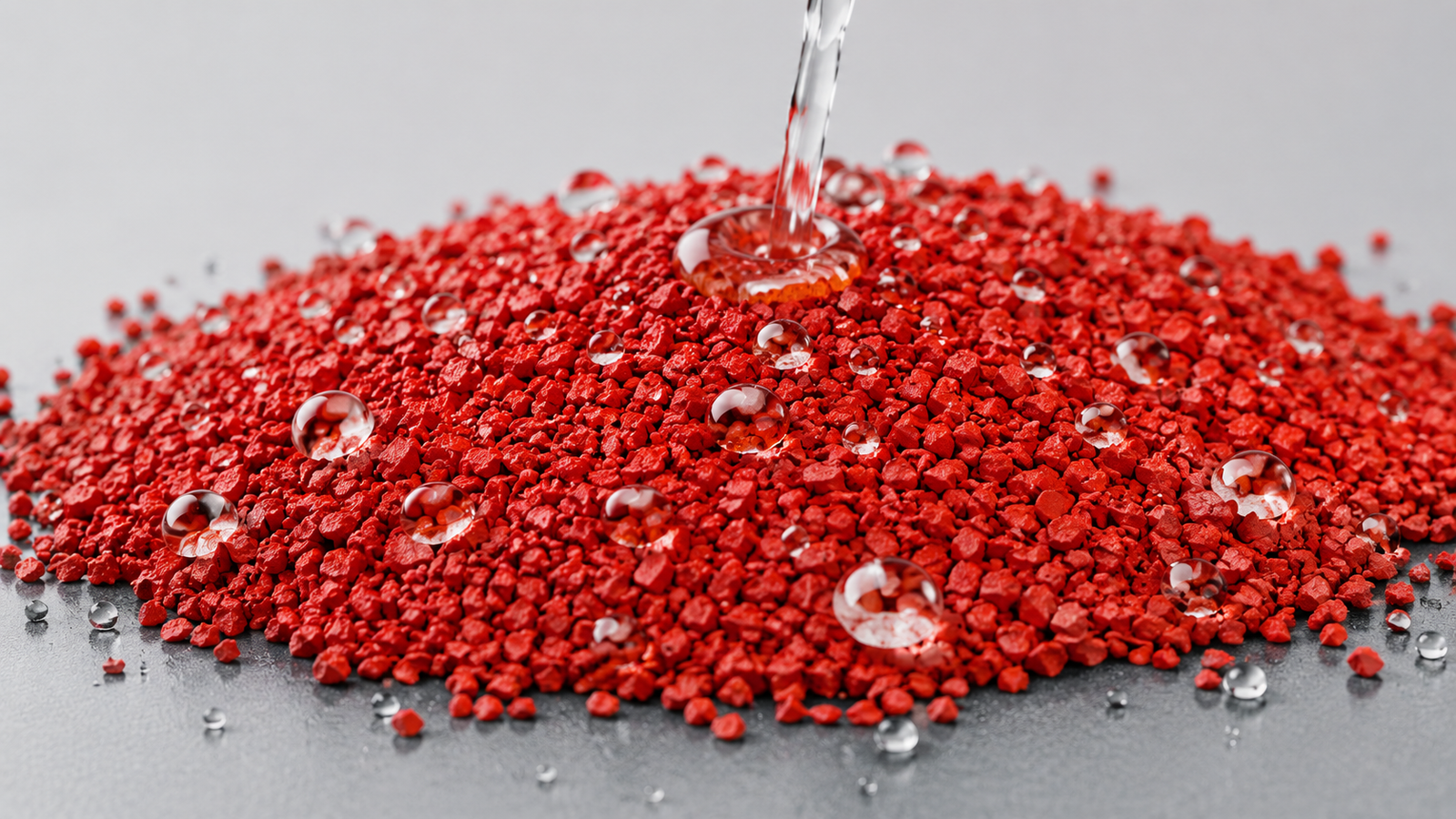
EPDM stands for Ethylene Propylene Diene Monomer — a synthetic rubber polymer manufactured specifically for outdoor durability. In granule form, EPDM is processed into small particles through a controlled vulcanization process: raw EPDM polymer is compounded with colorfast pigments, stabilizers, and curing agents, then extruded and precision-cut into granules of specified sizes.
The defining characteristic of quality EPDM granules is integral pigmentation — color is embedded throughout the granule during manufacturing, not applied as a surface coating. This means color cannot chip, peel, or wash off. Combined with EPDM’s inherent resistance to UV radiation, ozone, and temperature extremes (−40°C to +120°C), this produces a surface material that maintains its appearance and performance for 10–20 years outdoors.
When bound together with polyurethane (PU) binder at 14–18% by weight, EPDM granules form a seamless, porous, impact-absorbing surface — the wet-pour poured-in-place (PIP) system used globally for playground, sports, and landscape surfacing.
Virgin EPDM vs Recycled-Blend: Why It Matters
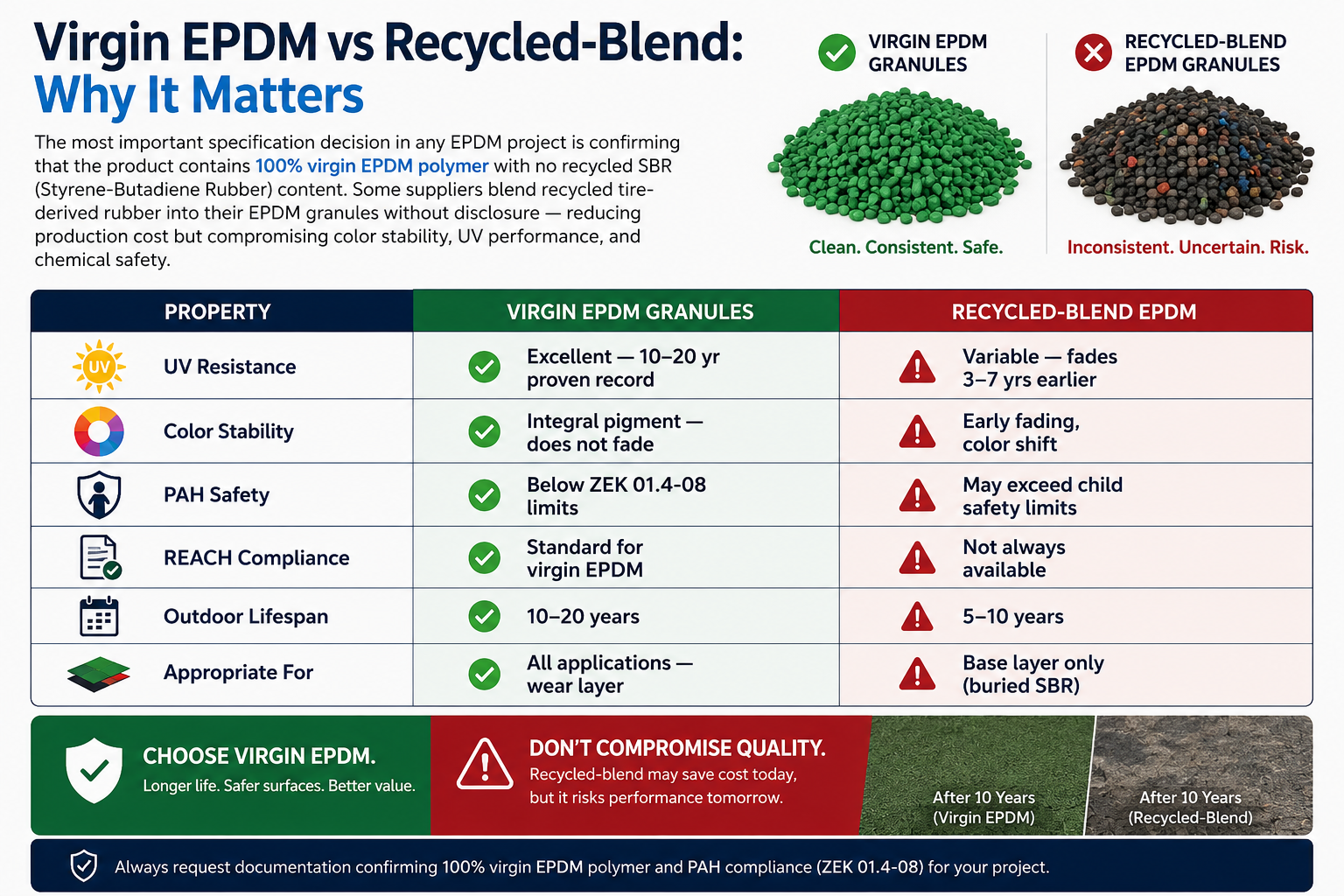
The most important specification decision in any EPDM project is confirming that the product contains 100% virgin EPDM polymer with no recycled SBR (Styrene-Butadiene Rubber) content. Some suppliers blend recycled tire-derived rubber into their EPDM granules without disclosure — reducing production cost but compromising color stability, UV performance, and chemical safety.
| Property | Virgin EPDM Granules | Recycled-Blend EPDM |
|---|---|---|
| UV Resistance | Excellent — 10–20 yr proven record | Variable — fades 3–7 yrs earlier |
| Color Stability | Integral pigment — does not fade | Early fading, color shift |
| PAH Safety | Below ZEK 01.4-08 limits | May exceed child safety limits |
| REACH Compliance | Standard for virgin EPDM | Not always available |
| Outdoor Lifespan | 10–20 years | 5–10 years |
| Appropriate For | All applications — wear layer | Base layer only (buried SBR) |
For a detailed guide on recycled rubber safety and how to verify virgin content, see: Are Recycled EPDM Granules Safe for Children’s Playgrounds?
2. Key Technical Specifications
When evaluating EPDM granules, request test data for each of the following parameters. A credible supplier provides documentation for all of them — not just a subset.
| Parameter | Specification | Test Method | Why It Matters |
|---|---|---|---|
| Granule Size | 1–3mm / 2–4mm / 3–5mm (±5% tolerance) | Sieve analysis | Controls surface texture, traction, and drainage |
| EPDM Content | ≥85% virgin polymer | Material composition certificate | Higher content = better elasticity and durability |
| Shore A Hardness | 50–70 Shore A | ISO 7619-1 | Surface softness and impact absorption |
| Tensile Strength | ≥6.0 MPa | ISO 37 | Structural integrity under heavy use |
| Elongation at Break | ≥200% | ISO 37 | Resistance to cracking under stress |
| Bulk Density | 550–650 kg/m³ | ISO 8251 | Affects binder ratio and quantity calculation |
| UV Resistance | ΔE <3 after 1,000 hrs QUV | ASTM G154 / ISO 4892-3 | Color retention over years outdoors |
| Temperature Range | −40°C to +120°C | Cold flex / heat aging | All-climate performance |
| PAH Content | Below ZEK 01.4-08 limits | GC-MS 18-PAH analysis | Child safety — skin contact surfaces |
For granule size selection guidance by application, see: What Size EPDM Granules Are Best for Playground Surfaces?
3. Main Applications of EPDM Granules
EPDM granules are used across six major application categories. Each has distinct specification requirements — click through to the dedicated guide for your application.
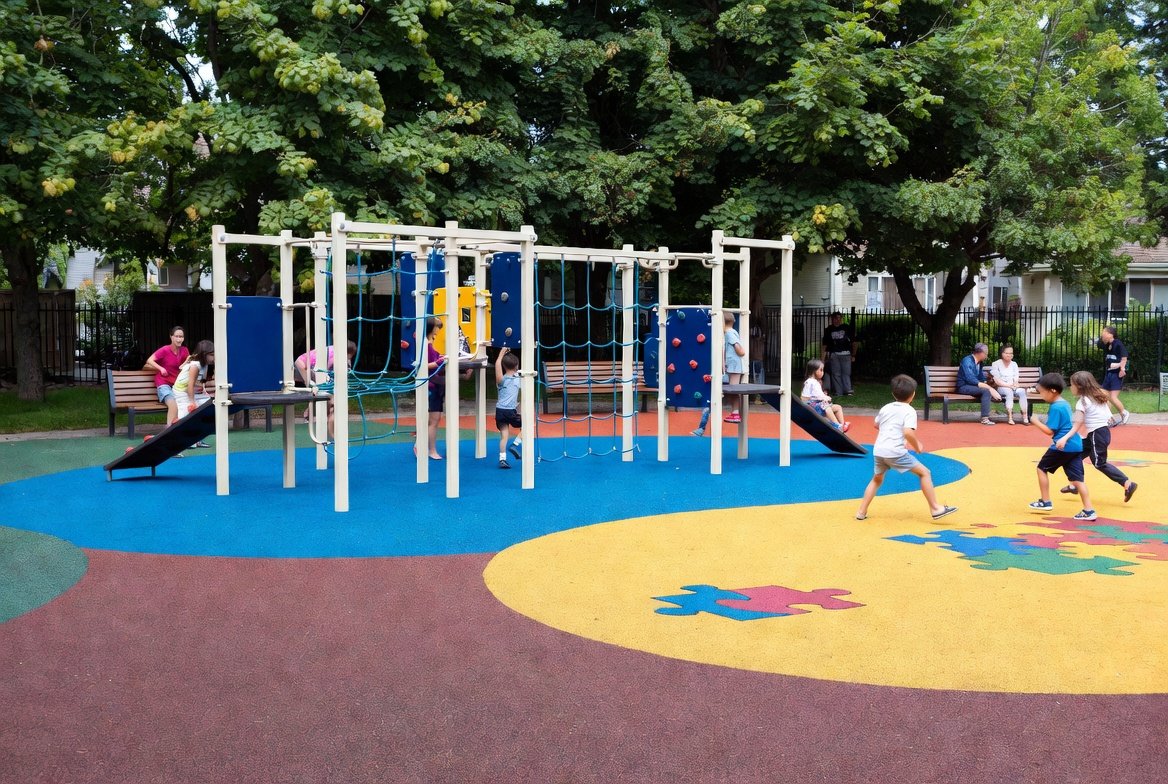
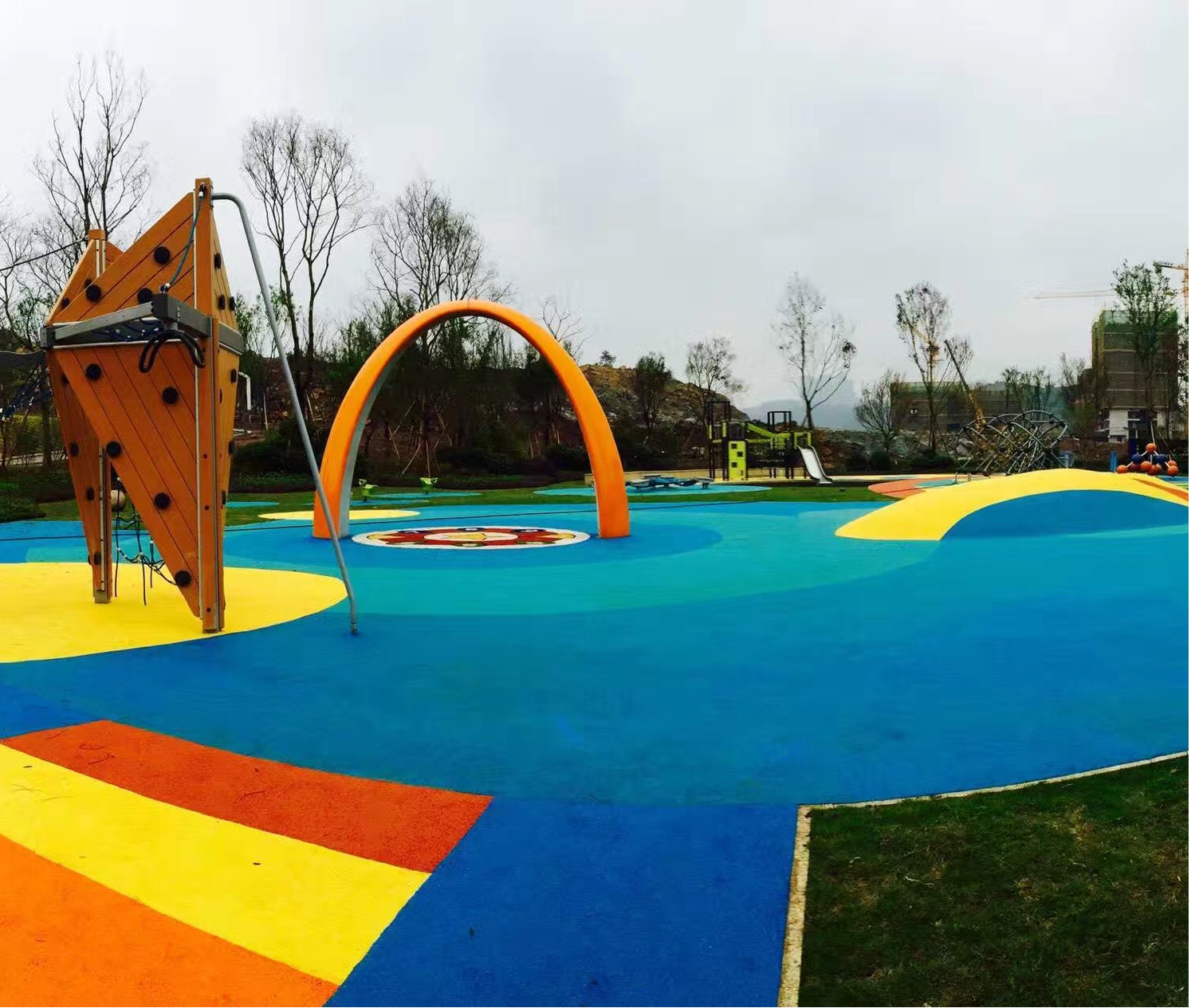
The largest global application. EPDM wet-pour systems deliver EN 1177 impact attenuation compliance, child-safe chemical certification, and vibrant multi-color design capability. Two-layer system: SBR base cushion (35–100mm depth based on Critical Fall Height) + EPDM wear layer (13mm, 1–3mm granules).

EPDM is the global standard for athletics tracks, MUGA courts, and multi-sport surfaces. Sandwich system: 9–10mm SBR base + 13mm EPDM wear layer. World Athletics (IAAF) Product Certificate required for competition tracks. Dark red (terracotta) is the universal athletics track color specification.
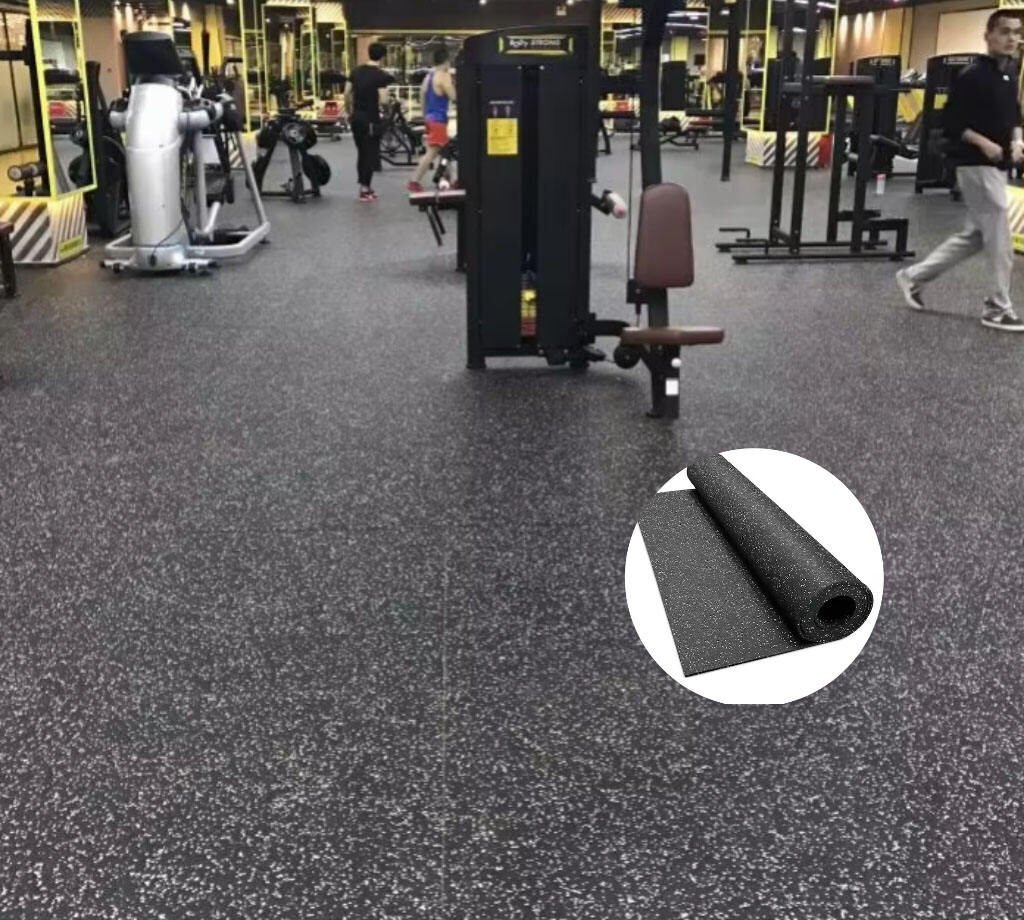
Commercial gyms, CrossFit facilities, indoor running tracks, and outdoor fitness parks. No UV constraint indoors — full color freedom. Free weight zones require 50–60mm SBR base for impact absorption. High-grade PU binder (16–18%) essential under equipment loads.
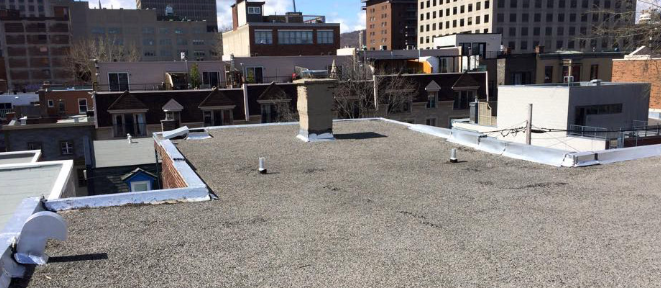
Rooftop terraces, garden pathways, urban plazas, pool surrounds, and decorative ground cover. Lightweight bound system (10–13mm, no SBR base) for rooftop structural load compliance. Earth tones and architectural neutrals dominate landscape applications. Loose fill available for non-walkable garden borders and planters.
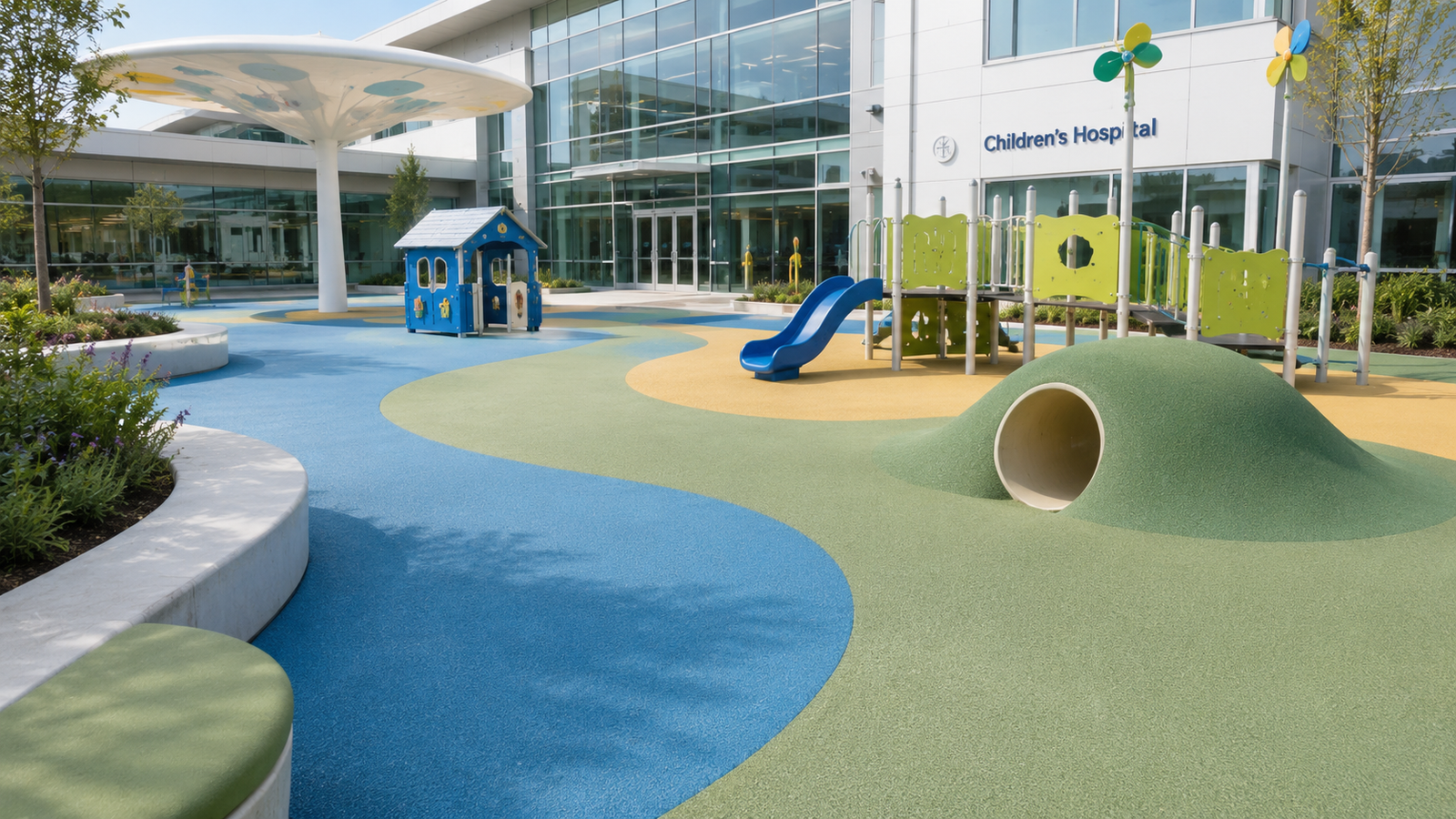
Children’s hospitals, sensory gardens, rehabilitation areas, and SEND school outdoor spaces. Strictest specification requirements: 1–2mm fine grade granules, PAH testing per batch, RoHS required, DDA-compliant surface levelness, and therapeutic color palettes. Standard playground specification is not sufficient for healthcare environments.
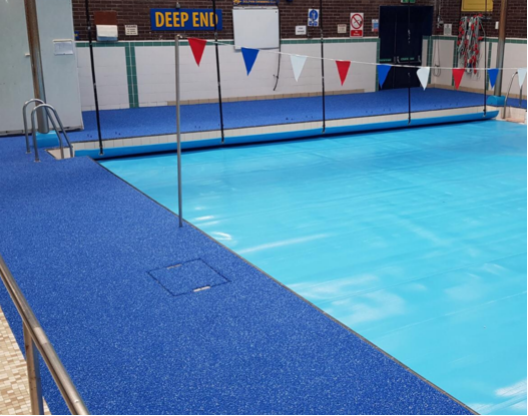
Swimming pool decks, splash pads, lido surrounds, and hotel pool terraces. Non-slip when wet, significantly cooler than stone or tile in direct sun, and resistant to pool water chemicals. Light to mid-tone colors essential for barefoot surface temperature safety in hot climates. Minimum 1:40 drainage fall specification required.
4. EPDM vs TPV Granules: Which Is Better?
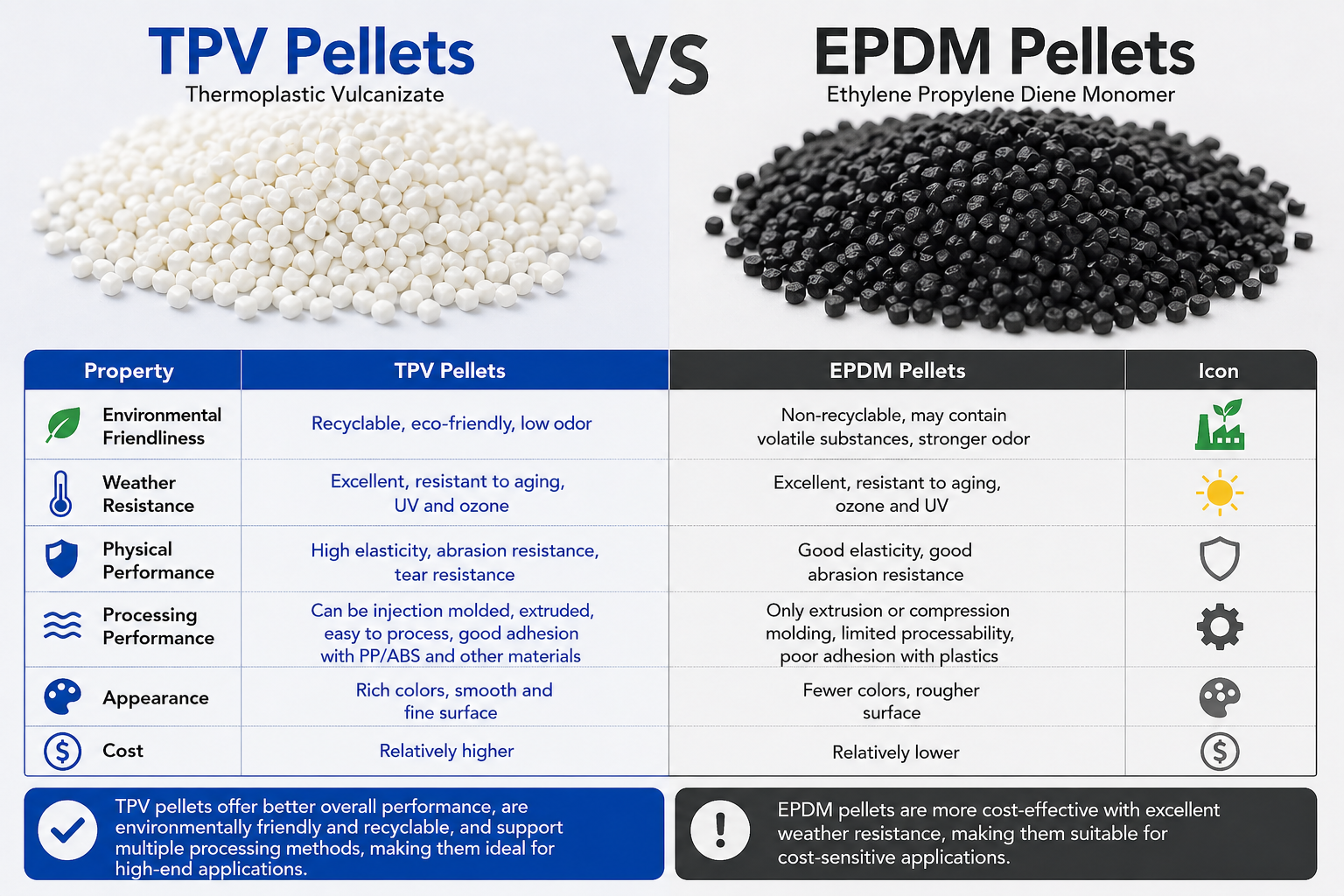
TPV (Thermoplastic Vulcanizate) granules are the primary alternative to EPDM for wet-pour surfaces. For most projects, EPDM is the better choice. Here is the summary comparison:
| Factor | EPDM Granules | TPV Granules | Advantage |
|---|---|---|---|
| Cost | $0.60–$2.00/kg | $1.20–$3.50/kg | EPDM — 20–40% cheaper |
| UV Track Record | 30+ years proven | 5–10 years field data | EPDM — longer proven history |
| Color Range | 20–100+ standard colors | 10–40 standard colors | EPDM — wider choice |
| Recyclability | Not recyclable (thermoset) | Fully recyclable | TPV — circular economy |
| Global Availability | Hundreds of suppliers | Limited suppliers | EPDM — easier sourcing |
| Green Certification | Partial support | Strong (BREEAM/LEED) | TPV — sustainability credits |
Choose EPDM for playgrounds, running tracks, sports courts, gym floors, and landscaping. Choose TPV only when full recyclability is a hard project requirement or a green building certification (BREEAM, LEED) mandates it.
For the full comparison including cost calculations and application-by-application analysis, see: EPDM vs TPV Granules: Which Is Better for Sports Flooring?
5. How to Choose the Best EPDM Granules Supplier
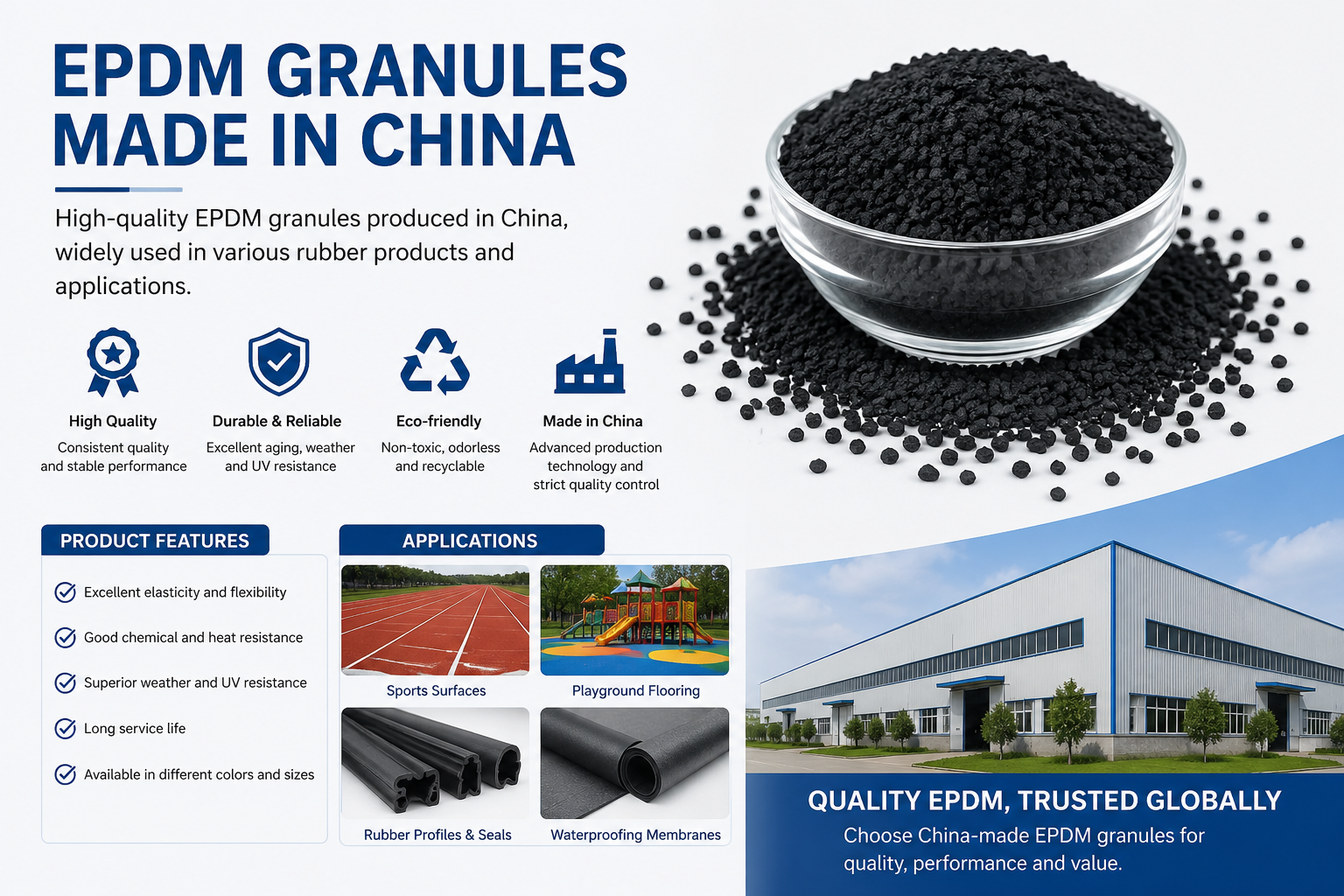
The best EPDM granules supplier combines certified product quality, consistent manufacturing standards, reliable supply chain, and technical support. Use this seven-point checklist to evaluate every supplier before placing an order.
Request a written material composition certificate confirming 100% virgin EPDM polymer content with no recycled SBR. This is the single most important document — without it, you cannot verify what you are actually buying.
EN 1177, REACH, and PAH certifications must come from ISO/IEC 17025 accredited third-party laboratories — not from the manufacturer’s own testing. Request the full lab report, not a summary certificate. Verify the lab’s accreditation status independently.
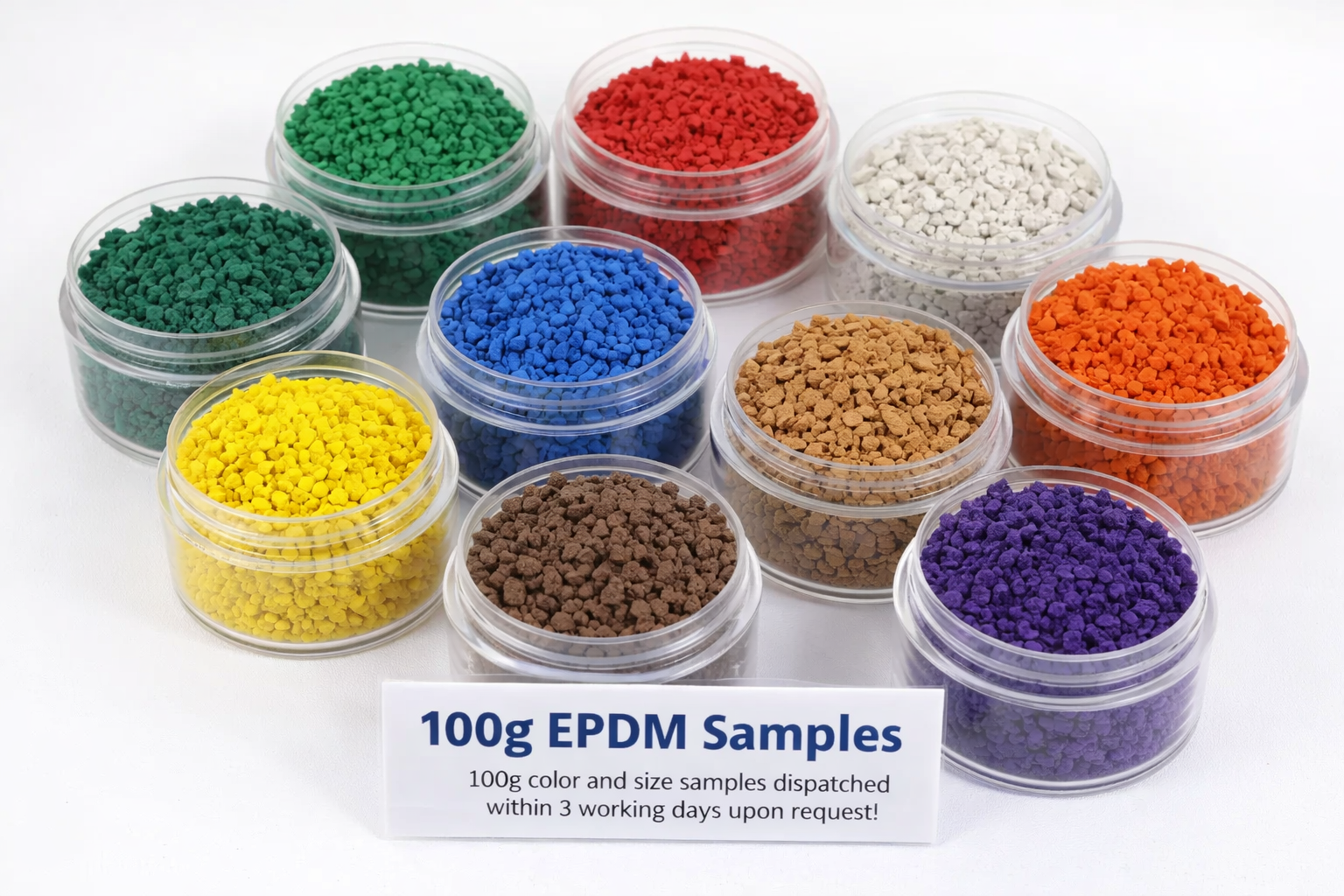
Request 200–500g physical samples per color. Check color consistency, granule size uniformity, and odor. Run a simple sieve test to verify the particle size distribution. Never commit to bulk purchase based on digital images or PDF color charts alone.
Cross-check the ISO 9001 certificate address against the supplier’s factory address. If they differ, you are dealing with a trading company — not a manufacturer. Ask for factory registration documents if in doubt.
Request QUV weathering test results (ASTM G154 or ISO 4892-3) for each color you are buying. Acceptable standard: ΔE <3 after 1,000 hours using UVA-340 lamps. This data should be color-specific — a test result for red does not cover blue.
For any new supplier relationship, place a 500–1,000 kg trial order before committing to full project volume. Verify the shipment against your sample: color accuracy, granule size distribution, and all documentation matches what was agreed.
Your purchase order must specify: granule size tolerance, EPDM content, color reference, required certifications, packaging, incoterms, and delivery schedule. A well-written PO gives you contractual recourse if out-of-spec material is delivered. Verbal agreements provide none.
For a full comparison of sourcing from China vs Europe vs local distributors, see: EPDM Granules Supplier Comparison: China vs Europe vs Local
For step-by-step guidance on vetting Chinese manufacturers specifically, see: How to Choose an EPDM Granules Manufacturer from China
6. Price Guide: How Much Do EPDM Granules Cost? (2025)
EPDM granule pricing varies significantly based on order volume, color, granule size, and supplier origin. The following ranges apply to virgin EPDM granules as of 2025 on a FOB (Free on Board) basis.
| Order Volume | Standard Colors | Custom Colors | Origin |
|---|---|---|---|
| 500–2,000 kg | $1.20–$2.00/kg | $1.80–$2.80/kg | China / Asia |
| 2,000–10,000 kg | $0.90–$1.50/kg | $1.40–$2.20/kg | China / Asia |
| 10,000+ kg | $0.60–$1.00/kg | $1.00–$1.60/kg | China / Asia |
| Any volume | $2.50–$4.50/kg | $3.50–$6.00/kg | Europe (premium) |
All prices above are FOB and exclude ocean freight, import duties, and inland transport. Add 15–35% for delivered (CIF/DDP) pricing depending on your destination. Always request a delivered price for accurate project budgeting — never compare FOB quotes from different origins without accounting for freight.
For a full pricing breakdown including color premiums, project volume calculations, and red flag pricing analysis, see: How Much Do EPDM Granules Cost Per kg? (2025 Price Guide)
7. Certifications to Look For
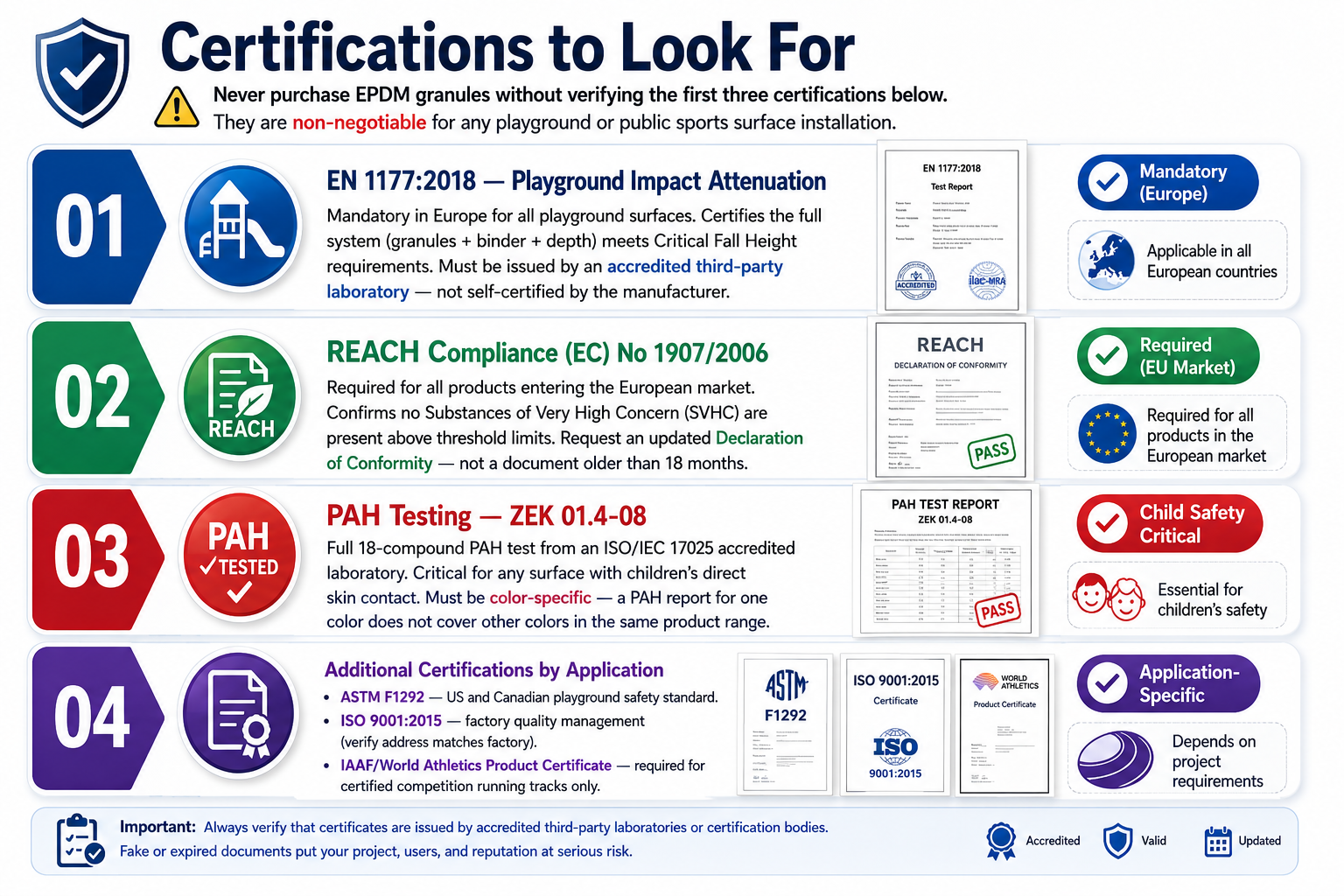
Never purchase EPDM granules without verifying the first three certifications below. They are non-negotiable for any playground or public sports surface installation.
Mandatory in Europe for all playground surfaces. Certifies the full system (granules + binder + depth) meets Critical Fall Height requirements. Must be issued by an accredited third-party laboratory — not self-certified by the manufacturer.
Mandatory (Europe)
Required for all products entering the European market. Confirms no Substances of Very High Concern (SVHC) are present above threshold limits. Request an updated Declaration of Conformity — not a document older than 18 months.
Required (EU Market)
Full 18-compound PAH test from an ISO/IEC 17025 accredited laboratory. Critical for any surface with children’s direct skin contact. Must be color-specific — a PAH report for one color does not cover other colors in the same product range.
Child Safety Critical
ASTM F1292 — US and Canadian playground safety standard. ISO 9001:2015 — factory quality management (verify address matches factory). IAAF/World Athletics Product Certificate — required for certified competition running tracks only.
Application-Specific
For a complete certification verification guide including how to spot fake certificates and what to do if a supplier cannot provide documentation, see: What Certifications Should EPDM Granules Have?
8. Color Options & UV Stability
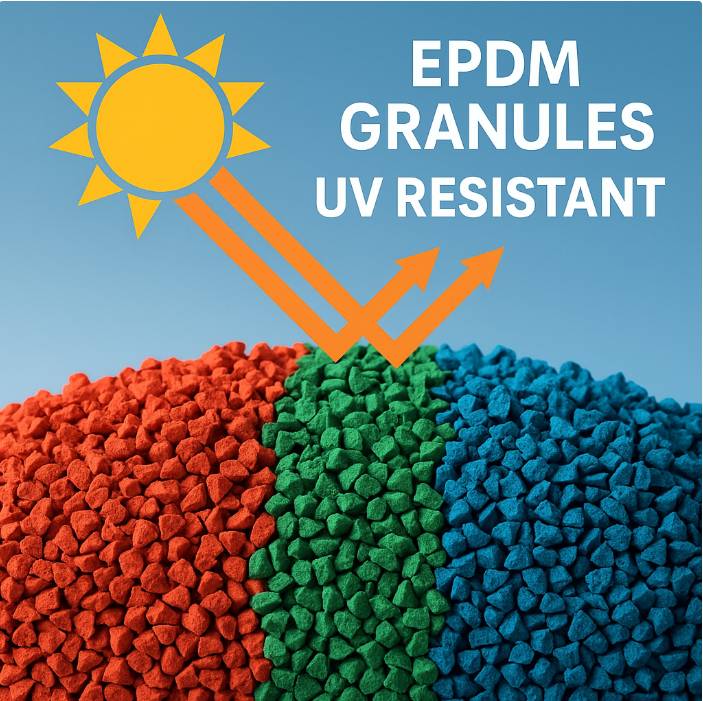
EPDM granules are available in 20–100+ standard colors. Color choice affects not just aesthetics — it directly impacts UV durability, surface temperature, and long-term lifecycle cost.
| Color Family | Pigment Type | UV Stability | Best Applications |
|---|---|---|---|
| Black | Carbon black | ⭐⭐⭐⭐⭐ Excellent | Running tracks, industrial, gym floors |
| Dark Red / Terracotta | Iron oxide red | ⭐⭐⭐⭐⭐ Excellent | Athletics tracks, MUGA courts |
| Dark Green | Chrome / iron oxide | ⭐⭐⭐⭐⭐ Excellent | Sports courts, landscaping |
| Standard Red / Blue / Green | Phthalocyanine / inorganic | ⭐⭐⭐⭐ Very Good | Playgrounds, sports courts |
| Orange / Purple | Organic pigments | ⭐⭐⭐ Good | Playground accents |
| White / Light Beige | Titanium dioxide | ⭐⭐ Fair | Indoor use preferred — yellows outdoors |
Always request QUV accelerated weathering test results showing ΔE values per color. Accept only ΔE <3 after 1,000 hours (UVA-340 lamps) as a minimum. For high-UV environments (Middle East, South Asia, Australia), request 1,500-hour test data. Never order based on digital color charts — always review physical samples outdoors in natural daylight.
For the complete color selection guide including UV stability ratings per color family, surface temperature data, and multi-color design guidelines, see: EPDM Granules Color Options: UV Stability Comparison Guide
9. How Long Do EPDM Granules Last Outdoors?
Lifespan is determined by six factors acting together — granule quality is the single most important variable, but installation and maintenance decisions matter almost as much.
| Application | Climate | Expected Lifespan | Key Limiting Factor |
|---|---|---|---|
| School Playground | Temperate | 10–15 years | High foot traffic + UV |
| Public Park Playground | Temperate | 12–18 years | UV + maintenance frequency |
| Running Track | Temperate | 10–15 years | Spike traffic + UV |
| Indoor Gym Floor | Indoor (no UV) | 15–25 years | Mechanical abrasion only |
| Playground (Middle East) | High UV + heat | 7–12 years | Extreme UV degradation |
| Landscaping / Decorative | Any | 12–20 years | UV only — low traffic |
The most common cause of premature EPDM surface failure is specification error at procurement — not wear or UV alone. Specifying recycled-blend granules instead of virgin EPDM, or underbinding with insufficient PU binder ratio, typically reduces surface life by 30–50% in the same environment. Get the specification right from the start.
For a full lifespan guide by application and climate, maintenance schedules, and repair vs replacement decision criteria, see: How Long Do EPDM Granules Last Outdoors?
10. Frequently Asked Questions
Summary: Key Takeaways for EPDM Granule Buyers

Choosing the best EPDM granules supplier is a systematic process — not a price comparison. The right supplier delivers certified product quality, consistent specifications, reliable supply chain, and technical support that protects your project from procurement through to long-term performance.
Complete Guide Series
This buyer’s guide is supported by 17 in-depth articles covering every aspect of EPDM granule specification, procurement, and application:
| Topic | Guide |
|---|---|
| Granule size specification | What Size EPDM Granules for Playgrounds? |
| EPDM vs TPV comparison | EPDM vs TPV: Which Is Better? |
| Pricing and cost guide | EPDM Granules Cost Per kg — 2025 |
| Certifications guide | What Certifications Should EPDM Have? |
| China manufacturer guide | How to Choose a Manufacturer from China |
| Running track specification | EPDM for Running Tracks |
| Child safety and recycled rubber | Are Recycled EPDM Granules Safe? |
| Outdoor lifespan guide | How Long Do EPDM Granules Last? |
| Color and UV stability | Color Options and UV Stability Guide |
| School playground application | EPDM for School Playgrounds |
| Sports field application | EPDM for Sports Fields |
| Gym flooring application | EPDM for Gym & Fitness Flooring |
| Rooftop & landscaping | EPDM for Rooftop & Landscaping |
| Hospital & sensory play | EPDM for Hospital & Sensory Play |
| Pool surrounds | EPDM for Pool Surrounds |
| Supplier comparison | China vs Europe vs Local Supplier |
Pillar Article · Focus keyword: best EPDM granules supplier
Ready to Source Certified EPDM Granules?
We supply 100% virgin EPDM granules with full EN 1177, REACH, and PAH documentation. 50+ standard colors. Free physical samples. Competitive FOB and CIF pricing from 500kg per color.