

Buyer Decision Guide · Article #17
For most global buyers, Asian manufacturers offer the best combination of price, color range, and supply volume. European suppliers are justified only when lead time is critical or local EN certification documentation is a hard procurement requirement. Local distributors suit small orders below 500kg where import logistics are not viable. This guide gives you the full comparison so you can make the right sourcing decision for your specific project.
For full EPDM granule specifications, certifications, and pricing, see our EPDM Granules Complete Buyer’s Guide.
Full Comparison: China vs Europe vs Local Distributor
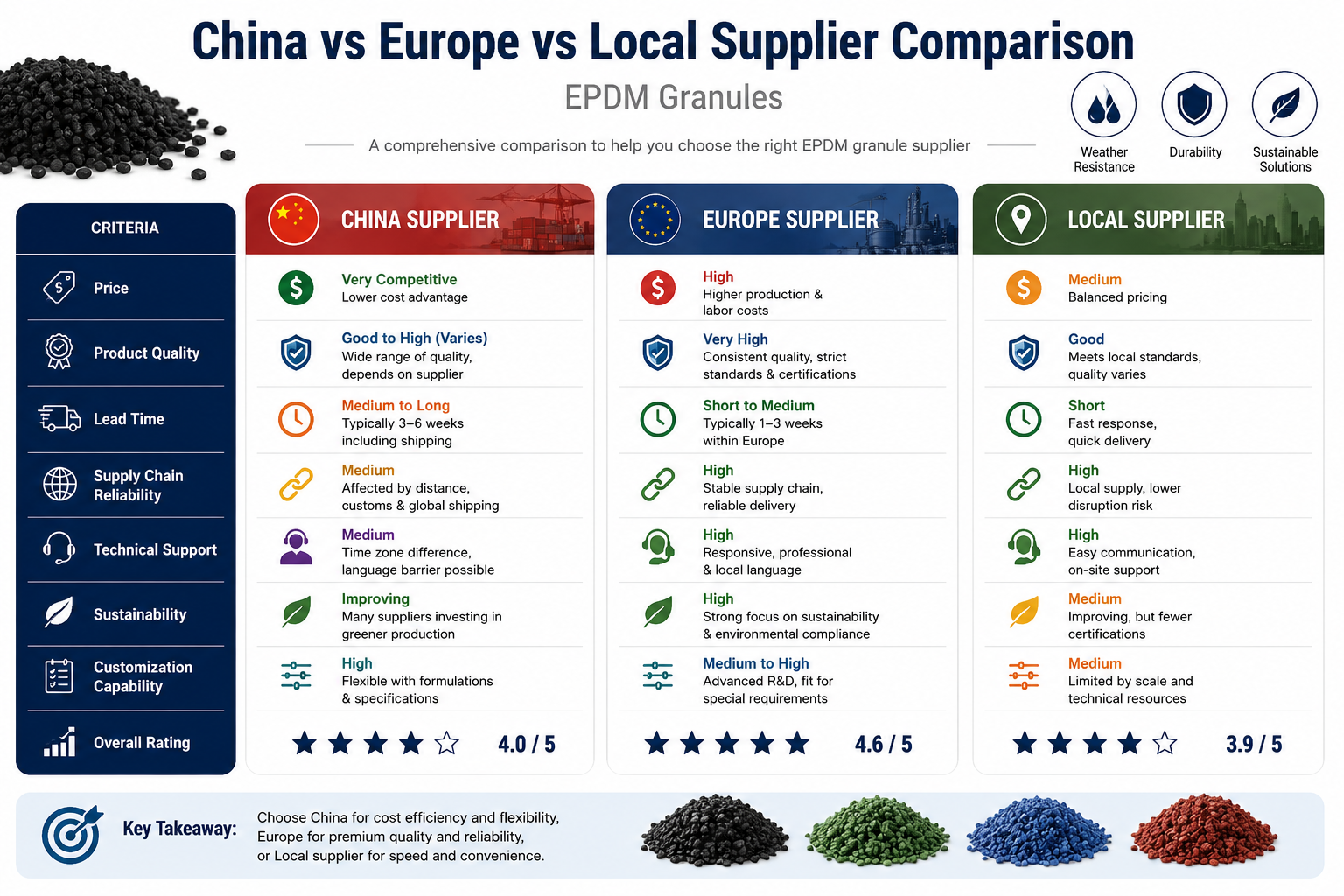
The three sourcing options differ across eight factors that matter to buyers. Here is the complete head-to-head comparison:
| Factor | China / Asia | Europe | Local Distributor |
|---|---|---|---|
| FOB Price (standard colors, 2,000kg+) | $0.90–$1.50/kg | $2.50–$4.50/kg | $3.00–$6.00/kg |
| Delivered Price (CIF Europe) | $1.10–$1.90/kg | $2.50–$4.50/kg | $3.00–$6.00/kg |
| Color Range | 20–100+ standard colors | 20–60 standard colors | 10–30 stocked colors |
| MOQ per color | 500–1,000 kg | 500–2,000 kg | No minimum (bags) |
| Production Lead Time | 7–15 days | 3–7 days | In stock / next day |
| Total Lead Time to Site | 6–10 weeks | 1–3 weeks | 1–5 days |
| EN 1177 / REACH / PAH Certification | Available — verify carefully | Widely available | Varies by product |
| Custom Color Availability | From 1,000–2,000 kg | From 2,000–5,000 kg | Rarely available |
| Factory Audit Capability | Possible (third party) | Easy to arrange | Not applicable |
| Best For | Large volume, price-sensitive, multi-color projects | Urgent projects, European buyers needing local support | Small orders, trial quantities, emergency top-ups |
Asian FOB pricing looks dramatically cheaper, but always compare on a delivered (CIF or DDP) basis before making a sourcing decision. Add ocean freight ($0.08–$0.18/kg), import duties (0–6.5% depending on destination), and inland transport to get your true landed cost. Even after these additions, Asian supply typically delivers at $1.10–$1.90/kg to Europe — still 40–60% below European manufacturer pricing.
When to Choose Each Source: Decision Checklist

Use this checklist to match your project requirements to the right sourcing option. Go through each criterion and select the source that fits your situation.
Your order is 2,000kg+ per color and lead time allows 8 weeks→ Source from Asia. At this volume and timeline, Asian supply delivers the best price by a significant margin. The quality of certified Asian manufacturers is equivalent to European supply — the difference is logistics time, not material quality.
Your project needs materials on site within 3 weeks→ Source from Europe or local distributor. Asian supply requires 6–10 weeks total lead time. If your installation window is tight, a European manufacturer or regional distributor is the only viable option — even at a higher per-kg cost.
Your project requires a custom or Pantone-matched color→ Source from Asia. Asian manufacturers offer custom color from 1,000–2,000 kg minimum — significantly lower than European minimums of 2,000–5,000 kg. Custom color lead time is 2–4 weeks additional regardless of origin.
Your order is under 500kg total→ Source from a local distributor. Import logistics are not viable below approximately 500kg — the per-kg freight cost on small LCL shipments eliminates the price advantage. Local distributors sell in 25kg bags with no minimum order, at a higher per-kg price.
Your client or procurement policy requires a European-origin certificate→ Source from Europe. Some public sector frameworks, NHS contracts, and sustainability-certified projects specify European-manufactured materials. If origin is a contractual requirement — not just a preference — European supply is the only compliant option.
You need 10+ colors for a large multi-zone project→ Source from Asia, consolidated into a single FCL shipment. Large multi-color projects benefit most from Asian supply — the wide color range, lower per-color MOQ, and FCL economics work together to deliver the best total project cost.
This is your first EPDM import and you want to manage risk→ Start with a trial order from Asia (500–1,000 kg), then scale. Place a small trial order to verify quality before committing to full project volume. The per-kg price is higher on trial orders, but the risk management value justifies it on first-time imports.
Price Comparison by Source: Real Delivered Cost Examples
The following examples show total delivered cost per kg for a 5,000 kg order of standard red EPDM granules (1–3mm) delivered to a European buyer. All figures are indicative for 2025.
China / Asia — FCL
$1.20–$1.60
per kg delivered CIF Europe
- FOB price: $0.90–$1.20/kg
- Ocean freight: $0.10–$0.15/kg
- Import duty (EU ~3.5%): $0.05–$0.07/kg
- Inland delivery: $0.05–$0.10/kg
- Lead time: 6–9 weeks
China / Asia — LCL
$1.60–$2.20
per kg delivered CIF Europe
- FOB price: $0.90–$1.20/kg
- LCL freight: $0.30–$0.50/kg
- Import duty: $0.05–$0.07/kg
- Inland delivery: $0.05–$0.10/kg
- Lead time: 7–10 weeks
European Manufacturer
$2.50–$4.50
per kg ex-works Europe
- No import freight or duty
- Inland delivery: $0.05–$0.15/kg
- Lead time: 1–3 weeks
- Local technical support
- EN documentation readily available
Local Distributor
$3.00–$6.00
per kg ex-stock
- No minimum order quantity
- Available in 25kg bags
- Next day delivery possible
- Limited color range
- Best for emergency top-ups
Red Flags by Source: What to Watch For
Each sourcing channel has its own specific risks. Knowing what to look for protects you from quality failures and supply disruptions.
| Source | Red Flag | What It Means | How to Protect Yourself |
|---|---|---|---|
| China / Asia | Price below $0.50/kg FOB for “virgin EPDM” | Almost certainly blended with recycled SBR or low-grade polymer | Request material composition certificate — refuse if unavailable |
| China / Asia | ISO 9001 certificate address differs from factory address | You are dealing with a trading company, not the manufacturer | Cross-check addresses; request factory registration documents |
| China / Asia | Certifications only available “after order” | Supplier cannot or will not provide pre-purchase documentation | Walk away — never accept this condition for safety certifications |
| Europe | Premium price but cannot provide batch-specific PAH reports | European origin does not automatically guarantee compliance | Request color-specific, current PAH test reports regardless of origin |
| Europe | MOQ significantly higher than stated on first enquiry | Your color or volume may not be viable with this supplier | Confirm MOQ per color in writing before investing time in sampling |
| Local Distributor | Cannot provide original manufacturer certification | Distributor may be sourcing from unverified supply chain | Request the manufacturer name and obtain certificates directly from source |
| Local Distributor | Sells “EPDM granules” at SBR recycled rubber prices | Product may not be virgin EPDM — label misrepresentation is a risk at distributor level | Request material composition certificate and PAH test per color |
Frequently Asked Questions
Yes — for certified manufacturers, the answer is yes. EPDM polymer itself is a commodity chemical produced to international specifications regardless of where the granules are manufactured. The quality difference between suppliers is determined by polymer grade, pigment quality, production process control, and certification compliance — not by country of origin. Many Chinese manufacturers supply to European playground and sports contractors on a regular basis and hold current EN 1177, REACH, and PAH certifications from European-accredited laboratories. The key is verifying the specific manufacturer’s credentials, not assuming quality based on geography.
On a 5,000 kg order of standard colors delivered to Europe, the saving is typically $4,000–$12,000 — that is $0.80–$2.40/kg difference between Asian delivered pricing ($1.20–$1.60/kg) and European ex-works pricing ($2.50–$4.00/kg). On larger projects (20,000–50,000 kg for a full athletics track), the saving scales to $30,000–$100,000+ on material cost alone. This is why major European playground and sports surface contractors routinely source from Asia for large projects.
For most sustainability frameworks (BREEAM, LEED), origin country has minimal impact on certification scoring. What is evaluated is the product’s chemical safety profile (REACH, PAH), lifecycle recyclability, and embodied carbon. Virgin EPDM from Asia and virgin EPDM from Europe have essentially the same product-level environmental profile. The additional carbon from ocean freight is real but relatively modest — approximately 0.02–0.05 kg CO₂ per kg of granules shipped by sea, compared to the product’s own embodied carbon of approximately 3–5 kg CO₂/kg. If carbon footprint is a hard project requirement, discuss with your sustainability consultant before sourcing.
Technically possible but not recommended. Mixing granules from different suppliers introduces color consistency risk — nominally identical colors from different manufacturers can differ visibly when installed side by side. It also complicates certification documentation, as EN 1177 system certificates are issued for specific product combinations. For large projects where a single supplier cannot fulfil all colors, source all colors from the same manufacturer in the same production batch wherever possible. If mixing is unavoidable, test samples from both suppliers together in natural daylight before committing.
Standard payment terms for first-time orders from Asian manufacturers are typically 30% deposit on order confirmation, 70% balance against Bill of Lading copy (before the shipment arrives). Some manufacturers offer 100% payment after shipment for established buyers. Letter of Credit (L/C) is available for large orders but adds bank charges. Avoid 100% advance payment on first orders with unverified suppliers — the standard 30/70 split balances the supplier’s production cost against the buyer’s risk. After 2–3 successful orders, better payment terms are usually negotiable.
For ongoing multi-project supply, establishing a direct relationship with one or two verified Asian manufacturers is the most reliable and cost-effective approach. Once a supplier relationship is established — with verified quality, certification documentation, and payment terms — repeat orders become significantly more efficient. Build a secondary supplier relationship as a backup for supply chain resilience. European manufacturers are a good secondary source for urgent top-up orders when Asian lead times cannot be accommodated.
We supply certified virgin EPDM granules direct from manufacturer — EN 1177, REACH, and PAH documentation included. Competitive FOB and CIF pricing. Free physical samples before any order commitment.