

EPDM Interlocking Tiles for Pool Surrounds & Wet Areas: Complete Guide
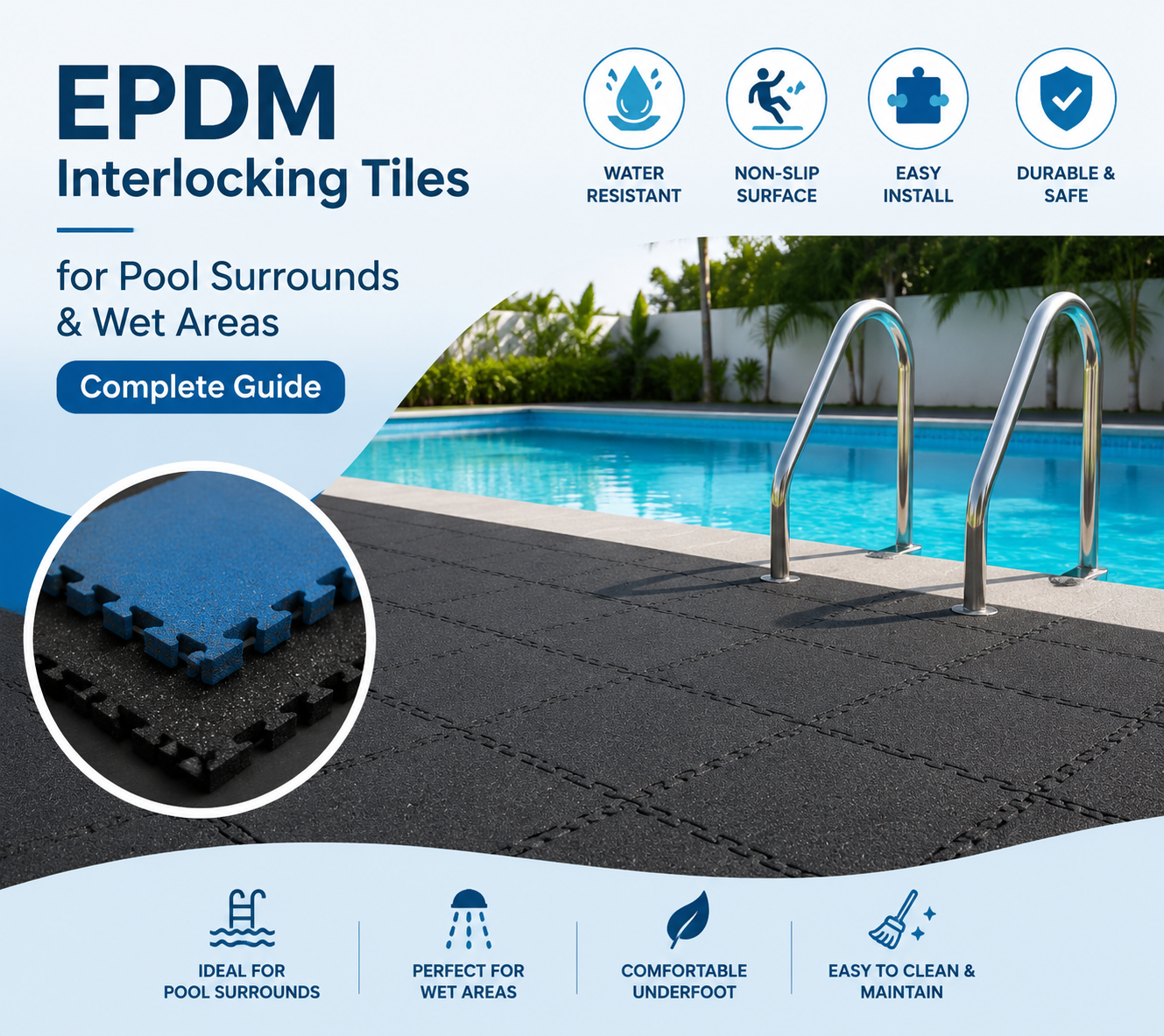
Pool decks, changing rooms, shower areas, and splash pad surrounds demand a flooring system that stays non-slip when wet, resists chemical exposure, manages surface temperature for barefoot comfort, and drains efficiently — all while remaining easy to lift for maintenance access. EPDM interlocking tiles meet every one of these requirements, with the added benefit of tool-free installation directly over existing pool deck surfaces. This guide covers the complete specification.
For pool surrounds and wet areas, specify 15–20mm virgin EPDM interlocking tiles with an open-grid or drainage-channel base design, in light to mid-tone colors (sand, light grey, warm beige) to keep surface temperature comfortable for barefoot use. Require PAH and REACH certification. For splash pads and children’s water play with equipment, EN 1177 certification is also required. Minimum drainage fall of 1:40 should be confirmed in the substrate before installation.
For the complete buyer’s guide including pricing, certifications, and installation, see our EPDM Interlocking Rubber Tiles Complete Buyer’s Guide.
Why EPDM Interlocking Tiles Outperform Alternatives Around Water
Pool surrounds have traditionally used ceramic tile, natural stone, or poured concrete — all of which become dangerously slippery when wet and can reach uncomfortable or even hazardous surface temperatures in direct sun. EPDM interlocking tiles solve both problems while adding the practical advantage of being liftable for under-deck access and drainage maintenance.
| Factor | EPDM Interlocking Tiles | Ceramic / Stone Tile | Wet-Pour EPDM |
|---|---|---|---|
| Slip resistance (wet) | Excellent — textured surface | Requires special anti-slip treatment | Excellent |
| Surface temperature | Lower — light colors available | Can exceed 60°C in direct sun | Lower with light colors |
| Maintenance access (under-deck) | Lift individual tiles — instant access | Tiles must be broken to access | Permanent — no access without cutting |
| Drainage | Open-grid options drain freely | Relies on substrate falls only | Porous surface — good drainage |
| Joint hygiene | Tile joints — minimal but present | Grout lines — bacteria risk | Fully seamless |
| Installation over existing deck | Direct — no demolition needed | Requires removal of old surface | Possible with substrate prep |
| Impact cushioning | Good — comfort underfoot | None — hard surface | Excellent |
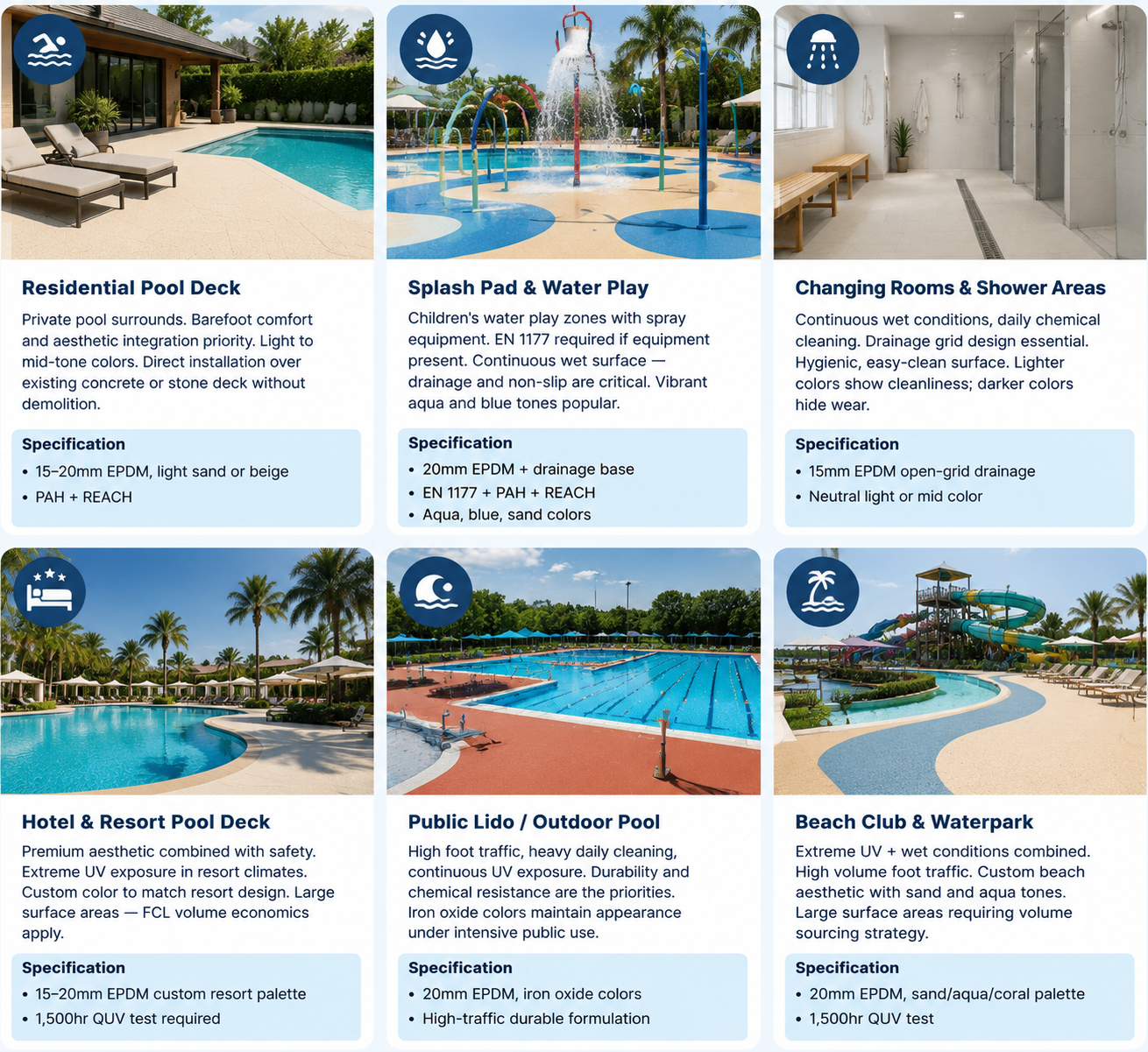
EPDM Interlocking Tiles by Wet Area Application
Surface Temperature by Color: Critical for Barefoot Pool Areas
| Tile Color | Surface Temp (35°C air, direct sun) | Barefoot Safety |
|---|---|---|
| Black | 65–75°C | 🚩 Not recommended poolside |
| Dark Red / Dark Green | 55–65°C | 🚩 Caution in extreme heat |
| Standard Blue / Green | 50–58°C | ⚠ Acceptable — monitor in peak heat |
| Light Sand / Warm Beige | 38–45°C | ✅ Comfortable — recommended choice |
| White / Light Grey | 35–42°C | ✅ Coolest — but lower UV stability |
Use light sand or warm beige as the primary pool deck color — this balances comfortable surface temperature with acceptable UV stability (iron oxide-blended light tones perform better than pure titanium dioxide white). Reserve darker accent colors for shaded zones, planters, or feature borders only. Never specify black or dark green as the dominant color for a barefoot pool deck in any climate where summer air temperature regularly exceeds 30°C.
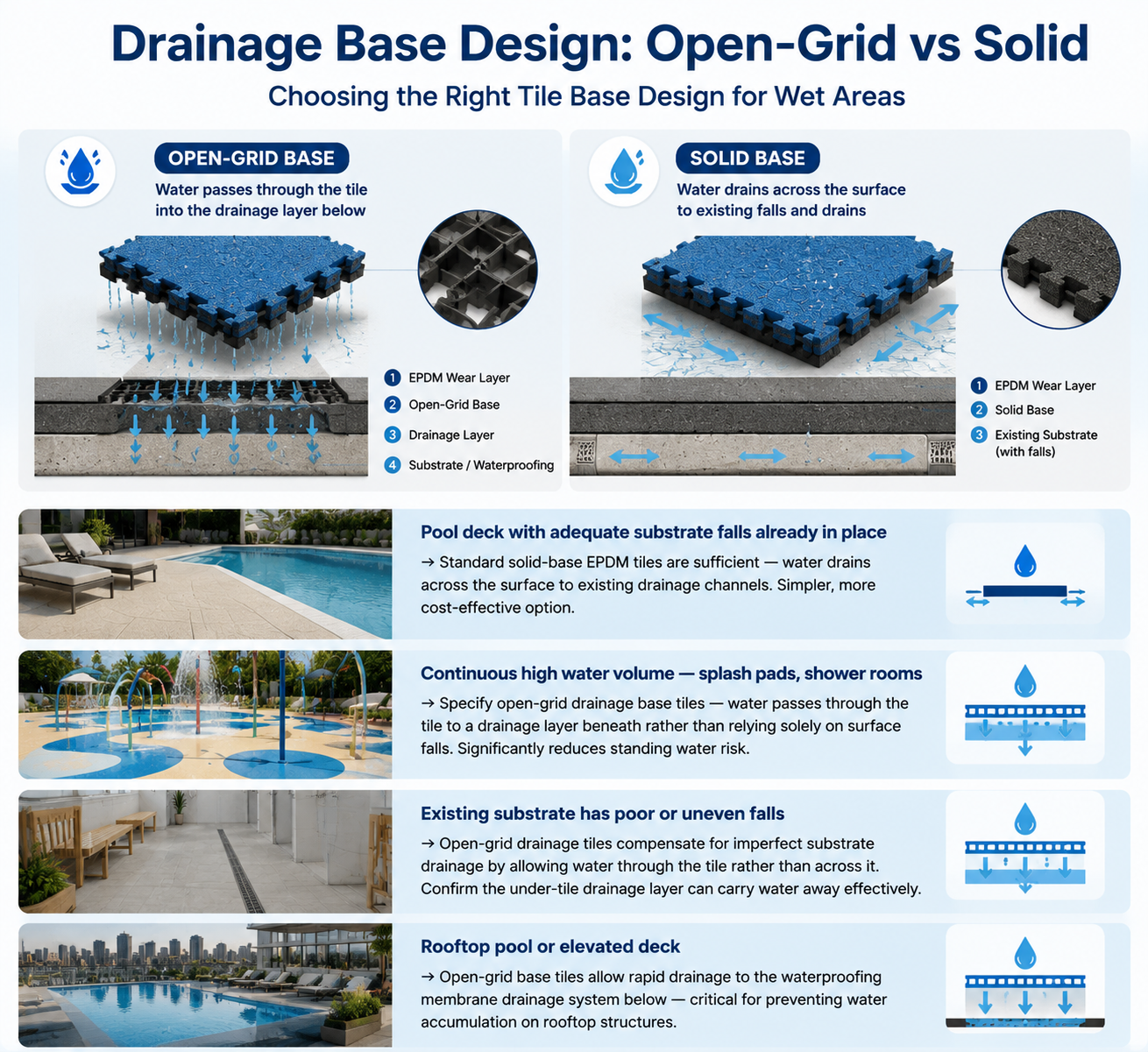
Drainage Base Design: Open-Grid vs Solid
Project Scale Reference
15mm EPDM in light sand or beige. Solid base sufficient if existing deck drains well. Direct over existing pool concrete or stone deck. Installation by homeowner or pool contractor in 1 day for 100m². No demolition of existing surface needed.
Custom resort color palette likely — request 1,500hr QUV data for the specific custom blend. At this volume, FCL shipping is economical. Phase installation by zone to minimise resort operational disruption. Order 10–15% spare tiles given the custom color reorder lead time.
Frequently Asked Questions — Pool Surrounds & Wet Areas
Yes — virgin EPDM has excellent inherent resistance to chlorine at standard pool water concentrations (1–3 ppm). This is one of EPDM’s defining material properties, shared with its use in outdoor seals and weatherstripping. No special formulation is needed for normal pool splash exposure. For maintenance, use only pH-neutral cleaning agents — avoid acid-based tile cleaners and strong alkaline products, both of which can degrade rubber over time with repeated use.
Yes — this is one of the most practical advantages of interlocking tiles over poured or ceramic pool deck surfaces. Individual tiles or sections can be lifted in minutes to access under-deck plumbing, drainage, or electrical conduits, then relaid without any visible repair or patching. This significantly reduces the cost and disruption of routine pool equipment maintenance compared to surfaces that require cutting or breaking to access the same areas.
EPDM interlocking tiles provide superior wet slip resistance compared to even specially treated anti-slip ceramic tile, due to the inherently textured rubber surface rather than a surface treatment that can wear off over time. EPDM also offers significantly better barefoot comfort — both thermally (cooler in direct sun with light colors) and physically (cushioned rather than hard). The trade-off is aesthetic — ceramic and stone offer a different visual character that some pool designs specifically require. For family pools, public facilities, and safety-prioritised projects, EPDM is increasingly the preferred specification.
If the splash pad includes climbing or play equipment with a fall risk, the area beneath that equipment must meet EN 1177 Critical Fall Height requirements — typically 40mm EPDM tiles for standard splash pad equipment heights. Areas without equipment (open spray zones, walkways) can use 15–20mm tiles focused on drainage and slip resistance rather than impact attenuation. Always assess equipment fall heights separately from general wet area requirements when specifying a splash pad project.
We supply virgin EPDM interlocking tiles in light and mid-tone colors with solid and open-grid drainage base options. Full PAH and REACH documentation. Custom resort color matching available. Free physical samples.
Request Samples & Drainage Specification
Read the Buyer’s Guide
Article #15Part of the best EPDM interlocking rubber tiles content series. ← Back to Buyer’s Guide