

EPDM Interlocking Tiles for Outdoor Sports Courts & MUGA: Specification Guide
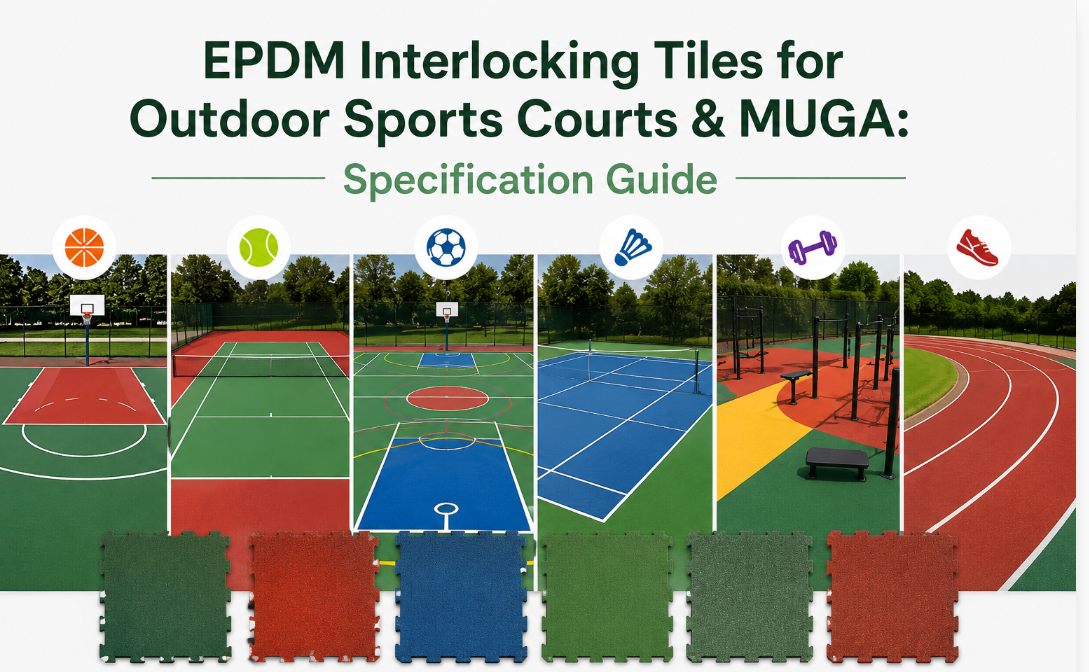
Multi-Use Games Areas, basketball courts, tennis practice zones, and outdoor sports facilities require a surface that delivers consistent grip, UV-stable sport-standard colors, all-weather durability, and easy maintenance across years of heavy use. EPDM interlocking rubber tiles combine all four — with the added advantage of individual tile replacement when isolated damage occurs, without resurfacing the entire court. This guide covers the complete specification for outdoor sports court applications.
For outdoor MUGA courts and sports surfaces, specify 20–25mm virgin EPDM interlocking tiles in sport-standard colors (green, blue, red). Require UV stability data (QUV test showing ΔE <3 after 1,000 hours) for each color. PAH and REACH certification recommended. EN 1177 not required for adult sports courts — only needed if the facility includes a children’s play area. Drainage falls of minimum 1:60 must be planned before installation.
For the complete buyer’s guide including pricing, certifications, and supplier selection, see our EPDM Interlocking Rubber Tiles Complete Buyer’s Guide.
Why EPDM Interlocking Tiles for Outdoor Sports Courts?
Outdoor sports courts have traditionally used tarmac paint, resin-bound coatings, or poured rubber as the playing surface. EPDM interlocking tiles offer a compelling alternative — particularly for retrofit projects, budget-phased installations, and facilities where court layout may need to change over time.
| Factor | EPDM Interlocking Tiles | Tarmac Paint / Coating | Wet-Pour EPDM | Best Option |
|---|---|---|---|---|
| Installation on existing tarmac | Direct — no prep needed | Direct — surface prep only | Possible — substrate prep needed | Tiles or coating |
| UV color stability | 10–15 years (virgin EPDM) | 2–4 years before recoating | 10–20 years | Tiles or wet-pour |
| Repair of damaged zone | Replace individual tiles — minutes | Full recoat required | Specialist patch repair | ✅ Tiles |
| Court reconfiguration | Fully reconfigurable | Permanent | Permanent | ✅ Tiles |
| Upfront cost | Medium | Lowest | Highest | Coating (short term) |
| 10-year total cost | Low — no recoating needed | High — 2–3 recoat cycles | Low — long lifespan | Tiles or wet-pour |
| Shock absorption | Good — joint protection | None — hard surface | Excellent | Tiles or wet-pour |
EPDM Interlocking Tiles by Court Type
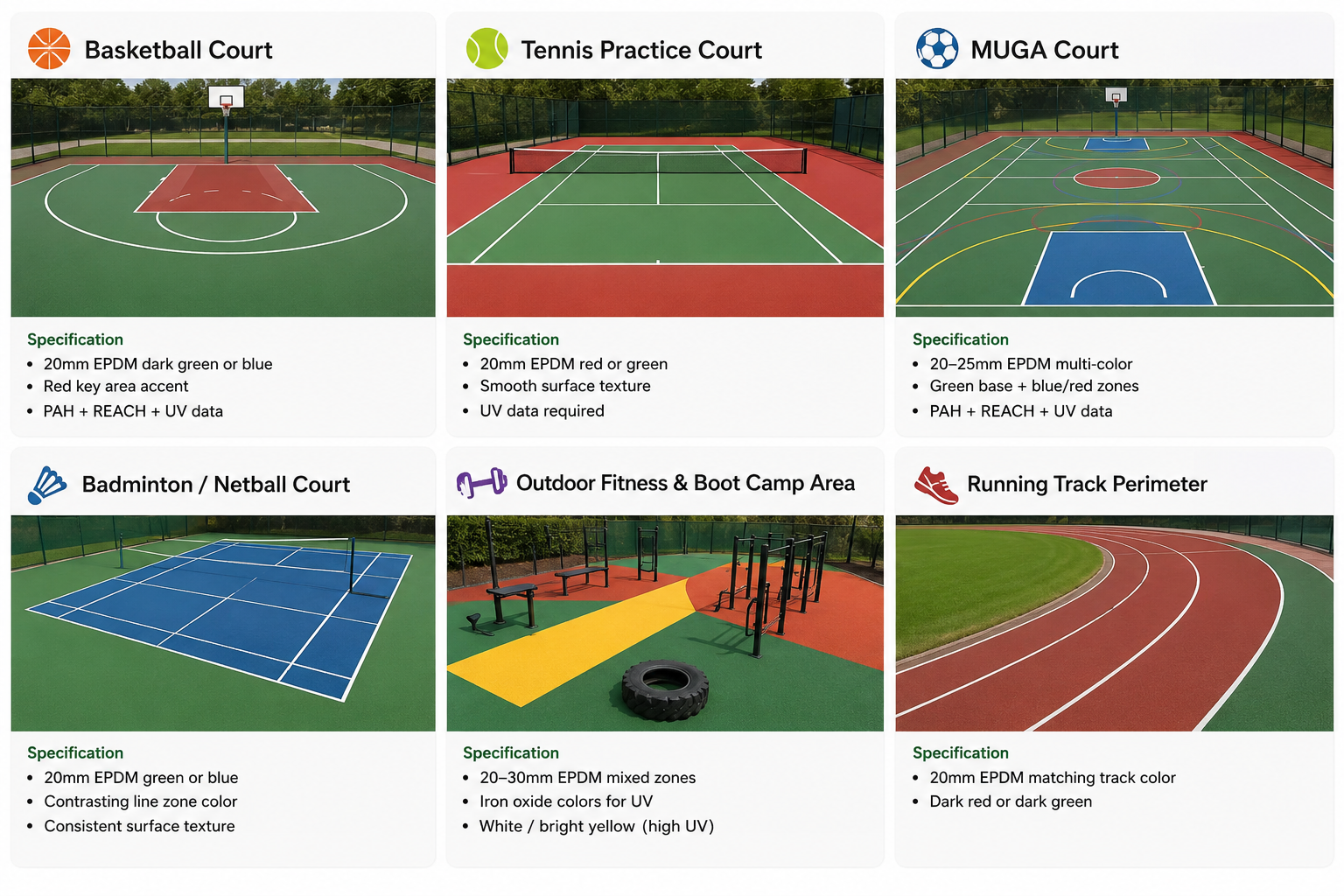
Standard court 28×15m. Primary color + contrasting key area and three-point line. High-frequency lateral movement — non-slip surface critical. UV-stable colors for court marking longevity.
20mm EPDM dark green or blue base
Red key area accent
PAH + REACH + UV data
Non-competitive practice surfaces. Red or green standard court colors. Ball bounce consistency and non-slip when wet are key requirements. Polymer tiles also viable for tennis.
20mm EPDM red or green
Smooth surface texture
UV data required
Multi-Use Games Area for basketball, netball, football, hockey. Typically 30×18m. Multi-color zone design with sport-specific line markings. High daily traffic — durable tile specification essential.
20–25mm EPDM multi-color
Green base + blue/red zones
PAH + REACH + UV data
Precise court dimensions and clear line marking zones. High-frequency jumping and lateral movement. Non-slip performance and surface consistency across the full court are critical.
20mm EPDM green or blue
Contrasting line zone color
Consistent surface texture
Outdoor fitness circuits, boot camp zones, calisthenics areas. Mix of activity types — moderate impact, high UV exposure. Zone color design enhances circuit identification.
20–30mm EPDM mixed zones
Iron oxide colors for UV
White / bright yellow (high UV)
Perimeter safety zones around athletics tracks. EPDM tiles provide color-coded safety margins and impact cushioning around the track edge. Matches track color scheme.
20mm EPDM matching track color
Dark red or dark green
Drainage: The Most Critical Installation Requirement for Outdoor Courts
Standing water on an outdoor sports court is the single biggest safety hazard — regardless of surface material. EPDM interlocking tiles must be installed with adequate drainage falls to prevent water pooling.
Sport-Standard Colors for Outdoor Courts
| Sport | Primary Court Color | Accent / Zone Color | UV Stability Note |
|---|---|---|---|
| Basketball | Dark Green or Blue | Red key area | Iron oxide green — excellent stability |
| Tennis | Red or Green | White line markings (paint) | Iron oxide red/green — excellent |
| Netball | Green or Blue | Red or yellow circle | Standard green/blue — very good |
| Football (5-a-side) | Green | White markings (paint) | Dark green — best UV stability |
| MUGA (multi-sport) | Green base | Blue + Red zones | Mix iron oxide + phthalocyanine |
| Outdoor Fitness | Dark Red or Green | Yellow or orange accent | Iron oxide base — max UV life |
Project Scale Reference
20mm EPDM in dark green (base), dark blue (basketball zone), red (penalty area). PAH and REACH certification per color. UV data required. Install by facility team over 2–3 days. Order 10% spare for future zone repairs. Line markings painted on after tile installation.
At 1,200m² total volume, FCL container shipping becomes viable — reducing freight to $0.08–$0.12/kg and significantly lowering landed cost. 20mm throughout for sports court use (no drop weight risk). Phase installation over school holidays to minimise disruption.
Frequently Asked Questions — Outdoor Sports Courts
For permanent line markings on EPDM interlocking tiles, use a rubber-compatible paint or line marking system specifically formulated for rubber surfaces — standard tarmac line paint does not adhere reliably to EPDM. Alternatively, specify tiles in different colors to create the court zone boundaries directly through the tile layout — this eliminates painted lines entirely and creates color boundaries that cannot chip or fade. For MUGA courts, a combination approach works well: tile color zones for the main areas, painted lines for specific sport markings within each zone.
On an outdoor sports court in a temperate climate with regular use, virgin EPDM interlocking tiles typically last 12–18 years before widespread replacement is needed. High-traffic zones (centre court, penalty areas) may show surface texture wear at 8–10 years — these zones can be selectively replaced without disrupting the rest of the court. Specify iron oxide-based colors (dark green, dark red) for the primary court surface to maximise UV color stability over the full lifespan.
Yes — installing EPDM interlocking tiles directly over existing tarmac is one of the most common applications. Requirements: the tarmac must be structurally sound with no major cracking or heaving; existing drainage falls must be adequate (≥1:80); and the surface must be clean and free of loose material. EPDM tiles over tarmac provide significantly better player grip and cushioning than the bare tarmac surface, while the tile system can be lifted and relaid if the tarmac substrate needs future repairs.
No — virgin EPDM interlocking tiles maintain good slip resistance when wet due to the textured granule surface. Standard 20–25mm EPDM tiles typically achieve a Pendulum Test Value (PTV) of 45–60 when wet — well above the 36 PTV minimum recommended for outdoor sports surfaces. The surface texture that provides grip also provides drainage pathways for water to clear quickly, reducing the duration of any wet surface condition. For maximum wet-weather grip, 2–4mm granule surface texture EPDM tiles outperform smooth-surface polymer alternatives.
We supply 20–25mm virgin EPDM interlocking tiles in sport-standard colors with full UV stability data, PAH, and REACH documentation. Multi-color packs for MUGA court designs. Free physical samples and court layout specification support.
Request Court Specification & Samples
Read the Buyer’s Guide
Article #14Part of the best EPDM interlocking rubber tiles content series. ← Back to Buyer’s Guide