

EPDM Interlocking Tiles for Rooftop & Urban Landscaping: Specification Guide
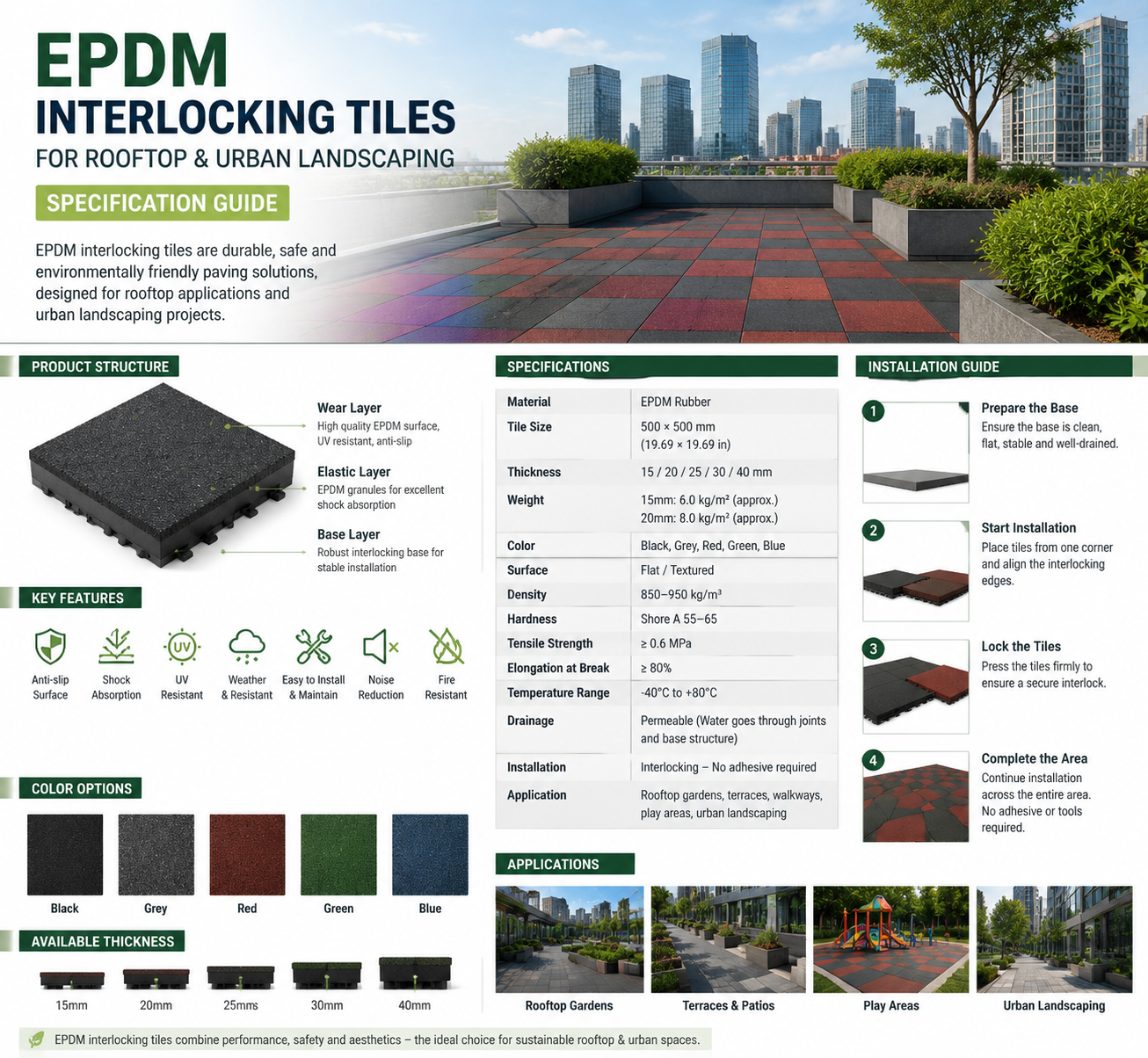
Rooftop terraces, amenity decks, urban plazas, and residential courtyards all share a critical installation constraint: nothing can compromise the waterproofing membrane beneath. EPDM interlocking tiles are uniquely suited to these environments — requiring no adhesive, lightweight enough for most structural load limits, and fully liftable for membrane inspection or repair. This guide covers the complete specification for rooftop and urban landscape applications.
For rooftop terraces and urban landscaping, specify 20–30mm virgin EPDM interlocking tiles with no adhesive — floating installation protects the waterproofing membrane below. Use a separation/protection layer between the membrane and tiles. Choose architectural neutral or earth tone colors (charcoal, warm grey, terracotta) for integration with surrounding design. Always confirm structural load capacity before specifying — a 20mm tile adds approximately 8–12 kg/m², well within most rooftop slab capacities.
For the complete buyer’s guide including pricing, certifications, and installation, see our EPDM Interlocking Rubber Tiles Complete Buyer’s Guide.
Why Interlocking Tiles Are the Preferred Rooftop Surfacing System
Rooftop and elevated terrace installations have one requirement that overrides almost every other design consideration: protecting the waterproofing membrane. A failed or compromised membrane on an occupied building causes water damage that can cost many times more than the original surfacing project. EPDM interlocking tiles are the surfacing system best designed around this constraint.
| Factor | EPDM Interlocking Tiles | Wet-Pour EPDM | Stone / Paving |
|---|---|---|---|
| Membrane protection | No adhesive — floating system | PU binder can bond to membrane | Pedestals avoid direct bonding |
| Weight per m² | 8–15 kg/m² (20-30mm) | 8–12 kg/m² (10-13mm) | 40–80 kg/m² typical |
| Membrane access | Lift any tile in minutes | Cannot be removed once cured | Pedestal systems liftable |
| Surface comfort | Cushioned, warm underfoot | Cushioned, warm underfoot | Hard, can be very hot |
| Installation speed | Hours — no cure time | Days including cure | Days — laying time |
| Color / design options | 20+ colors | Custom designs possible | Limited to stone/paver range |
Structural Load: The Critical Rooftop Constraint
Before specifying any rooftop surfacing, the structural load capacity of the roof slab must be confirmed. This is the single most important technical consideration that differentiates rooftop projects from ground-level installations.
| System | Thickness | Approx. Weight | Typical Suitability |
|---|---|---|---|
| EPDM interlocking tiles (20mm) | 20mm | ~8–12 kg/m² | Most rooftop terraces (typical capacity 150–300 kg/m²) |
| EPDM interlocking tiles (30mm) | 30mm | ~12–18 kg/m² | Rooftop terraces with children’s play zones |
| EPDM interlocking tiles (40mm) | 40mm | ~16–24 kg/m² | Rooftop play areas requiring EN 1177 compliance |
| Loose stone paving on pedestals | 40–60mm | ~50–80 kg/m² | Verify capacity carefully — significantly heavier |
Most commercial rooftop slabs are designed for 150–300 kg/m² live load. A 20mm EPDM interlocking tile system at 8–12 kg/m² is comfortably within this capacity for the vast majority of rooftop projects. However, if other elements are included in the rooftop build-up — planters, furniture, gathering of multiple people, additional drainage layers — the cumulative load must be calculated. Never assume capacity without verification from structural drawings or a qualified structural engineer, particularly for older buildings or rooftops not originally designed for occupied use.
EPDM Interlocking Tiles by Landscape Application
Hotel rooftops, residential amenity decks, office terraces. Architectural neutral colors integrate with modern building materials. No adhesive — full membrane protection.
20mm EPDM, charcoal/warm grey
Protection layer over membrane
Private gardens, courtyard walkways, residential outdoor flooring. Earth tone colors blend with planting. Easy DIY installation for homeowners over existing patios.
20mm EPDM, terracotta/brown
Direct over existing patio surface
Commercial public spaces, shopping centre forecourts, transit plazas. High foot traffic — durable specification needed. Color design can reinforce wayfinding or public art themes.
25–30mm EPDM, mid-tone neutrals
UV-stable architectural palette
Combines rooftop weight constraints with pool surround requirements. Light colors for surface temperature management. Open-grid drainage base if installed near direct water exposure.
15–20mm EPDM, light sand
Open-grid drainage base
Urban developments with rooftop play zones. EN 1177 required for equipment. Higher thickness needed — confirm structural load capacity carefully before specifying 40mm+ tiles.
40mm EN 1177 EPDM (load permitting)
PAH + REACH + structural sign-off
Walkable areas immediately around raised planters and tree pits in urban settings. Practical, durable surfacing that complements landscaping without competing with it visually.
20mm EPDM, dark green/brown
Architectural earth tones
Architectural Color Selection for Rooftop & Landscape Projects
Protecting the Waterproofing Membrane: Essential Steps
Even though EPDM interlocking tiles require no adhesive, a protection layer between the membrane and the tile system is still recommended. This prevents rubber from leaving residue marks on the membrane over years of contact, distributes point loads from furniture or equipment, and allows the membrane to remain fully inspectable when tiles are lifted. Confirm compatibility with your waterproofing manufacturer before installation — most membrane warranties remain valid with a correctly specified protection layer.
Frequently Asked Questions — Rooftop & Landscaping
In exposed, high-wind rooftop locations, individual tiles can be subject to wind uplift forces around the perimeter and at building corners where wind speeds accelerate. For these areas, perimeter anchor strips or a thin bead of compatible adhesive on the outer one to two rows of tiles secures the installation while the field tiles remain fully floating and removable. Consult a wind load assessment for tall buildings or particularly exposed rooftop locations — standard ground-level installation guidance does not always account for rooftop wind dynamics.
EPDM interlocking tiles are designed for walkable hard-surface areas — they are not installed directly into planted or green roof zones. They are commonly used for the walkway and seating areas that border or run through a green roof landscape, providing a defined, durable circulation path while the planted areas remain separate. Where a tile area meets a planted zone, use an edge restraint to keep growing medium separate from the tile system.
Rooftop surfaces experience more extreme temperature swings than ground-level installations due to direct sun exposure and lack of surrounding thermal mass. Virgin EPDM performs across −30°C to +80°C, which covers the vast majority of rooftop temperature extremes globally. Allow slightly larger expansion gaps (5–8mm rather than the standard 3–5mm) for rooftop installations to accommodate the greater thermal cycling, and acclimatise tiles for the full 48-hour period before installation in extreme climates.
For a 150–300m² rooftop terrace using 20mm EPDM tiles in standard architectural colors, expect material cost of $2,700–$8,400 FOB Asia, before freight and any custom color premium. Total installed cost including any protection layer and edge detailing is typically lower than equivalent paved or wet-pour systems, due to the absence of adhesive, mortar, or curing labor. Custom architectural colors to match a specific design scheme add $4–$8/m² and 2–4 weeks lead time.
We supply lightweight EPDM interlocking tiles in 20+ standard colors including a full architectural neutral and earth tone range. No adhesive required — membrane-safe installation. Free physical samples and structural load consultation support.
Request Samples & Project Consultation
Read the Buyer’s Guide