

Scene Application · School Playground
EPDM Interlocking Tiles for School Playgrounds: Complete Specification Guide
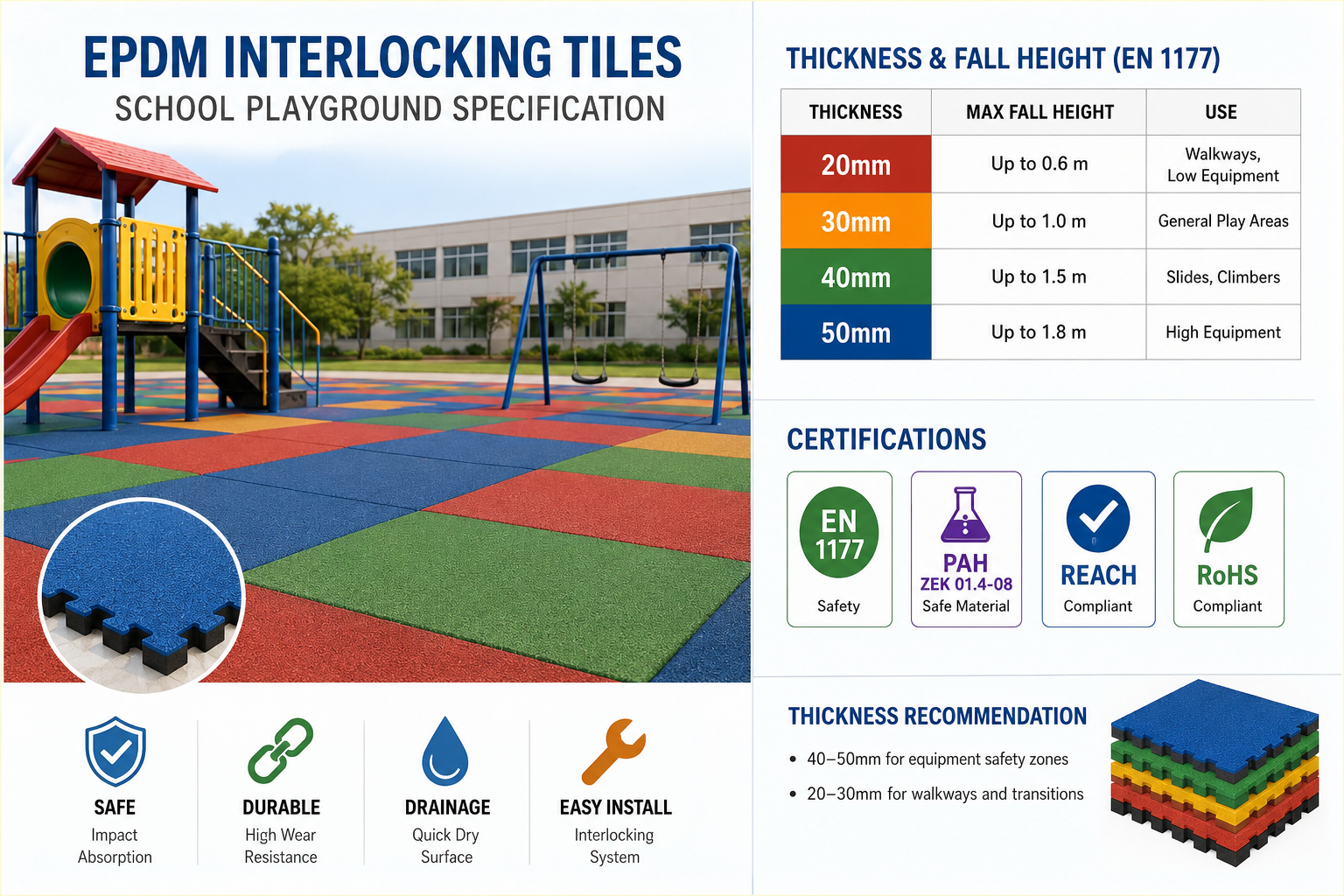
School playgrounds face the most demanding combination of requirements in the rubber tile market — EN 1177 safety compliance, child-safe chemical certification, high daily foot traffic, vibrant multi-color zone design, and a specification that must satisfy both local authority inspection and parental expectations. EPDM interlocking tiles offer a compliant, flexible, and maintainable alternative to wet-pour rubber for school playground projects. This guide covers every specification decision from thickness to color to certification.
For school playgrounds, specify 40–50mm EN 1177 certified virgin EPDM interlocking tiles under equipment zones, with the thickness determined by the Critical Fall Height required for your specific equipment. Require PAH (ZEK 01.4-08) certification per color, REACH compliance, and a material composition certificate confirming 100% virgin EPDM content. Pathway and transition areas between equipment zones can use 20–30mm tiles.
For the complete buyer’s guide including pricing, supplier selection, and installation, see our EPDM Interlocking Rubber Tiles Complete Buyer’s Guide.
Why Choose Interlocking Tiles Over Wet-Pour for a School Playground?
Both EPDM interlocking tiles and wet-pour EPDM are fully compliant options for school playgrounds. The decision between them comes down to installation practicality, maintenance requirements, and project timeline.
| Factor | EPDM Interlocking Tiles | Wet-Pour EPDM | Better for Schools? |
|---|---|---|---|
| Installation disruption | Minimal — no curing time | 2–5 days + cure period | ✅ Tiles — less disruption |
| Surface finish | Tile joints visible | Fully seamless | ✅ Wet-pour — hygiene preference |
| Individual repair | Replace one tile — minutes | Contractor patch required | ✅ Tiles — easier maintenance |
| Phased installation | Zone by zone — flexible | Full area at once | ✅ Tiles — budget phasing |
| Color design | Standard zone colors | Complex designs possible | ✅ Wet-pour — graphic designs |
| EN 1177 compliance | Available — certified products | Widely certified | 🤝 Both compliant |
| Upfront cost | Lower — no contractor | Higher — material + labor | ✅ Tiles — lower initial cost |
Specification by Playground Zone
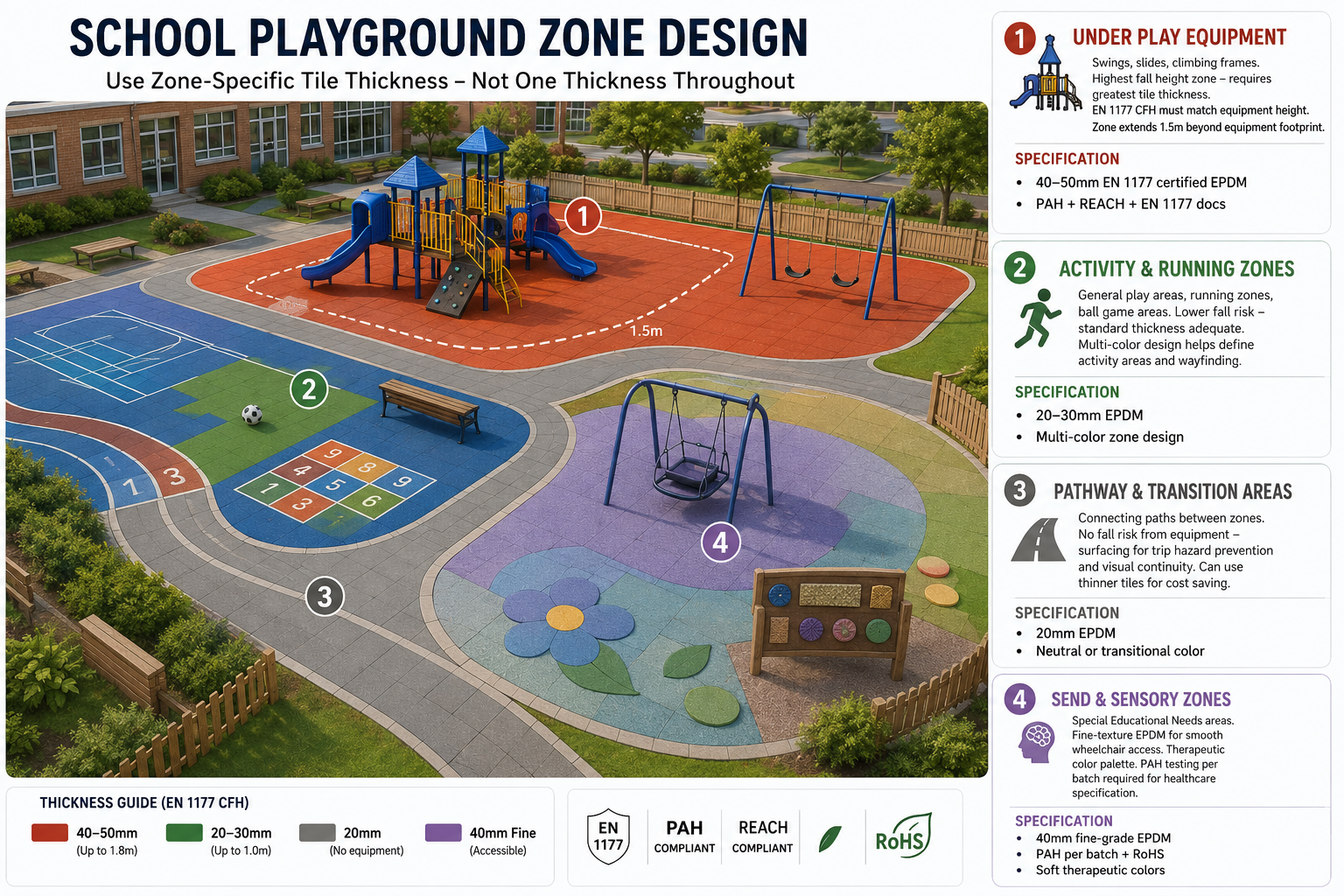
A school playground contains multiple distinct zones with different fall heights and safety requirements. Use zone-specific tile thickness — not one thickness throughout.
Swings, slides, climbing frames. Highest fall height zone — requires greatest tile thickness. EN 1177 CFH must match equipment height. Zone extends 1.5m beyond equipment footprint.
40–50mm EN 1177 certified EPDM
PAH + REACH + EN 1177 docs
General play areas, running zones, ball game areas. Lower fall risk — standard thickness adequate. Multi-color design helps define activity areas and wayfinding.
20–30mm EPDM
Multi-color zone design
Connecting paths between zones. No fall risk from equipment — surfacing for trip hazard prevention and visual continuity. Can use thinner tiles for cost saving.
20mm EPDM
Neutral or transitional color
Special Educational Needs areas. Fine-texture EPDM for smooth wheelchair access. Therapeutic color palette. PAH testing per batch required for healthcare specification.
40mm fine-grade EPDM
PAH per batch + RoHS
Soft therapeutic colors
Thickness and Critical Fall Height: School Playground Reference
| Equipment Type | Max Fall Height | Required CFH | Tile Thickness | Standard |
|---|---|---|---|---|
| Toddler activity panel | 0.4–0.6m | ≥0.6m | 30mm | EN 1177 |
| Standard swing | 0.8–1.0m | ≥1.0m | 40mm | EN 1177 |
| Slide (low) | 1.0–1.2m | ≥1.2m | 40mm | EN 1177 |
| Climbing frame (standard) | 1.2–1.5m | ≥1.5m | 40–50mm | EN 1177 |
| Higher slide / tower | 1.5–2.0m | ≥2.0m | 50mm | EN 1177 |
| Pathway / general area | None | Not required | 20mm | PAH + REACH |
The CFH values above are indicative. The actual certified CFH for any specific tile product depends on rubber density and hardness — not just thickness. Always request the EN 1177 system test report for the specific tile product and thickness you are specifying, and verify the certified CFH against your equipment’s maximum fall height. Never rely on the table above as a substitute for a product-specific test report.
Color Design for School Playgrounds
Multi-color EPDM tile designs are highly valued in school playgrounds — they define activity zones, support learning through embedded visual cues, and create an engaging environment. Here are the key design principles:
Project Scale Reference
2–3 standard EPDM colors. Equipment zones 40–50mm EN 1177 certified; pathway zones 20mm. PAH certification per color mandatory. Full installation possible by school facilities team in 1–2 days — no contractor needed. Order 10% spare tiles for future repairs.
Phased installation viable — complete equipment zones first, pathways in subsequent phase. At 500m²+ total volume, FCL shipping reduces per-m² freight cost significantly. Consider consolidating all school rubber tile requirements (playground + sports hall) into one order for maximum volume pricing.
Frequently Asked Questions — School Playgrounds
Yes — for pathway and general activity zones (20–30mm tiles), installation by school facilities staff is entirely practical with basic DIY skills. For equipment zones (40–50mm EN 1177 certified tiles), the installation itself is still tool-free, but post-installation EN 1177 verification testing should be commissioned from a certified inspector to confirm CFH compliance — particularly for public sector and local authority inspections. The installer does not need to be certified; the installed surface does.
With correct specification and annual maintenance, 10–15 years is the realistic lifespan for school playground EPDM interlocking tiles in temperate climates. High-traffic equipment zones may show visible wear at 8–10 years — these zones can be selectively replaced without disturbing the surrounding surface. Pathway tiles in lower-traffic areas typically last 15+ years. Annual maintenance inspection and prompt replacement of cracked or worn tiles significantly extends the installation’s effective lifecycle.
Yes — for public sector school playgrounds, it is best practice and in many procurement frameworks mandatory to commission an in-situ EN 1177 test after installation. This verifies the installed surface achieves the required CFH in actual site conditions. Ongoing, EN 1177 re-testing every 3–5 years is strongly recommended as tiles age and rubber hardness increases. Many local authority and insurance requirements specify this frequency. Keep all test reports on file as part of the school’s playground safety documentation.
Yes — provided the existing tarmac is structurally sound, reasonably flat (±5mm over 2m), and free of major cracks or depressions. Fill any significant cracks or holes in the tarmac before tiling. EPDM interlocking tiles installed over sound tarmac perform well — the tarmac provides a stable, well-drained base. Do not tile over tarmac with widespread cracking, heaving, or poor drainage — address the substrate issues first or the tile system will mirror the substrate problems.
We supply EN 1177 certified virgin EPDM interlocking tiles in 40mm and 50mm with full PAH, REACH, and material composition documentation. Multi-color packs available. Free physical samples.
Article #13Part of the best EPDM interlocking rubber tiles content series. ← Back to Buyer’s Guide