

How to Request and Evaluate EPDM Interlocking Tile Samples
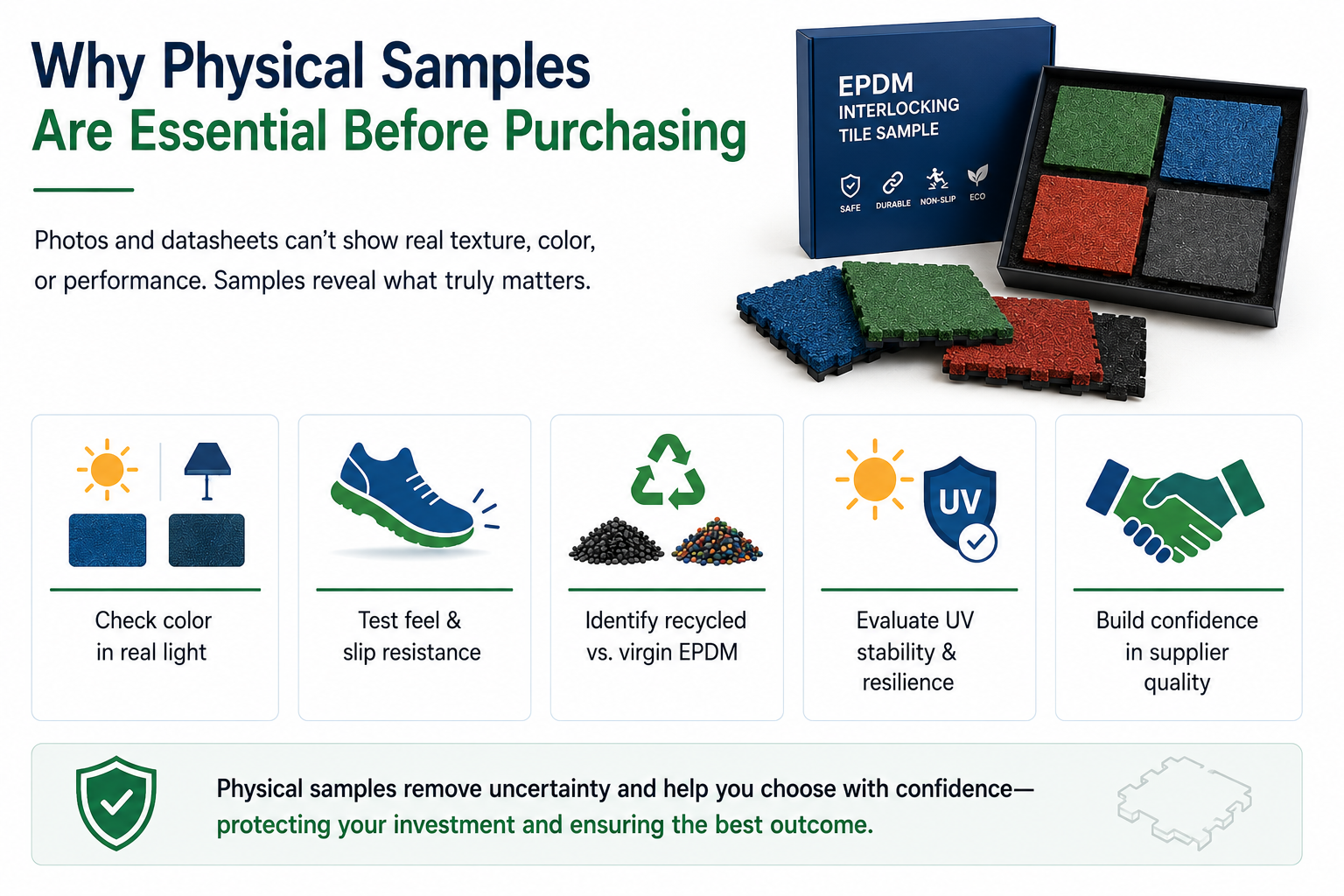
Requesting and thoroughly evaluating physical EPDM interlocking tile samples is a critical step that separates successful projects from expensive mistakes. High-quality samples allow you to verify color, texture, durability, safety compliance, and interlocking performance before committing to a large order. This comprehensive guide provides a detailed, step-by-step process used by professional specifiers, architects, and facility managers.
Contact 3–5 reputable suppliers and request full-size tiles (not small swatches) in your target colors and thicknesses. Evaluate them systematically for color accuracy, granule quality, odor, density, interlocking fit, flexibility, and edge finish. Always request current batch certifications including EN 1177, PAH (per batch), REACH, and RoHS. Test samples in real-world conditions before final approval.
For complete specifications, supplier recommendations, and pricing insights, see our EPDM Interlocking Rubber Tiles Complete Buyer’s Guide.
Why Physical Samples Are Essential Before Purchasing
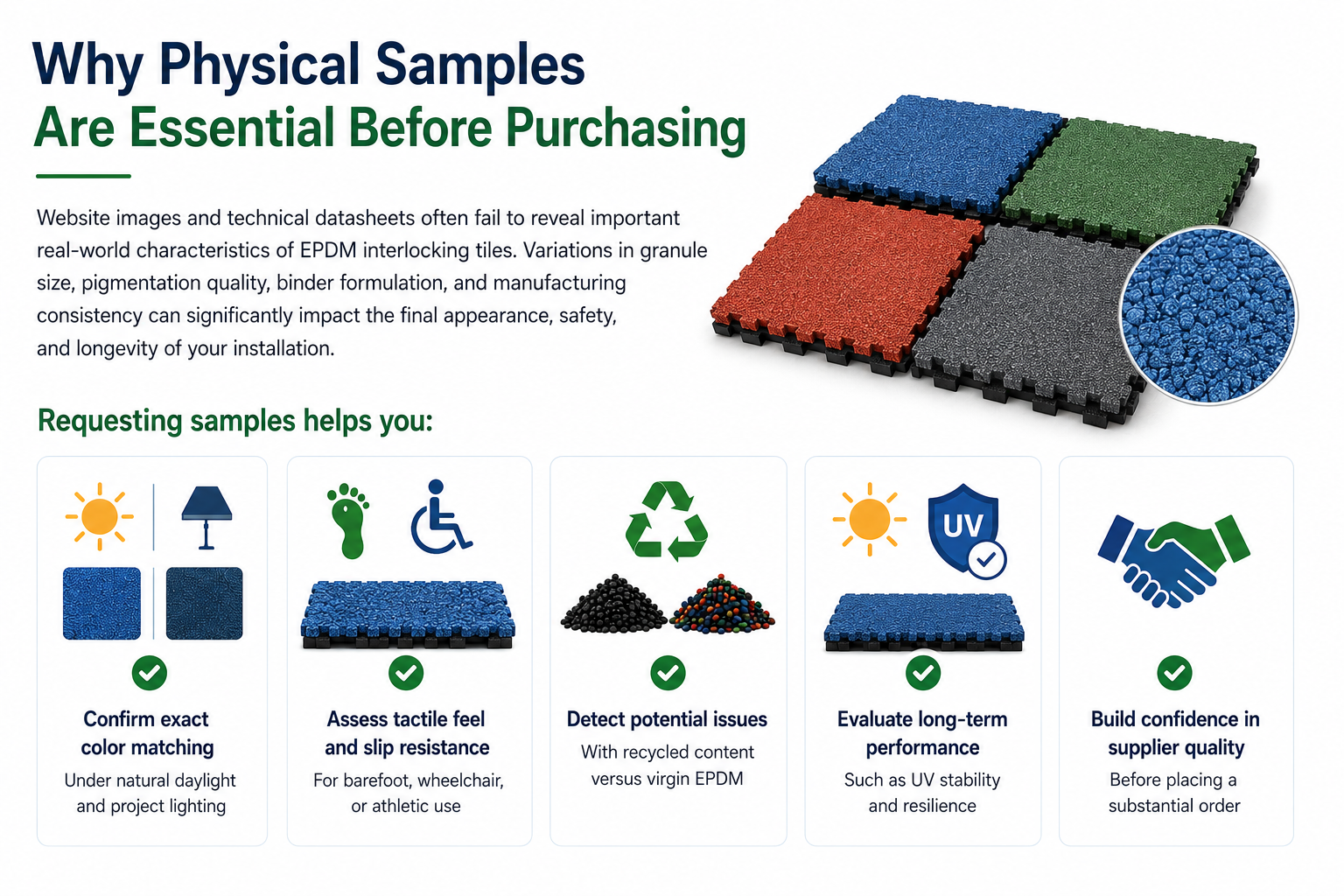
Website images and technical datasheets often fail to reveal important real-world characteristics of EPDM interlocking tiles. Variations in granule size, pigmentation quality, binder formulation, and manufacturing consistency can significantly impact the final appearance, safety, and longevity of your installation.
Requesting samples helps you:
- Confirm exact color matching under both natural daylight and your project’s specific lighting conditions
- Assess tactile feel and slip resistance for barefoot, wheelchair, or athletic use
- Detect potential issues with recycled content versus virgin EPDM
- Evaluate long-term performance indicators such as UV stability and resilience
- Build confidence in supplier quality before placing a substantial order
Step-by-Step Guide: How to Request EPDM Interlocking Tile Samples
| Step | Detailed Actions | Best Practices & Why It Matters |
|---|---|---|
| 1. Research & Shortlist Suppliers | Identify suppliers known for virgin EPDM material. Check reviews, case studies, and certification history. | Focus on manufacturers with ISO 9001 certification and transparent supply chains to ensure consistent quality. |
| 2. Prepare a Professional Request | Email or use contact forms specifying: exact colors (with RAL codes if possible), thicknesses (e.g., 30mm, 40mm, 50mm), granule size (fine 1–2mm preferred), and number of full tiles per color. | Clear requests reduce the chance of receiving low-grade or mismatched samples. Mention your project type (playground, hospital, school) for tailored recommendations. |
| 3. Request Comprehensive Documentation | Ask for batch-specific test reports: PAH, REACH SVHC, RoHS, EN 1177 (system certification), and material safety data sheets (MSDS). | Especially important for healthcare, educational, or public projects where compliance documentation is mandatory. |
| 4. Clarify Logistics | Inquire about sample lead time (usually 3–7 days), shipping costs, and return policy. | Some suppliers offer free samples for serious inquiries; others may charge nominal fees. Confirm this upfront. |
| 5. Follow Up | Send a polite follow-up after 48 hours if no response. Reference your project timeline. | Professional suppliers respond quickly. Slow responses may indicate service issues. |
Comprehensive Evaluation Checklist for EPDM Tile Samples
| Evaluation Criteria | What to Check For | Red Flags / Warning Signs |
|---|---|---|
| Color Accuracy & Consistency | Examine under multiple lighting conditions. Check for uniform pigmentation across the tile surface and between multiple samples of the same color. | Fading, streaking, color variation between tiles, or significant difference from website images. |
| Granule Quality & Surface Texture | Look for clean, uniformly sized 1–2mm fine granules. Surface should feel smooth yet provide good grip. No visible dust or loose particles. | Large, irregular granules, crumbly texture, visible black recycled rubber specks, or overly rough surface. |
| Odor & Material Purity | Fresh virgin EPDM should have only a mild rubber scent that fades quickly. Leave sample in a well-ventilated area for 24–48 hours. | Strong, persistent chemical or “burnt rubber” smell indicating poor quality binders or high recycled content. |
| Thickness & Density | Use digital calipers to measure thickness at multiple points. Weigh the tile. Quality tiles feel substantial and dense. | Variation >1mm across one tile, unusually lightweight feel, or hollow-sounding when tapped. |
| Interlocking System Performance | Assemble 4–6 tiles. Check alignment, gap size (should be minimal), lateral stability, and ease of connection/disconnection. | Loose fit, excessive gaps, difficult assembly, or tiles that separate too easily under light pressure. |
| Flexibility & Shock Absorption | Gently bend corners and press firmly in the center. The tile should return to shape quickly without cracking. | Excessive rigidity, cracking, permanent deformation, or overly soft/squishy feel. |
| Edge & Manufacturing Quality | Inspect all edges and interlocking tabs for clean, precise cuts and consistent molding. | Rough, frayed, or uneven edges; flash or molding defects. |
| UV & Weather Resistance Indicators | Place samples outdoors for several days and monitor for color fading or surface degradation. | Rapid fading or chalking after short exposure. |
Pro Tips for Effective Sample Evaluation
- Test samples on your actual intended substrate (concrete, asphalt, compacted base) to see real appearance and stability.
- Simulate traffic: walk on them, roll a wheelchair or stroller, and drop soft objects to assess impact absorption.
- For large projects, request a small test panel (e.g., 1m x 1m) assembled by the supplier.
- Photograph and document every sample with date, supplier name, and your notes for future reference.
- Compare samples side-by-side under the same lighting for fair evaluation.
- If possible, visit a completed installation by the supplier to see aged performance.
Special Considerations for Healthcare, Schools & Sensory Areas
For sensitive environments, go beyond standard checks:
- Request PAH testing results specifically from the current production batch
- Verify low-VOC and low-odor formulations
- Evaluate calming therapeutic color options (muted greens, soft blues, warm neutrals)
- Confirm fine granule surface for smooth wheelchair rolling and barefoot comfort
- Request PTV (Pendulum Test Value) slip resistance data for wet and dry conditions
Common Mistakes to Avoid
- Relying only on small swatches instead of full tiles
- Evaluating samples indoors only
- Skipping documentation requests
- Approving samples without testing interlocking performance
- Ordering without a signed sample approval clause in the contract
Frequently Asked Questions
For most projects, request 4–6 different colors plus duplicates from your top supplier. Larger projects may require 8–10 samples to cover primary colors, borders, and accents.
Reputable suppliers typically provide 1–3 free full tiles per color for serious buyers. Be wary of companies that only send tiny pieces or charge excessively — this often correlates with lower overall service quality.
Include a clear “must match approved sample” clause in your purchase order. Reputable suppliers will replace non-conforming tiles at no cost. Always keep approved samples for reference during and after installation.
Allow at least 5–7 days: 1–2 days for initial inspection, 2–3 days for outdoor testing, and time for team/stakeholder review.
We provide premium virgin EPDM interlocking tiles with full certification packages and offer generous sample support for specifiers and contractors. Fast turnaround and expert guidance included.
Request Your Samples Today
Download the Full Buyer’s Guide
← Back to Complete Buyer’s Guide