

For most gym applications, 20mm interlocking rubber tiles are the standard specification — covering cardio zones, stretching areas, and general fitness use. Free weight and Olympic lifting zones require 40mm minimum. Getting the thickness wrong is the most common and most costly mistake in gym floor procurement.
Standard thickness for
most gym applications
Minimum for free weights
and Olympic lifting
Maximum standard thickness
for playground EN 1177
10mm — yoga, stretching, light cardio. 20mm — standard gym, cardio equipment, functional training. 30–40mm — free weights, powerlifting, CrossFit. 50mm — Olympic lifting platforms, heavy drop zones, playground safety surfaces. When in doubt, go thicker — you cannot add thickness after installation, and under-specifying thickness is the leading cause of subfloor damage and tile deformation in commercial gyms.
For a full overview of interlocking sports flooring tile materials, pricing, and supplier selection, see our Interlocking Sports Flooring Tiles Complete Buyer’s Guide.
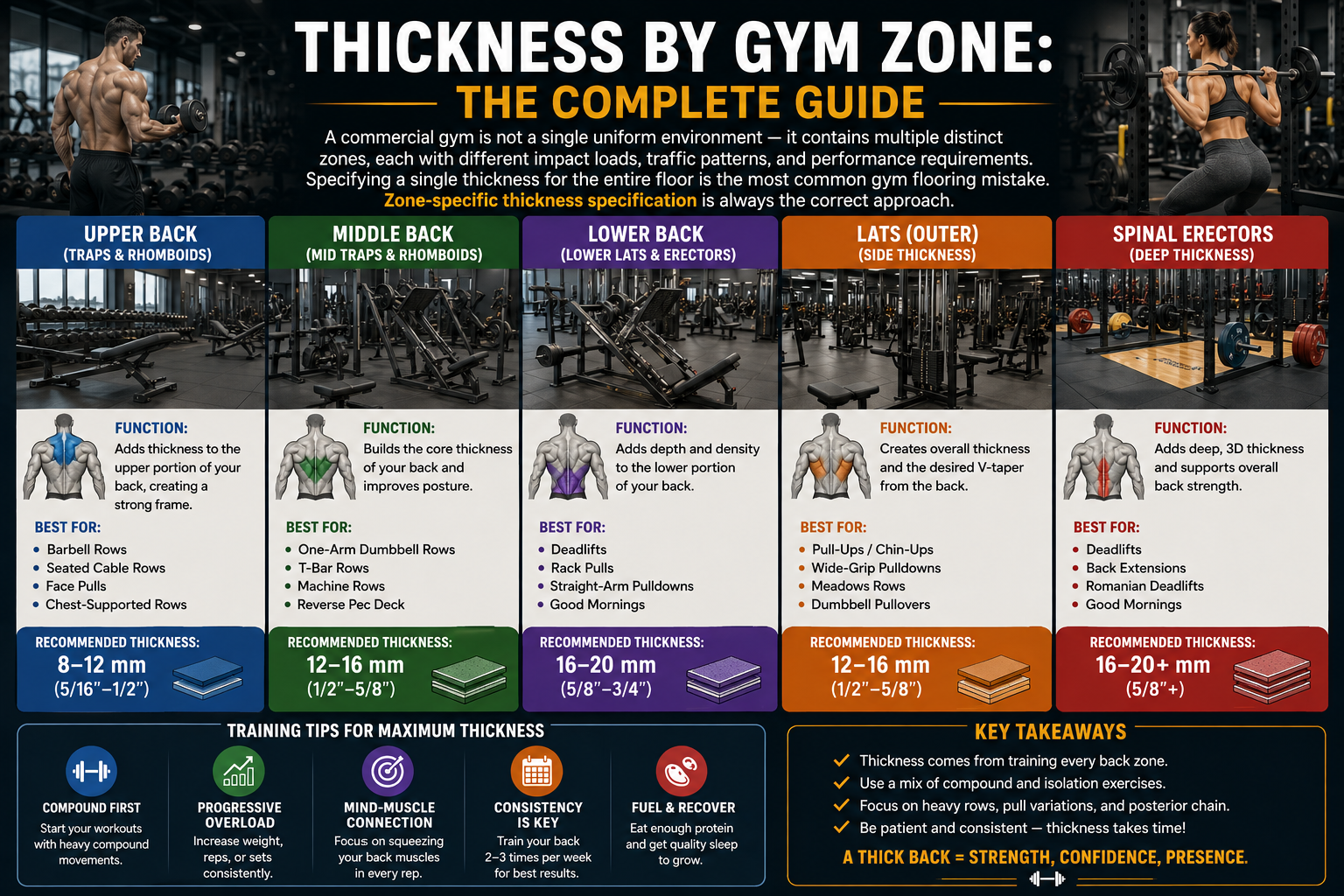
Thickness by Gym Zone: The Complete Guide
A commercial gym is not a single uniform environment — it contains multiple distinct zones, each with different impact loads, traffic patterns, and performance requirements. Specifying a single thickness for the entire floor is the most common gym flooring mistake. Zone-specific thickness specification is always the correct approach.
| Gym Zone | Recommended Thickness | Why | Material |
|---|---|---|---|
| Yoga / Stretching | 10mm | Low impact — comfort and grip only needed | Rubber or foam |
| Cardio Equipment Zone | 15–20mm | Treadmill, bike vibration absorption | Recycled rubber SBR |
| Functional Training | 20mm | Moderate impact — kettlebells, bodyweight | Recycled rubber SBR |
| Free Weights / Dumbbells | 30–40mm | Dropped weight impact protection for subfloor | Recycled rubber SBR |
| Powerlifting / Barbell | 40mm | Heavy bar drops — subfloor and equipment protection | Recycled rubber SBR |
| Olympic Lifting Platform | 50mm | Maximum impact — full barbell drops from overhead | High-density SBR |
| CrossFit / Box Jump Zone | 30–40mm | Repeated impact — landing zones need full protection | Recycled rubber SBR |
| Indoor Running Track | 13–20mm | Energy return + cushioning for repetitive stride | EPDM or rubber |
| Playground (indoor) | 40–50mm | EN 1177 CFH compliance for play equipment | Virgin EPDM |
How to Calculate the Right Thickness for Your Specific Equipment
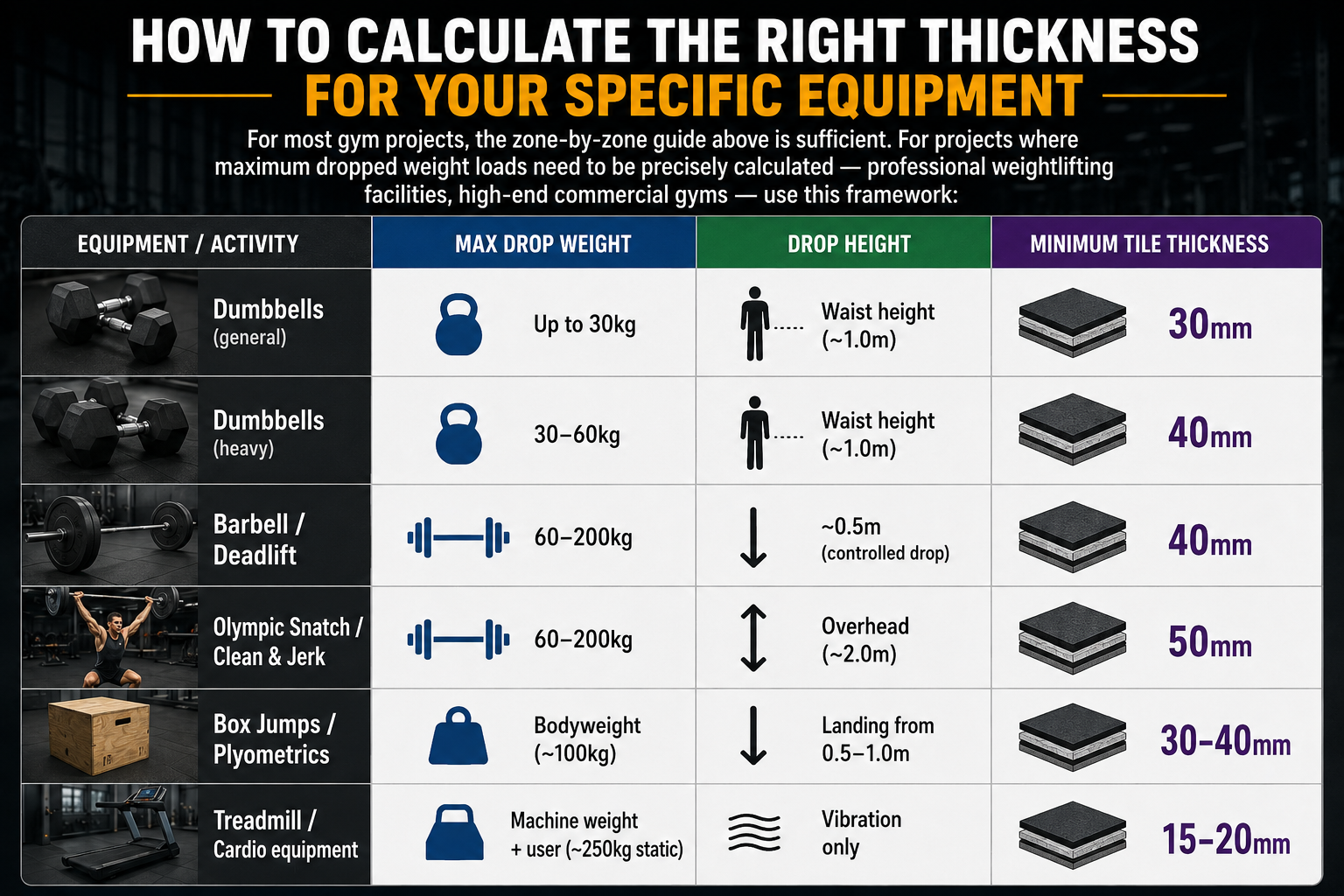
For most gym projects, the zone-by-zone guide above is sufficient. For projects where maximum dropped weight loads need to be precisely calculated — professional weightlifting facilities, high-end commercial gyms — use this framework:
| Equipment / Activity | Max Drop Weight | Drop Height | Minimum Tile Thickness |
|---|---|---|---|
| Dumbbells (general) | Up to 30kg | Waist height (~1.0m) | 30mm |
| Dumbbells (heavy) | 30–60kg | Waist height (~1.0m) | 40mm |
| Barbell / Deadlift | 60–200kg | ~0.5m (controlled drop) | 40mm |
| Olympic Snatch / Clean & Jerk | 60–200kg | Overhead (~2.0m) | 50mm |
| Box Jumps / Plyometrics | Bodyweight (~100kg) | Landing from 0.5–1.0m | 30–40mm |
| Treadmill / Cardio equipment | Machine weight + user (~250kg static) | Vibration only | 15–20mm |
Thickness Mistakes That Cost Gym Owners Money
Specifying 10mm for the entire gym to save cost — results in subfloor damage within 12 months in weight zones
Using the same thickness under racks and in lifting zones — racks need stability, lifting zones need thickness
Forgetting that “20mm” tile thickness + edge ramp = 20mm step up from surrounding floor — trip hazard risk
Ordering online without physical sample — thickness can vary ±3mm from spec in low-quality tiles
Not ordering spare tiles — matching replacements become unavailable when product changes
Zone-specific specification — 20mm for general areas, 40mm under free weight zones
Place rigid platform under heavy racks on thick tiles — prevents rocking, extends tile life
Use matching edge ramp strips — create a gradual transition at the perimeter, no trip hazard
Always request and test physical sample before bulk order — verify actual thickness with calipers
Order 10% extra and store as spares — same batch, guaranteed color and dimension match
Frequently Asked Questions
Summary: Gym Tile Thickness Quick Reference
Article #2 · Series: best interlocking sports flooring tiles · ← Back to Buyer’s Guide
Get the Right Thickness for Your Gym Project
We supply interlocking rubber tiles in 10mm, 20mm, 30mm, 40mm, and 50mm thickness. Free physical samples. Technical specification support for zone-by-zone thickness planning.
Request Samples & Thickness Advice
Read the Full Buyer’s Guide