

For sports flooring, rubber tiles outperform foam and polymer in impact absorption and long-term durability — but polymer tiles are the better choice for outdoor courts and wet areas, and foam tiles serve specific indoor cushioning needs at the lowest cost. This guide gives you the complete comparison so you can specify the right material for your exact application.
Rubber tile outdoor
lifespan
Typical foam tile lifespan
under commercial use
Polymer tile outdoor
lifespan
Rubber tiles — best for gyms, playgrounds, and any surface with dropped weights or heavy foot traffic. Foam tiles — best for indoor children’s play areas, yoga studios, and temporary light-use surfaces. Polymer tiles — best for outdoor sports courts, pool surrounds, and wet areas where drainage and dimensional stability matter most. Never use foam tiles outdoors or under heavy equipment — and never use thin polymer tiles as the only surface in a high-impact gym.
For the complete interlocking sports flooring tile buyer’s guide including pricing, supplier selection, and installation, see our Interlocking Sports Flooring Tiles Complete Buyer’s Guide.
Full Comparison: Rubber vs Foam vs Polymer
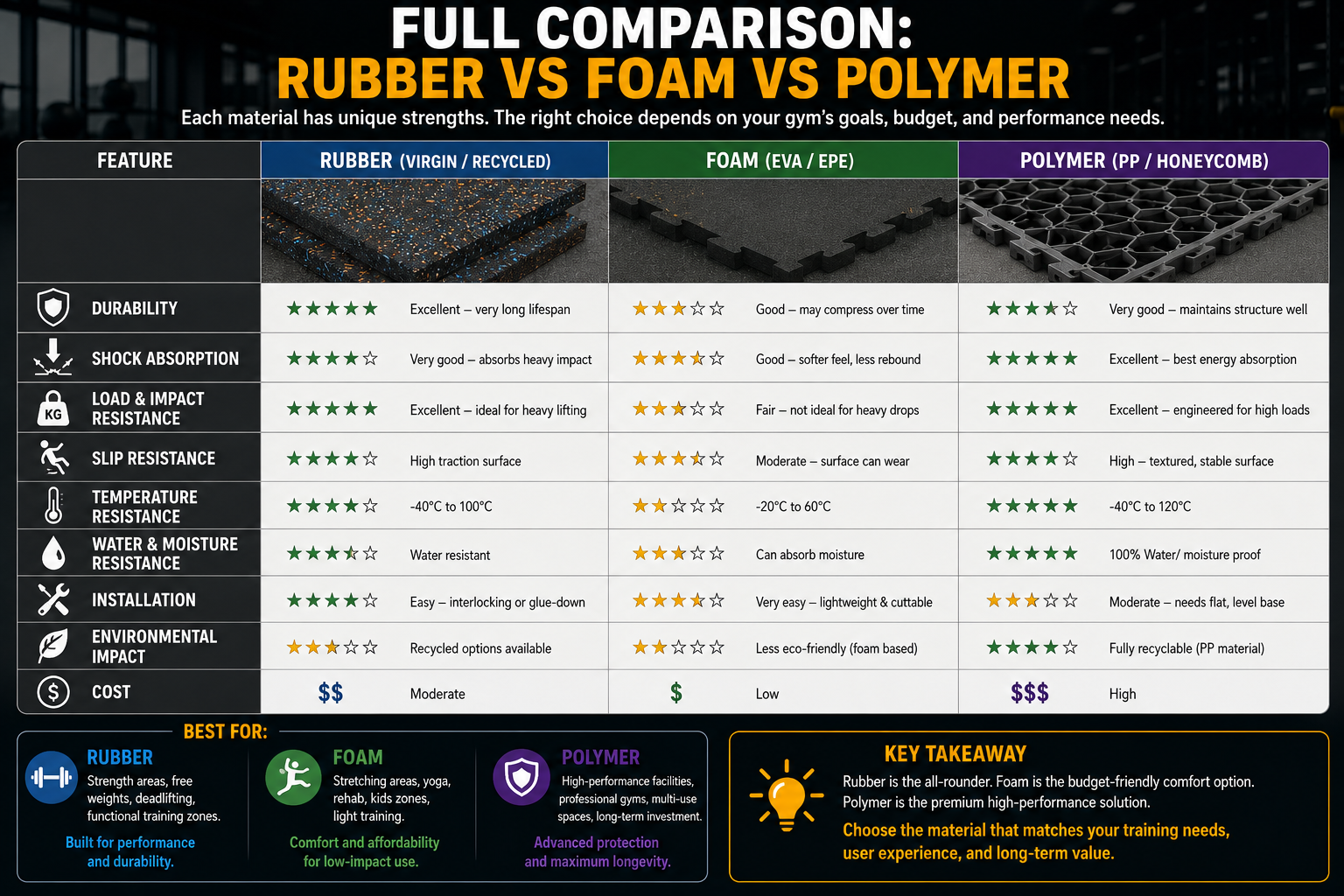
Each material has a distinct performance profile. Here is the complete head-to-head comparison across the ten factors that matter most in sports flooring specification.
| Factor | Rubber Tiles (SBR/EPDM) | Foam Tiles (EVA/PE) | Polymer Tiles (PP/PE) |
|---|---|---|---|
| Impact Absorption | ✅ Excellent — rated for dropped weights | ✅ Good — soft cushioning | ⚠ Moderate — depends on thickness |
| Durability (commercial use) | ✅ 8–15 years | ❌ 1–3 years (compresses permanently) | ✅ 10–15 years |
| Outdoor UV Resistance | ✅ Good–Excellent (EPDM) | ❌ Poor — degrades rapidly outdoors | ✅ Very good (UV-stabilised) |
| Water / Drainage | ⚠ Solid base — pools if not sloped | ❌ Absorbs moisture — mold risk | ✅ Excellent — open-grid drains through |
| Price Range (per m²) | $8–$45/m² | $3–$10/m² | $5–$15/m² |
| Slip Resistance (wet) | ✅ Good | ❌ Poor when wet | ✅ Excellent (textured surface) |
| Temperature Stability | ✅ Good (−30°C to +80°C) | ❌ Poor — shrinks cold, warps hot | ✅ Excellent (−40°C to +90°C) |
| Child Safety (playground) | ✅ EN 1177 certified options | ⚠ Indoor play only — not EN 1177 | ⚠ Verify certification per product |
| Heavy Equipment Load | ✅ Handles 1,500+ kg/m² static | ❌ Compresses permanently under load | ✅ Handles 800–1,500 kg/m² |
| Noise Reduction | ✅ Excellent — 15–22dB reduction | ✅ Good — soft material absorbs sound | ⚠ Moderate |
| Cleaning / Hygiene | ✅ Non-porous — easy to clean | ❌ Porous — harbours bacteria and odour | ✅ Non-porous — easy to clean |
| Best For | Gyms, playgrounds, sports courts, outdoor fitness | Yoga rooms, children’s indoor play, temporary events | Outdoor courts, pool surrounds, wet areas, rooftops |
Rubber Tiles: When to Specify and Why
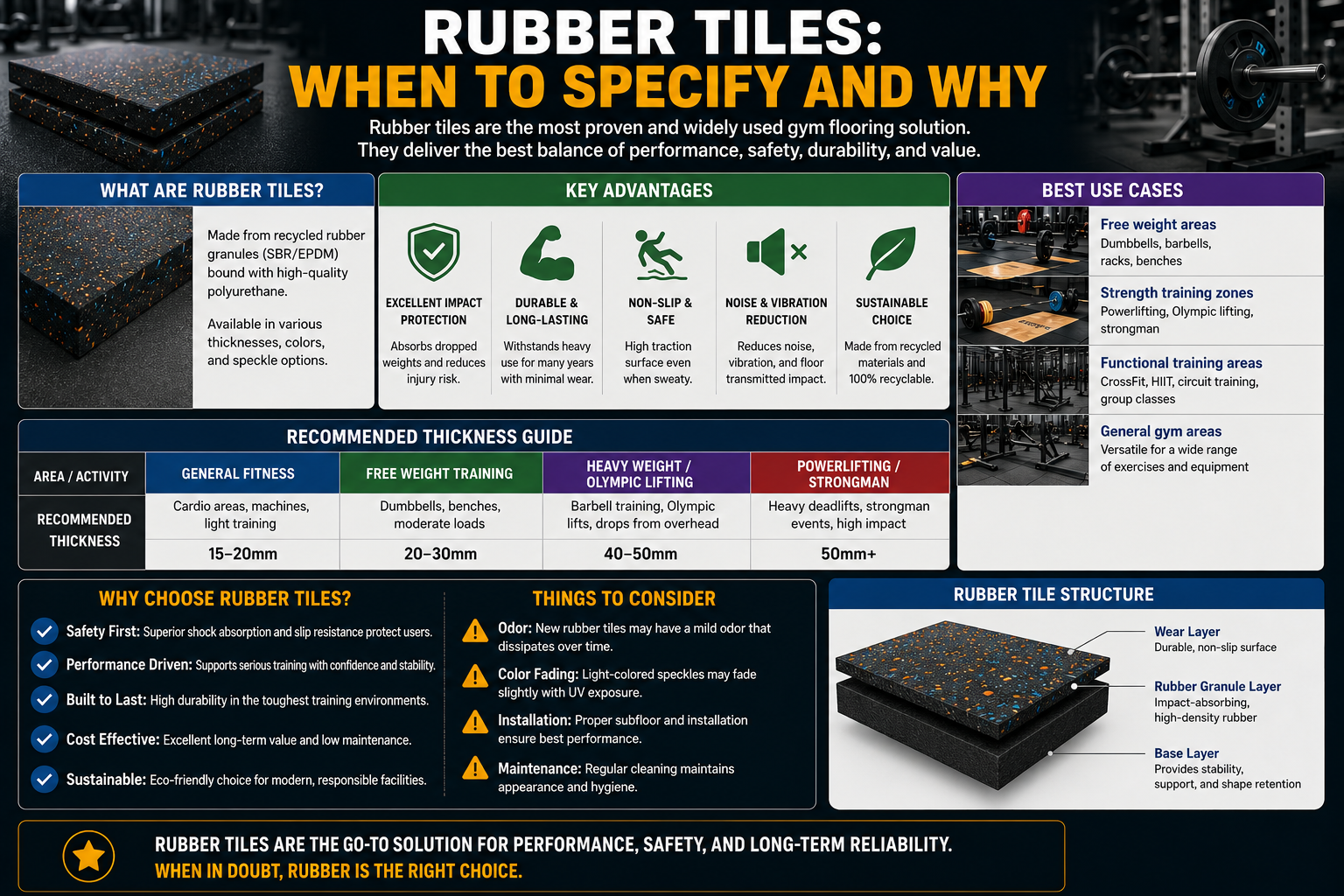
Rubber tiles — made from either recycled SBR (Styrene-Butadiene Rubber) or virgin EPDM (Ethylene Propylene Diene Monomer) — are the workhorse of sports flooring. They are the only material capable of handling dropped weights, outdoor UV exposure, and playground safety requirements simultaneously.
Your application involves dropped weights, heavy foot traffic, or outdoor exposure. You need EN 1177 playground safety compliance. You require long-term commercial durability (10+ years). The surface will be cleaned with commercial cleaning agents regularly. You need noise reduction between floors in a multi-storey building.
Commercial Gym / Playground / Outdoor Fitness
Recycled SBR rubber tiles are limited to black and dark grey — no color options. EPDM tiles offer colors but at 2–3× the price of SBR. Very thick rubber tiles (40–50mm) can cause heavy equipment to rock slightly — requires platform solution. Heavier than foam or polymer — shipping costs are higher per m².
Color Limitation on SBR / Weight for Shipping
Foam Tiles: When They Work — and When They Fail
Foam tiles (typically EVA — Ethylene-Vinyl Acetate) are the cheapest and lightest flooring option. They have a legitimate role in specific applications — but are widely misused in sports settings where they are simply not durable enough.
The surface is indoor only with no heavy equipment. The application is yoga, pilates, children’s soft play, or martial arts. The installation is temporary or the budget is severely constrained. Ease of handling and very lightweight installation is important. The surface will be replaced every 1–2 years as part of regular facility refresh.
Yoga / Indoor Children’s Play / Temporary Events
Any dropped weights or heavy equipment will be used. The installation is outdoors or in a wet environment — foam absorbs moisture, develops mold, and degrades rapidly in UV. Commercial use with heavy daily foot traffic is expected — foam compresses permanently within months under repeated loading. EN 1177 playground compliance is required — foam tiles do not meet this standard.
Not for Weights / Not Outdoors / Not Playground
The most common — and most expensive — foam tile mistake is using EVA foam tiles in a commercial gym to save upfront cost. Under commercial use with weights and heavy foot traffic, foam tiles compress permanently and deform within 3–6 months, creating an uneven surface that is both aesthetically poor and a trip hazard. The cost of replacing foam with rubber tiles — including disposal of the failed foam — exceeds the initial cost saving within the first year. In commercial applications, rubber tiles are always the lower total cost option despite higher upfront price.
Polymer Tiles: The Outdoor and Wet Area Specialist
Polypropylene (PP) and polyethylene (PE) polymer tiles occupy a distinct performance niche that neither rubber nor foam can match: outdoor courts, pool surrounds, and wet areas where drainage performance and dimensional stability across extreme temperatures are the primary requirements.
The surface is outdoors and exposed to UV, rain, and temperature extremes. Drainage performance is critical — pool surrounds, shower rooms, outdoor sports courts. The surface needs to be installed over existing tile, concrete, or asphalt without adhesive. The installation is a rooftop terrace where lightweight material is important. Color options (polymer tiles are available in a wide range) are needed for an outdoor court with line markings.
Outdoor Courts / Pool Surrounds / Rooftops
Impact absorption is significantly lower than rubber — not suitable as the primary floor surface in heavy gym applications. The hard polymer surface can be uncomfortable underfoot for prolonged barefoot use compared to rubber. In very cold climates, some polymer grades become brittle — confirm temperature rating for your specific climate. Surface texture on polymer tiles provides grip but does not match the anti-fatigue properties of rubber for standing all-day use.
Lower Impact Absorption / Harder Feel
Which Material for Each Application: Decision Guide
| Application | Best Material | Acceptable Alternative | Avoid |
|---|---|---|---|
| Commercial Gym — Free Weights | Rubber SBR 40mm | EPDM 40mm (premium) | Foam, thin polymer |
| Home Gym — General | Rubber SBR 20mm | Rubber SBR 30mm | Foam under barbells |
| Yoga / Pilates Studio | Rubber SBR 10mm or foam | EPDM 10mm | Nothing below 8mm |
| Outdoor Playground | Rubber EPDM 40–50mm | Certified rubber SBR 40mm | Foam, standard polymer |
| Outdoor Basketball Court | Polymer PP/PE 15–20mm | Rubber SBR 20mm | Foam |
| Pool Surround | Polymer drainage grid 15mm | Rubber 15mm with drainage | Foam |
| Rooftop Terrace | Polymer PP/PE 20–30mm | Rubber SBR 20mm | Foam |
| Children’s Indoor Play | Foam EVA 20mm or Rubber EPDM | Rubber SBR (PAH certified) | Uncertified materials |
| CrossFit / Box | Rubber SBR 30–40mm | EPDM 30–40mm | Foam, thin polymer |
| Industrial / Garage | Rubber SBR 20–40mm heavy duty | Polymer heavy duty grade | Foam |
True Cost Comparison Over 5 Years
Upfront price is misleading — what matters is total cost over the installation’s lifespan. Here is a real-world 5-year cost comparison for a 200m² commercial gym floor:
| Cost Factor | Foam Tiles (EVA) | Rubber Tiles (SBR) | Polymer Tiles (PP) |
|---|---|---|---|
| Initial material cost (200m²) | $800–$1,600 | $2,400–$4,000 | $1,200–$2,400 |
| Replacements needed (5 years) | 2–3 full replacements | 5–10% spot replacements | 5–10% spot replacements |
| Replacement cost (5 years) | $1,600–$4,800 | $120–$400 | $120–$400 |
| Subfloor repair (if any) | $500–$2,000 (damage likely) | Negligible | Negligible |
| Total 5-year cost | $2,900–$8,400 | $2,520–$4,400 | $1,320–$2,800 |
| Verdict | Most expensive in commercial use | Best value for heavy use | Best value for light outdoor use |
Frequently Asked Questions
Summary: Material Selection at a Glance
Article #3 · Series: best interlocking sports flooring tiles · ← Back to Buyer’s Guide
Find the Right Material for Your Project
We supply interlocking rubber tiles (SBR and EPDM) and polymer tiles for gym, playground, outdoor court, and pool surround applications. Free physical samples. Technical specification support included.