

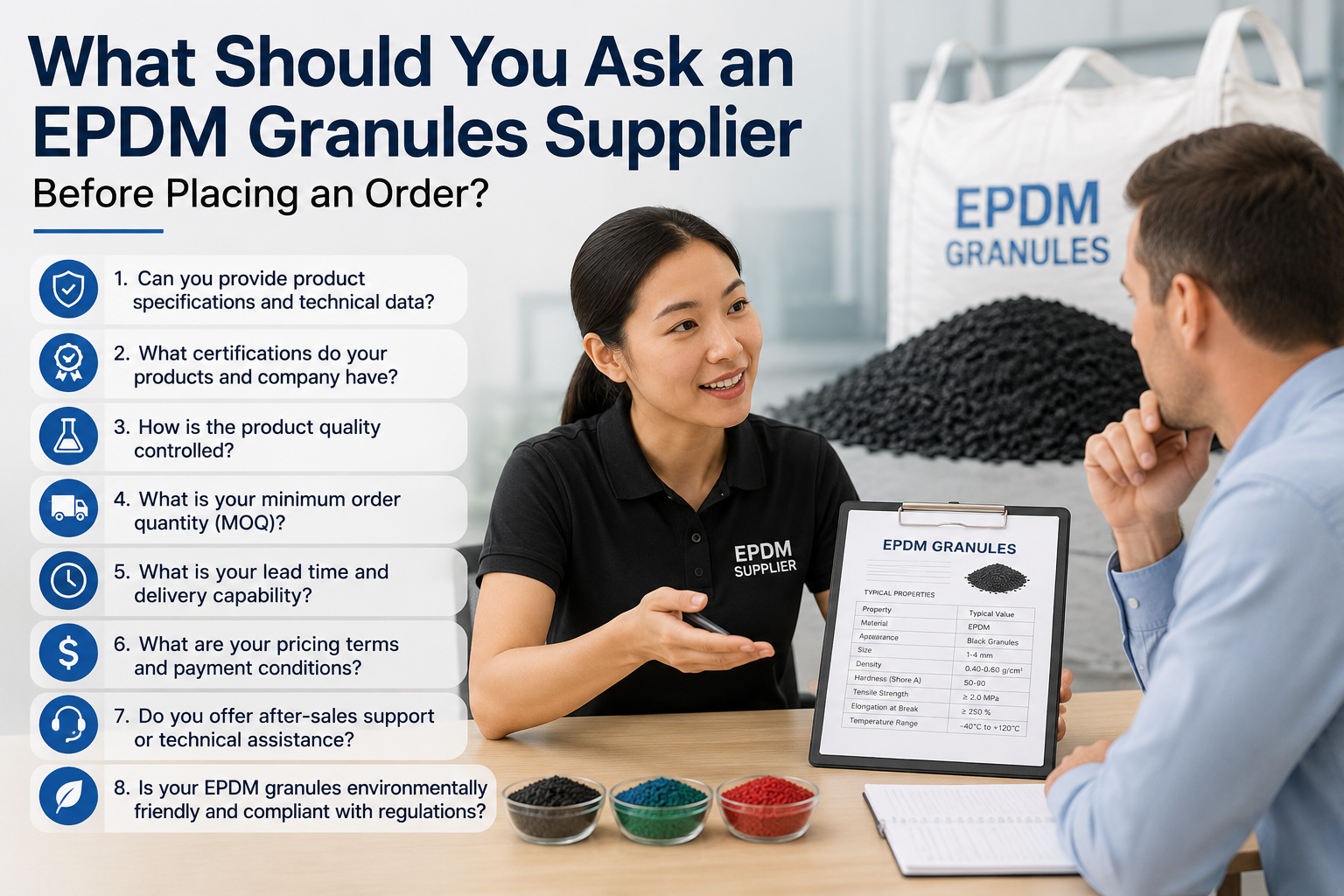
Before committing to any EPDM granule purchase, ask these 10 questions — and only proceed if you receive satisfactory, documented answers to all of them. Buyers who skip this process are the ones who end up with wrong colors, failed certifications, delayed shipments, and surfaces that need replacing in five years instead of fifteen. These questions take less than 30 minutes to ask. The answers tell you everything you need to know about a supplier’s quality, reliability, and professionalism.
For the complete supplier selection framework, pricing guide, and certification requirements, see our EPDM Granules Complete Buyer’s Guide.
Good Answer vs Red Flag Answer: At a Glance
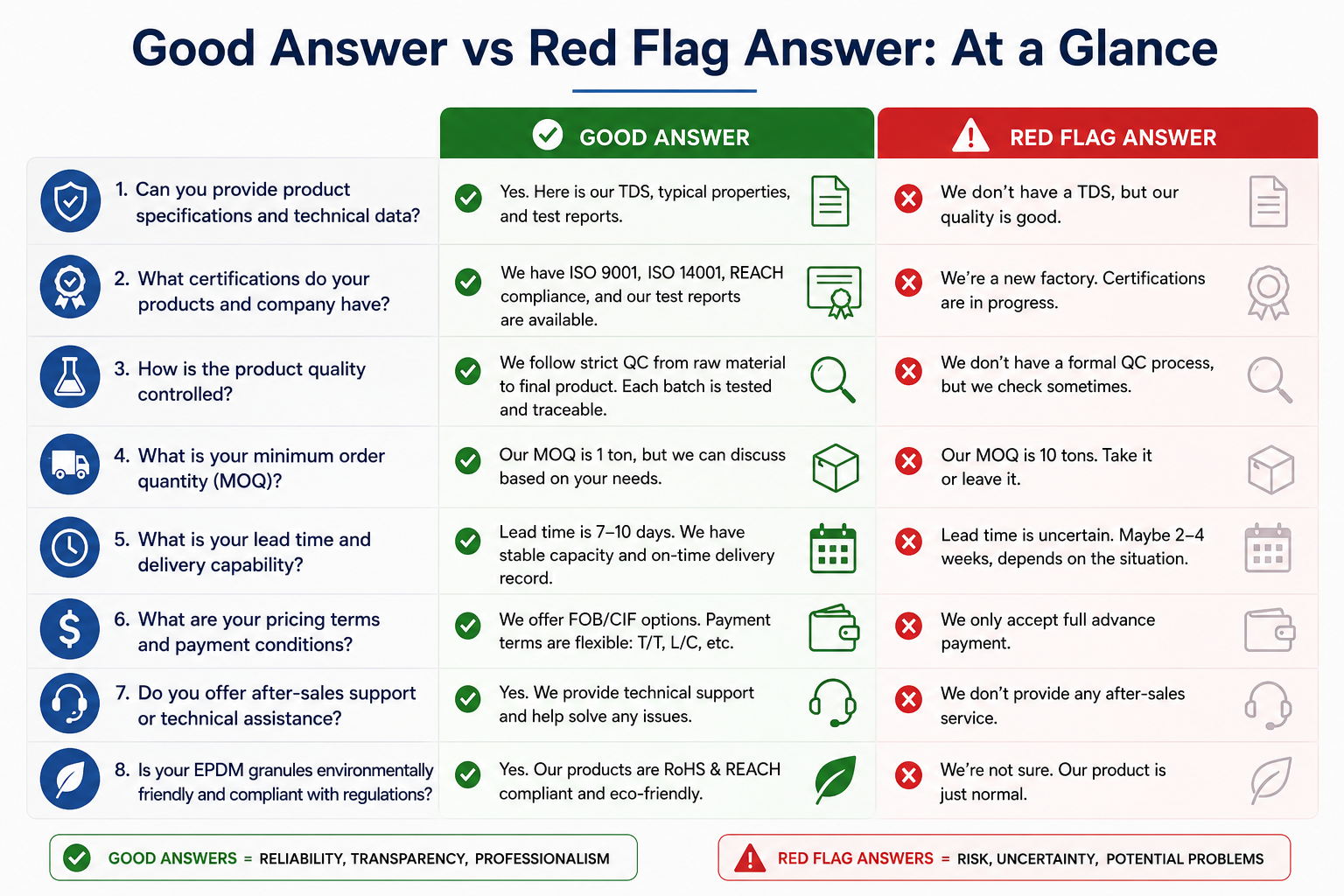
Before going through each question in detail, here is a quick reference for what separates a supplier worth proceeding with from one that should be eliminated immediately.
| Question Topic | Good Answer | Red Flag Answer |
|---|---|---|
| Virgin EPDM content | Provides material composition certificate immediately | “Yes of course” — but no document available |
| PAH certification | Sends color-specific lab report from accredited lab | Generic certificate or “available after order” |
| EN 1177 system test | Provides system-level report with depth and binder specification | “Our product meets EN 1177” without documentation |
| Are you the manufacturer? | ISO 9001 certificate address matches factory — confirmed manufacturer | Evasive answer — cannot provide factory registration |
| Granule size consistency | Provides sieve analysis report showing PSD data | “Our quality is very good” — no data provided |
| UV stability data | QUV test report showing ΔE per color after 1,000+ hours | “UV stable” — no test data, no ΔE values |
| MOQ and lead time | Clear MOQ per color, production lead time, and shipping schedule | Vague — “depends on order” without specifics |
| Bulk matches sample? | Written confirmation + COA per batch provided with each shipment | “No problem” — verbal only, no written commitment |
| Payment terms | 30% deposit, 70% against B/L — standard and fair | 100% advance payment required — high risk for buyer |
| References or export history | Provides client references or documented export records to regulated markets | Claims large export volume but cannot provide any evidence |
The 10 Questions — In Full Detail
Ask each question in writing — by email, not platform message — and require a documented response. A supplier’s willingness and ability to answer these questions in writing is itself a quality signal.
Question 1: “Can you confirm this product contains 100% virgin EPDM polymer with no recycled SBR content — and provide a material composition certificate?”This is the most important question. The answer tells you immediately whether the supplier is transparent about what they are selling. A material composition certificate is a standard document that any legitimate manufacturer can produce within 24 hours. If a supplier cannot or will not provide this document, do not proceed — regardless of how competitive their price is. Recycled-blend products look identical to virgin EPDM and cannot be distinguished without laboratory testing.
Question 2: “Can you provide current EN 1177, REACH, and PAH test reports — color-specific, from an accredited laboratory?”Three certifications, all required. Specify “color-specific” — a PAH report for black granules does not cover your red granules. Specify “accredited laboratory” — reject self-issued certificates. Ask for the lab name and verify their ISO/IEC 17025 accreditation status independently. These documents protect you legally and commercially — a playground with uncertified surfacing exposes the site owner to significant liability if a child is injured.
Question 3: “Are you the manufacturer, or a trading company? Can you provide your factory’s ISO 9001 certificate and registered factory address?”Knowing whether you are dealing with a manufacturer or a trading company changes the entire quality assurance picture. A manufacturer controls production quality directly. A trading company sources from multiple factories with varying standards. Cross-check the ISO 9001 certificate address against the address they provide for the factory — if they differ, you are dealing with a trader. Ask for the business registration certificate if still uncertain. This is not an aggressive question — any legitimate manufacturer will answer it readily.
Question 4: “Can you provide a sieve analysis (PSD) report for this product showing particle size distribution?”Granule size consistency is critical for surface quality — inconsistent sizing leads to uneven surfaces, poor binder bonding, and EN 1177 non-compliance. A particle size distribution (PSD) report from the manufacturer’s quality control laboratory shows the percentage of material within, above, and below the stated size range. Acceptable standard: ≥95% within range. This report is routine quality documentation for any serious manufacturer — if they do not have it, their quality control process is inadequate.
Question 5: “What is the QUV UV stability test result for each color I am ordering — specifically the ΔE value after 1,000 hours?”UV stability determines how long your surface maintains its appearance outdoors. The ΔE value (color change measurement) after 1,000 hours of QUV accelerated weathering tells you precisely how much a color will fade relative to its original appearance. Accept only ΔE <3 after 1,000 hours using UVA-340 lamps. Ask this question per color — the answer will differ between dark iron oxide colors (very stable) and bright organic pigment colors (less stable). If the supplier has no QUV data, they have not tested their product for outdoor durability.
Question 6: “What is your minimum order quantity per color, your standard lead time for this color, and your available production capacity per month?”Three sub-questions in one — all operationally critical. MOQ per color determines whether your project quantities are viable with this supplier. Lead time determines whether the supplier can fit your project timeline. Production capacity tells you whether the supplier can consistently supply your volume — a manufacturer with monthly capacity of 50 tons cannot reliably supply a 400m athletics track project requiring 80 tons on a tight timeline. Get specific numbers, not ranges.
Question 7: “What are your payment terms for a first order — and what is your standard payment term for repeat orders?”Standard and fair payment terms for first orders are 30% deposit on order confirmation, 70% balance against Bill of Lading copy. This structure protects both parties — the supplier recovers production costs upfront; the buyer retains leverage until proof of shipment is provided. If a supplier requires 100% advance payment for a first order with an unknown buyer, this is a high-risk structure that experienced importers avoid. If a supplier offers 0% deposit to a new customer, question whether they have the financial stability to fulfil the order.
Question 8: “Can you guarantee the bulk shipment will match the approved sample — and will you provide a Certificate of Analysis (COA) with each shipment?”This question separates suppliers with real quality systems from those relying on goodwill. A Certificate of Analysis (COA) is a batch-level quality document showing the actual measured properties of each production run — granule size distribution, bulk density, color measurements, and any relevant test values. Require this document for every shipment. It is your proof that what you ordered is what was shipped — and your evidence in any quality dispute. Any supplier who cannot commit to providing a COA per batch has no documented quality assurance process.
Question 9: “What is your recommended PU binder ratio for this specific product — and do you supply or recommend a compatible PU binder?”The PU binder ratio affects surface durability, drainage, and impact performance as much as the granule quality itself. A supplier who knows their product will give you a specific recommendation — typically 14–16% for standard 1–3mm granules, 16–18% for finer 1–2mm. A vague answer (“follow the binder manufacturer’s instructions”) suggests they have not tested their granules with binder systems and cannot support installation decisions. If the supplier also supplies compatible PU binder, ask for the technical data sheet and price — bundled procurement can simplify logistics.
Question 10: “Can you provide references from customers in my market — or show me export records demonstrating supply to my region?”A manufacturer who regularly exports certified EPDM granules to European or North American markets has demonstrated sustained compliance with those markets’ demanding certification requirements. Ask for client references you can contact directly — even one or two verified references from your market significantly reduces procurement risk. If they cannot provide any references or export documentation to regulated markets, treat this as a risk signal — not necessarily a disqualifier, but a reason to be more rigorous with trial ordering and pre-shipment inspection.
Supplier Scoring: How to Compare Multiple Suppliers
After asking all 10 questions across multiple suppliers, use this simple scoring framework to make an objective comparison. Score each supplier 0–2 on each question.
Complete documented answer
16–20 pts
Strong supplier — proceed to trial order
- All documents provided proactively
- Specific data — not vague assurances
- Fast response — within 48 hours
- Consistent answers across questions
- No hesitation on any critical question
Answer provided but incomplete
10–15 pts
Proceed with caution — request missing items
- Some documents missing initially
- Provides data when specifically requested
- Slight delays in responses
- Minor inconsistencies in answers
- Consider for trial order with tighter controls
No answer or red flag answer
Below 10 pts
Eliminate from consideration
- Cannot provide key certifications
- Evasive or inconsistent answers
- Requires 100% advance payment
- No COA or quality documentation
- Do not proceed regardless of price
Instant Disqualifiers: When to Walk Away Immediately
| Disqualifier | Why It Matters |
|---|---|
| Cannot provide PAH test report from accredited lab | No way to verify child safety compliance — unacceptable for any playground or public sports surface |
| Requires 100% advance payment on first order | No financial recourse if goods are not shipped or are out of spec — never acceptable for first-time supplier |
| Certifications only available after order is placed | Documentation must be verified before commitment — not after. This structure has no buyer protection. |
| Price is more than 30% below comparable suppliers | Virgin EPDM has a commodity cost floor — prices significantly below market almost always indicate blended or low-grade material |
| Cannot or will not confirm factory address matching ISO 9001 certificate | Strong indicator of trading company misrepresenting as manufacturer — no direct quality control |
| Refuses to provide COA per shipment | No documented quality assurance — every shipment is an unverified gamble on matching your approved sample |
Frequently Asked Questions
A legitimate, professional manufacturer will not be annoyed by these questions — they will answer them efficiently because they have the documentation ready and understand that serious buyers require it. If a supplier reacts defensively, becomes evasive, or tries to pressure you past the due diligence process (“we have many customers who trust us”), treat this reaction itself as a red flag. Experienced exporters selling to regulated markets deal with these questions routinely. Annoyance at standard due diligence questions suggests either a supplier who is hiding something or one who lacks the quality systems to answer them.
Expect 48–72 hours for a complete response from an organized supplier. Some questions (material composition, MOQ, lead time) can be answered within hours. Others requiring document retrieval and collation (PAH reports per color, QUV data, ISO 9001 certificate) may take 1–2 business days. If a supplier has not responded fully within 5 business days despite a follow-up, this is a practical signal about their communication standards — which directly predicts their responsiveness during order fulfilment and any post-shipment issues.
Ask for price and quality documentation simultaneously — not sequentially. Send a single structured enquiry that includes your product specification (color, size, quantity, certifications required) and asks for both a price quote and the documentation list. This approach filters unqualified suppliers immediately — those who cannot provide documentation will self-select out before you invest time in price negotiation. Buyers who ask for price first and documentation second often find themselves negotiating hard with a supplier who ultimately cannot deliver compliant product.
Yes — and in fact, it is more important to ask all 10 questions for suppliers found on B2B platforms like Alibaba or Made-in-China, because these platforms mix manufacturers and trading companies, verified and unverified suppliers, in a single interface. Platform badges and star ratings do not substitute for documentation. The 10-question framework applies equally to platform-sourced suppliers and those found through other channels. A high-rated Alibaba supplier with no PAH documentation is still an unqualified supplier for a certified playground project.
We provide material composition certificates, EN 1177, REACH, and PAH documentation, sieve analysis reports, QUV UV stability data, and COA per shipment — all before you place any order. Request our full documentation pack with your sample enquiry.