


What Is the Minimum Order Quantity for EPDM Granules — and How Much Do You Actually Need?Most EPDM granule manufacturers accept a minimum order of 500–1,000 kg per color for standard colors. Custom colors require 1,000–2,000 kg minimum. For projects below 500 kg total, local distributors selling in 25 kg bags are the practical solution. For projects above 2,000 kg per color, meaningful bulk pricing becomes available. This guide tells you exactly how to calculate your quantity, match it to the right supply tier, and avoid over- or under-ordering.
For full pricing, supplier selection, and certification guidance, see our EPDM Granules Complete Buyer’s Guide.
MOQ and Pricing by Supply Tier
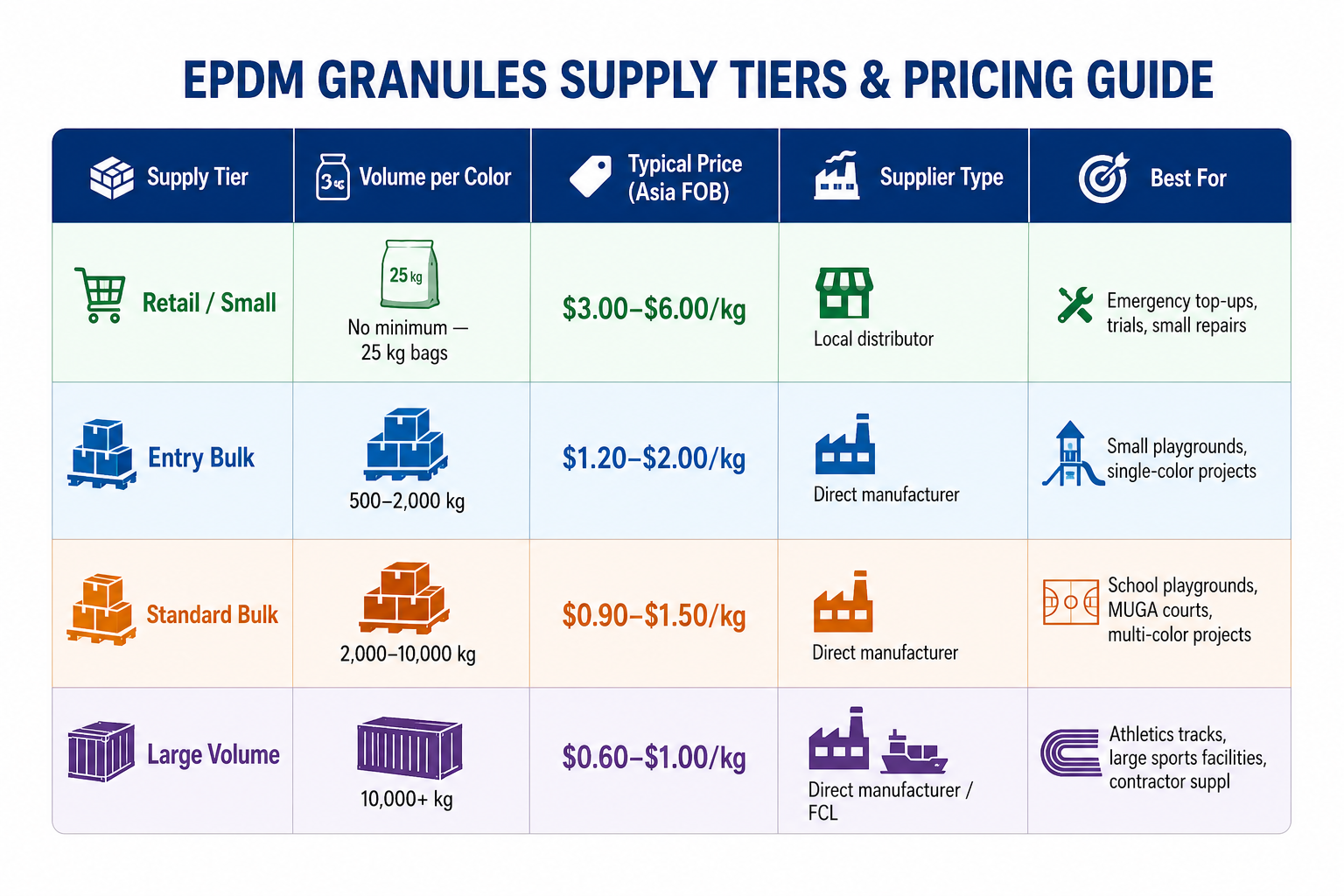
EPDM granule supply divides into four clear tiers based on order volume. Each tier has different pricing, MOQ requirements, and supplier types. Knowing which tier your project falls into is the first step to accurate budgeting.
| Supply Tier | Volume per Color | Typical Price (Asia FOB) | Supplier Type | Best For |
|---|---|---|---|---|
| Retail / Small | No minimum — 25 kg bags | $3.00–$6.00/kg | Local distributor | Emergency top-ups, trials, small repairs |
| Entry Bulk | 500–2,000 kg | $1.20–$2.00/kg | Direct manufacturer | Small playgrounds, single-color projects |
| Standard Bulk | 2,000–10,000 kg | $0.90–$1.50/kg | Direct manufacturer | School playgrounds, MUGA courts, multi-color projects |
| Large Volume | 10,000+ kg | $0.60–$1.00/kg | Direct manufacturer / FCL | Athletics tracks, large sports facilities, contractor supply |
The most common MOQ misunderstanding: manufacturer MOQs apply per color, not per total order. A project requiring 5 colors at 500 kg each = 2,500 kg total order, but each color is still at the 500 kg entry tier. To access better pricing, you need to reach the volume threshold within each individual color — consolidating colors where possible is the most effective way to reduce per-kg cost.
How to Calculate Exactly How Much EPDM You Need
Use this step-by-step calculation process for every project. Running the numbers before contacting suppliers prevents both under-ordering (causing project delays) and over-ordering (wasting budget on excess stock).
Step 1 — Measure your surface area per color zoneBreak your project into individual color zones and measure the area of each in m². For irregular shapes, divide into rectangles and triangles. For multi-color playground designs, your installer’s layout drawing should already show zone areas — request this before calculating quantities. Do not estimate — a 10% error in area measurement translates directly to a 10% error in granule quantity.
Step 2 — Confirm your wear layer depthStandard EPDM wear layer depth is 13mm (0.013m) for most playground and sports applications. Fine finish applications (yoga zones, hospital play areas) may use 10mm. High-traffic or premium installations may specify 15mm. Confirm the exact depth with your installer before calculating — a 2mm difference on a 1,000m² project changes your order by approximately 1,200 kg.
Step 3 — Apply the standard quantity formulaEPDM granule quantity (kg) = Surface area (m²) × Wear layer depth (m) × Bulk density (600 kg/m³) × Waste factor (1.05). Example: 300m² × 0.013m × 600 × 1.05 = 2,457 kg. Use 600 kg/m³ as the standard bulk density for 1–3mm virgin EPDM. For finer 1–2mm granules, use 620 kg/m³. For coarser 2–4mm, use 580 kg/m³.
Step 4 — Calculate PU binder quantity separatelyPU binder quantity (kg) = EPDM granule quantity × binder ratio. Standard ratio is 15% by weight for 1–3mm granules. Example: 2,457 kg × 0.15 = 368 kg binder. Note: binder is ordered and priced separately from granules — always calculate both and include both in your project material budget. Binder cost is typically $3.00–$5.00/kg, adding approximately $0.45–$0.75/kg to your effective granule cost.
Step 5 — Add SBR base layer quantity if applicableIf your project includes a playground SBR base cushion layer, calculate this separately: SBR quantity (kg) = Surface area × Base depth (m) × SBR bulk density (650 kg/m³) × 1.05. SBR base granules are typically sourced separately from EPDM wear layer granules — often from a different supplier at a much lower price ($0.10–$0.40/kg). Do not confuse SBR and EPDM quantities in your budget.
Step 6 — Check each color against MOQ thresholdsOnce you have calculated quantities per color, check each against your target supplier’s MOQ. If any color falls below 500 kg, consider: merging that color zone with an adjacent color to increase area; substituting a standard color used elsewhere in the project; or accepting the higher per-kg retail price for the small-quantity color. Never let a small-quantity color force you to over-order from the wrong supply tier.
Step 7 — Add a 5–10% contingency to your final orderAlways order 5% above your calculated quantity as a minimum contingency — 10% for complex multi-color designs with curved boundaries or irregular shapes. This covers installation waste, minor remixes, and small repairs during the warranty period. Ordering too little and running short mid-installation is a serious project risk — reordering a small quantity from the same production batch is often impossible once that batch is sold out.
Quantity Reference: Common Project Types
The following reference quantities cover the most common EPDM project types. Use these as a starting point before running the exact formula for your specific dimensions.
Primary School Playground
200–500 m²
Typical surface area
- EPDM wear layer: 1,600–4,100 kg
- Colors: 2–4 standard colors
- Supply tier: Entry Bulk (500–2,000 kg/color)
- FOB price range: $1.20–$2.00/kg
- Best source: Direct Asian manufacturer
Secondary School / MUGA
500–1,500 m²
Typical surface area
- EPDM wear layer: 4,100–12,300 kg
- Colors: 3–6 standard colors
- Supply tier: Standard Bulk (2,000–10,000 kg/color)
- FOB price range: $0.90–$1.50/kg
- Best source: Direct Asian manufacturer / FCL
400m Athletics Track
~9,500 m²
Standard track area
- EPDM wear layer: ~77,000 kg
- Colors: 1–2 (dark red dominant)
- Supply tier: Large Volume (10,000+ kg)
- FOB price range: $0.60–$1.00/kg
- Best source: Direct manufacturer, 4× FCL containers
Hotel Pool Surround / Resort
300–800 m²
Typical pool deck area
- EPDM wear layer: 1,900–5,100 kg
- Colors: 1–3 (custom palette likely)
- Supply tier: Entry–Standard Bulk
- FOB price range: $1.20–$2.50/kg (custom color premium)
- Best source: Direct manufacturer with custom color capability
MOQ Red Flags: Mistakes That Cost Buyers Money
| Mistake | What Goes Wrong | How to Avoid It |
|---|---|---|
| Ordering per total project — not per color | Supplier rejects order because individual colors fall below MOQ despite large total | Always calculate and confirm quantity per color before placing order |
| No contingency stock ordered | Installation runs short — reorder from different batch causes color mismatch | Always add 5–10% contingency — store surplus for warranty repairs |
| Ordering exactly at MOQ for custom colors | No surplus for repairs — custom color cannot be reordered in small quantities | Order 15–20% above calculated quantity for custom colors |
| Confusing EPDM and SBR quantities | Budget significantly understated — SBR base layer adds substantial weight | Calculate EPDM wear layer and SBR base layer as separate line items |
| Not accounting for binder in budget | Project material budget undershoots by 15–25% | Always calculate and budget PU binder separately at 15% of granule weight |
| Accepting supplier’s quantity estimate without checking | Supplier over- or under-quotes based on assumptions about your project | Always run the calculation yourself using your actual measured areas |
Frequently Asked Questions
Most manufacturers will not process orders below their stated MOQ for direct factory orders. Your options are: (1) source from a local distributor who sells in smaller quantities at a higher per-kg price; (2) increase your project scope to reach the MOQ — sometimes extending the surfaced area slightly is more cost-effective than paying retail distributor pricing; (3) consolidate with another project or contractor to reach MOQ together; or (4) contact the manufacturer directly — some will accept below-MOQ orders for first-time buyers at a small-order surcharge of 10–20% on the unit price.
No — MOQ applies per color, not per total order. Each color requires its own minimum because each color is a separate production run with dedicated pigment formulation and batch processing. You cannot combine 200 kg of red and 300 kg of blue to meet a 500 kg MOQ — the supplier needs 500 kg of red as a separate batch and 500 kg of blue as a separate batch. The only exception is if the supplier offers a pre-mixed color blend — but this is rare and not recommended for projects requiring specific color accuracy.
Order a 5% contingency minimum for simple single-color projects; 10% for multi-color designs; and 15–20% for custom colors. Store the surplus in a cool, dry location away from direct sunlight. Properly stored EPDM granules remain usable for 2–3 years. The cost of contingency stock is far less than the cost of a color mismatch repair caused by sourcing from a different production batch — which is the inevitable outcome if no surplus is retained.
Custom color MOQ from most Asian manufacturers is 1,000–2,000 kg. This higher threshold reflects the dedicated production setup cost — pigment formulation, batch preparation, and cleaning between colors. European manufacturers typically require 2,000–5,000 kg for custom colors. If your custom color requirement is below 1,000 kg, consider: whether a close standard color can substitute; whether the custom color can be used across multiple projects to reach MOQ; or whether the cost premium for a custom small batch from a European manufacturer is viable for your budget.
Always order slightly too much rather than too little — particularly for custom colors and large projects. The consequences of running short mid-installation are severe: project delays, additional freight costs for emergency resupply, and near-certain color mismatch if the original batch is exhausted. Surplus EPDM granules have real residual value — they can be used for future repairs, future projects, or resold. Running short has no good solution once the original production batch is gone.
Yes — phased ordering is possible for large projects, but requires careful management. If you split an order into two shipments, both shipments must come from the same production batch — batch numbers must match on both Certificates of Analysis. Color consistency cannot be guaranteed across different production batches even with the same color code. Discuss phased delivery explicitly with your supplier before ordering — a reliable manufacturer will reserve stock from a single batch for phased delivery if requested in advance.
Send us your project dimensions, color requirements, and installation timeline — we will provide an accurate quantity calculation, FOB and CIF pricing, and full certification documentation. No commitment required.