

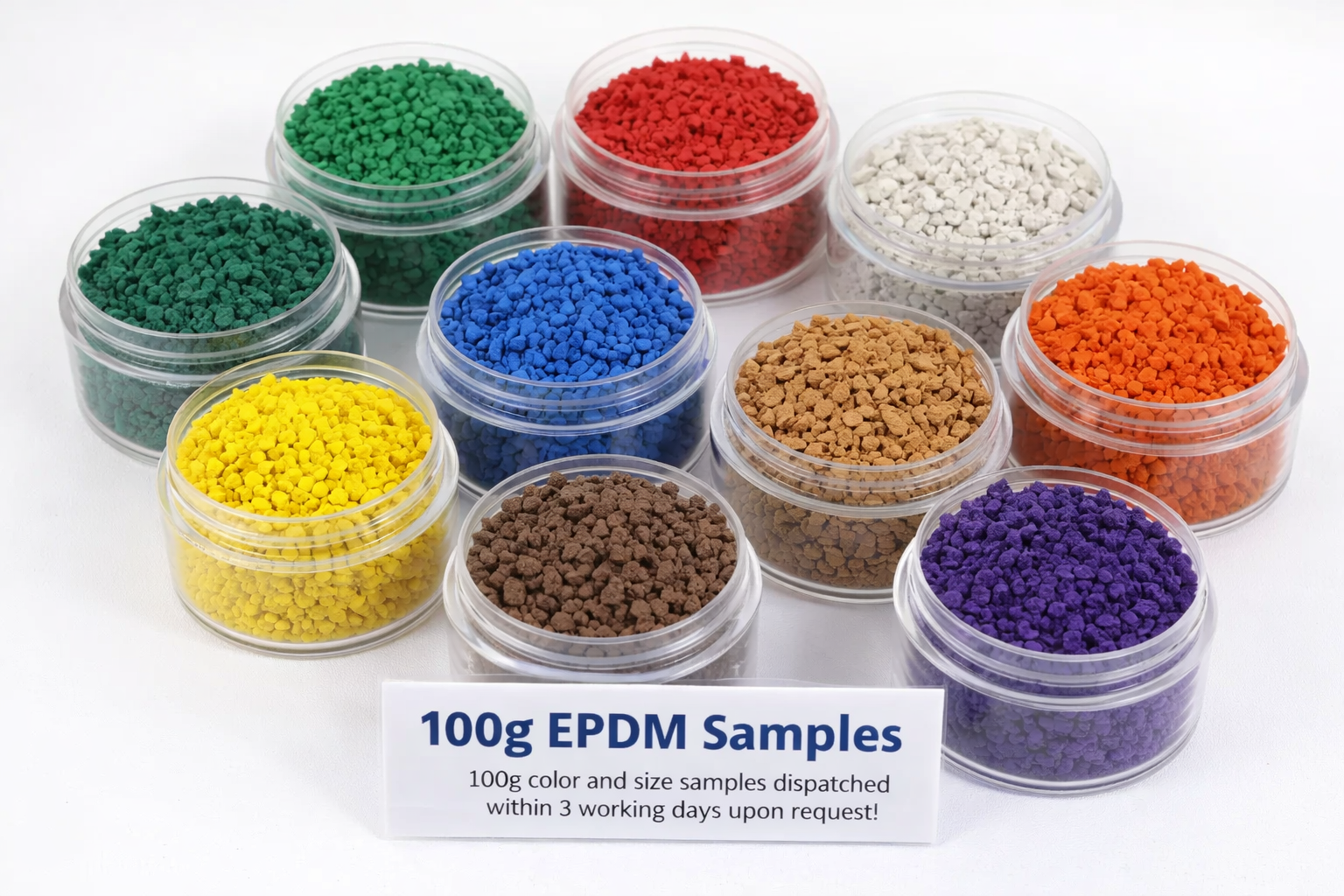
Request samples by specifying your exact color, granule size, and application in writing — then evaluate them against five criteria: color accuracy, size consistency, odor, UV data, and certification documents. Reputable suppliers provide free samples within 5–10 business days. Never commit to a bulk order without completing this process — it is the single most effective way to verify supplier quality before your project budget is at risk.
For the full supplier selection framework and pricing guide, see our EPDM Granules Complete Buyer’s Guide.
What a Good Sample Response Looks Like vs a Red Flag Response
How a supplier responds to your sample request tells you more about their quality and professionalism than any marketing material. Here is the comparison:
| Factor | Professional Supplier | Red Flag Supplier |
|---|---|---|
| Sample availability | Free samples dispatched within 3–5 business days | Charges for samples or takes more than 15 days |
| Sample quantity | 200–500g per color, clearly labelled | Sends unlabelled or mixed-color bags |
| Documentation with sample | TDS, PAH report, REACH declaration included | No documentation — “available later” |
| Color accuracy | Matches color chart within ΔE <3 | Noticeably different from catalog image |
| Granule consistency | Uniform size, no visible impurities | Mixed sizes, dust, or dark specks visible |
| Odor | Mild rubber smell — fades quickly | Strong chemical or solvent odor |
| Response to technical questions | Answers with data — binder ratio, bulk density, UV test results | Vague or deflects to sales pitch |
| Custom color sample | Offers to produce a custom sample at stated MOQ and lead time | Claims custom is possible but cannot give MOQ or timeline |
Step-by-Step: How to Request EPDM Samples Correctly
A well-structured sample request gets you better samples faster — and filters out unqualified suppliers before you waste time on back-and-forth. Follow these steps in order.
The Five-Point Sample Evaluation Framework
Use this framework to assess every sample you receive. Score each criterion pass or fail — a single critical fail should eliminate the supplier from consideration.
Color Accuracy
Visual + ΔE
Compare in natural daylight
- Place on white paper in daylight
- Compare to supplier color chart
- Accept: ΔE <3 from reference
- Reject: visible hue shift or inconsistency within the sample bag
- Critical fail: mixed colors in single bag
Granule Size Consistency
Sieve Test
Verify stated size range
- Run simple sieve through stated range
- Accept: ≥90% within stated range
- Check for excess dust (fines below 1mm)
- Check for oversize particles (above max)
- Critical fail: <80% within range
Odor Assessment
Sensory
Open bag and assess immediately
- Accept: mild rubber smell, fades in minutes
- Caution: moderate chemical smell — request VOC data
- Reject: strong solvent, petroleum, or persistent chemical odor
- Strong odor may indicate high solvent binder content or non-virgin polymer
- Critical fail: pungent, persistent chemical smell
Visual Purity
Visual Inspection
Spread thin layer on white paper
- Accept: uniform color, consistent shape
- Check for black or dark specks (SBR contamination indicator)
- Check for irregular or angular particles (processing defect)
- Check for clumping (moisture or premature binder activation)
- Critical fail: visible dark specks throughout sample
Documentation Completeness
Document Check
Verify all four documents
- TDS with granule size, bulk density, hardness data
- PAH test report — color specific, accredited lab
- REACH SVHC Declaration — current date
- Material composition certificate — virgin EPDM confirmed
- Critical fail: any of the four documents missing
Red Flags: When to Reject a Sample or Supplier
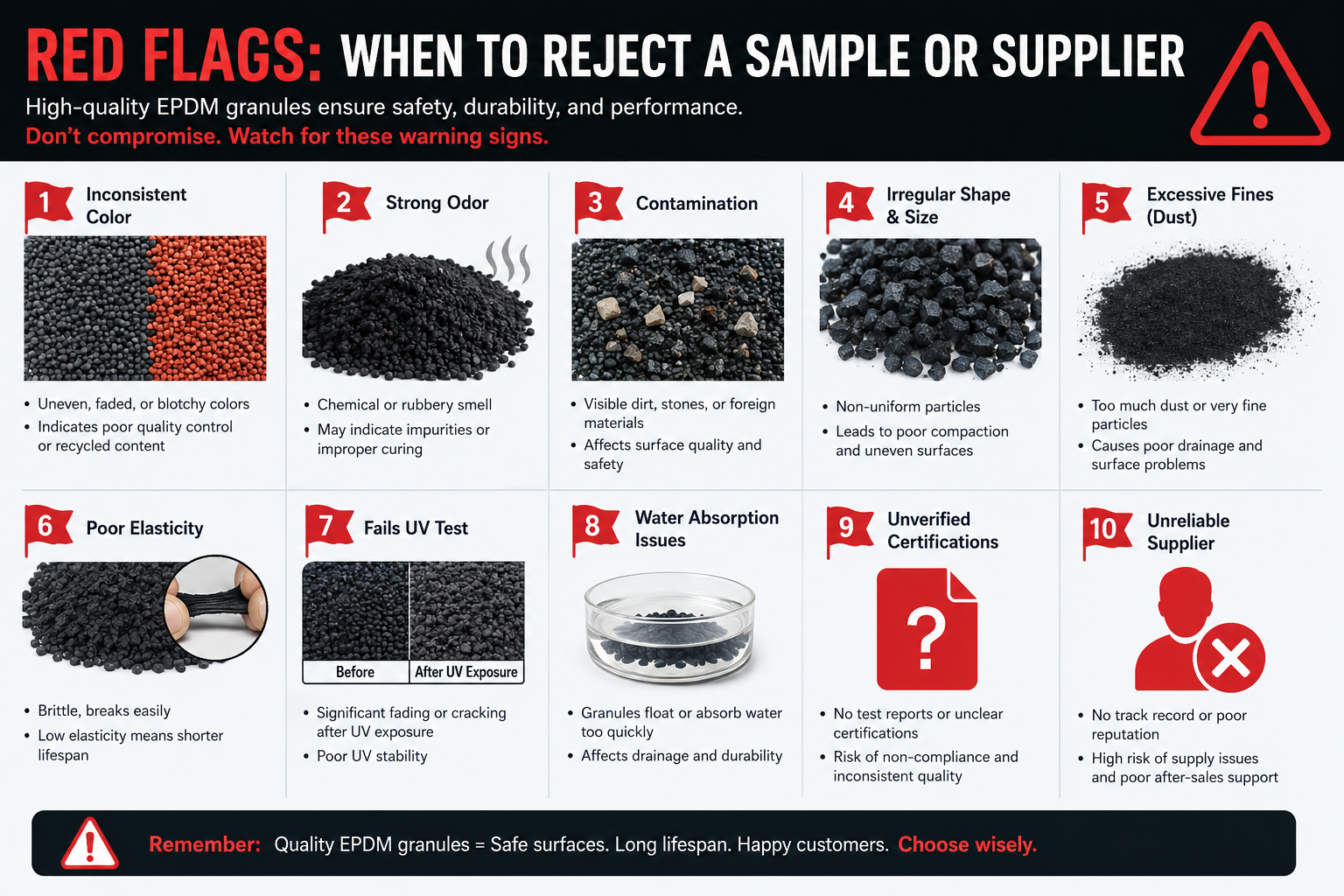
Some red flags discovered during the sample evaluation process are recoverable — the supplier can be given a chance to resend or clarify. Others are immediate disqualifiers. Know the difference before you invest more time.
| Red Flag | Severity | Action |
|---|---|---|
| Sample color significantly different from catalog | Medium | Request a re-send with corrected color — allow one retry |
| Dark specks or visible SBR contamination in sample | Critical | Disqualify supplier — indicates blended or contaminated product |
| Strong, persistent chemical odor | Critical | Request VOC emission test data — if unavailable, disqualify |
| PAH report missing or from unaccredited lab | Critical | Do not proceed — no accredited PAH report means no compliance verification |
| Granule size distribution fails sieve test (<80% in range) | Critical | Disqualify — out-of-spec sizing causes surface installation failures |
| Supplier cannot confirm bulk will match sample | Critical | Do not order — no quality assurance mechanism for the bulk shipment |
| Sample arrives with no labelling | Medium | Request re-labelled sample — poor packaging reflects quality control standards |
| Supplier charges for standard color samples | Low–Medium | Acceptable for custom colors — red flag for standard colors where all credible suppliers provide free samples |
The most common cause of costly EPDM procurement failures — wrong color, out-of-spec sizing, early fading, chemical safety issues — is skipping or rushing the sample evaluation process. Even for urgent projects, the 1–2 weeks spent on proper sample evaluation is a fraction of the cost of a failed installation. No sample, no order.
Frequently Asked Questions
Request 200–500g per color as a standard sample quantity. This is enough to conduct a sieve test (50–100g), a visual assessment, an odor check, and still have material remaining for client presentation or installer review. For projects requiring client color approval, request 500g — enough to present a meaningful visual sample. Avoid accepting samples smaller than 100g — they are insufficient for meaningful quality evaluation.
For standard colors: no. All credible EPDM granule manufacturers provide free standard color samples — the material cost is negligible and the commercial value of a sample to a serious buyer is clear. If a supplier charges for standard color samples, treat it as a signal of either a very small operation or a non-manufacturer trading company. For custom colors: a small charge of $30–$80 for custom sample production is reasonable and standard — this covers the dedicated pigment formulation and small production run.
From Asian manufacturers: 7–15 business days by international courier (DHL, FedEx, UPS). Expedited shipping is available for urgent projects — ask the supplier to use express courier and share the tracking number. From European manufacturers: 3–7 business days. If a supplier cannot confirm dispatch within 5 business days of your request, follow up once — if still no movement, move to the next supplier on your list. Slow sample response is a reliable predictor of slow order fulfilment.
PAH testing requires GC-MS (Gas Chromatography-Mass Spectrometry) laboratory analysis — it cannot be done with visual inspection, odor assessment, or any field test kit. If you have concerns about a supplier’s PAH certification, you can submit a sample to an accredited third-party laboratory for independent testing. Cost is typically $150–$400 per sample for a full 18-PAH panel. Labs accredited under ISO/IEC 17025 in your region can be found through your national accreditation body’s website (UKAS in UK, DAkkS in Germany, CNAS in China, A2LA in USA).
If standard colors from multiple suppliers do not match your requirement, you have two options: (1) Custom color production — provide your Pantone or RAL reference, confirm MOQ (typically 1,000–2,000 kg) and lead time (standard production + 2–4 weeks formulation). Request a custom color sample before committing to full production. (2) Re-evaluate the color requirement — review whether the project specification allows for the nearest standard color equivalent, which saves cost and lead time. For most projects, a standard color that is close is preferable to a custom color that adds $0.40–$0.80/kg and 3–4 weeks to the timeline.
For first-time EPDM procurement: sample 3–4 suppliers in parallel. This gives you a meaningful comparison baseline, reveals the real range of quality in the market, and ensures you have a viable backup if your first-choice supplier fails at trial order stage. For repeat procurement where you have an established supplier relationship: one supplier is sufficient unless you are testing a new color or have concerns about quality consistency. Do not sample more than 5–6 suppliers — beyond this, decision fatigue sets in and the marginal quality information decreases.
Tell us your required colors, granule size, and application — we will dispatch physical samples within 5 business days, with full TDS, PAH test reports, REACH declaration, and material composition certificate included.