

EPDM granules are available in 20–100+ colors — but not all colors perform equally under UV exposure. Darker colors last longer; whites and light pastels fade fastest. This guide covers the full color range, UV stability by color family, how to read QUV test data, and how to choose the right color for your climate and application.
Standard colors available
from leading suppliers
Acceptable color change
after 1,000hrs QUV
Minimum order for
custom color production
The most UV-stable EPDM colors are black, dark green, dark red, and dark blue — these use carbon black or iron oxide pigments that resist fading for 15+ years. The least stable are white, light beige, and bright yellow. For any outdoor installation, always request a QUV accelerated weathering test report showing delta E values per color before ordering.
For full supplier selection guidance and specifications, see our EPDM Granules Complete Buyer’s Guide.
Why Color Choice Matters Beyond Aesthetics
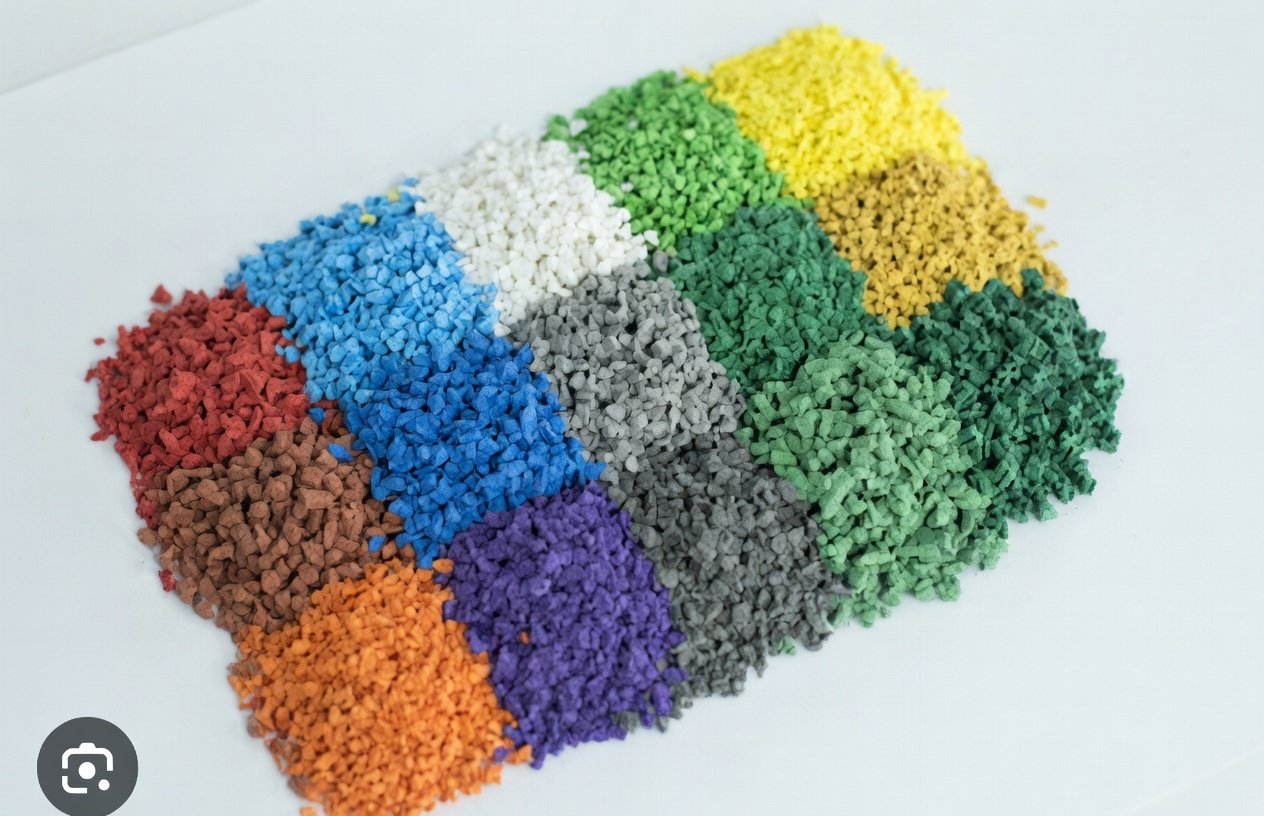
Color selection in EPDM granules is not purely an aesthetic decision — it directly affects UV durability, surface temperature, maintenance visibility, and long-term project cost. A color that looks vibrant on day one but fades visibly within 3–4 years creates a poor impression of the facility and may require earlier-than-expected resurfacing.
The key factor is pigment chemistry. Different colors use fundamentally different pigment types, and these pigment types have very different resistance to UV radiation, ozone, and thermal cycling. Understanding this chemistry helps you specify colors that perform well in your specific climate and application.
UV Stability by Color Family
| Color Family | Pigment Type | UV Stability Rating | Expected Fade (10 yrs outdoor) | Best For |
|---|---|---|---|---|
| Black | Carbon black | ⭐⭐⭐⭐⭐ Excellent | Minimal — nearly none | Running tracks, industrial |
| Dark Green | Chrome oxide / iron oxide | ⭐⭐⭐⭐⭐ Excellent | Very low — slight darkening | Sports courts, landscaping |
| Dark Red / Terracotta | Iron oxide red | ⭐⭐⭐⭐⭐ Excellent | Very low — slight dulling | Running tracks, MUGA |
| Dark Blue | Ultramarine / phthalocyanine | ⭐⭐⭐⭐ Very Good | Low — slight fading at edges | Indoor tracks, sports courts |
| Standard Red | Iron oxide / organic red | ⭐⭐⭐⭐ Very Good | Low–moderate | Playgrounds, MUGA |
| Standard Blue | Phthalocyanine blue | ⭐⭐⭐⭐ Very Good | Low–moderate | Playgrounds, sports courts |
| Standard Green | Phthalocyanine green | ⭐⭐⭐⭐ Very Good | Low–moderate | Playgrounds, landscaping |
| Orange | Organic orange | ⭐⭐⭐ Good | Moderate — noticeable within 5–7 yrs | Playgrounds |
| Purple | Organic violet / dioxazine | ⭐⭐⭐ Good | Moderate — shifts toward blue-grey | Playgrounds (accent) |
| Bright Yellow | Organic yellow / azo | ⭐⭐ Fair | Moderate–high — fades to pale | Playground accents only |
| White / Light Grey | Titanium dioxide | ⭐⭐ Fair | High — yellowing and chalking | Indoor use preferred |
| Light Beige / Cream | TiO₂ + iron oxide blend | ⭐⭐ Fair | Moderate–high — colour shift | Landscaping (low UV sites) |
| Pink / Light Pink | Organic red + TiO₂ | ⭐⭐ Fair | High — fades to pale peach | Indoor / low traffic only |
How to Read a QUV UV Stability Test Report
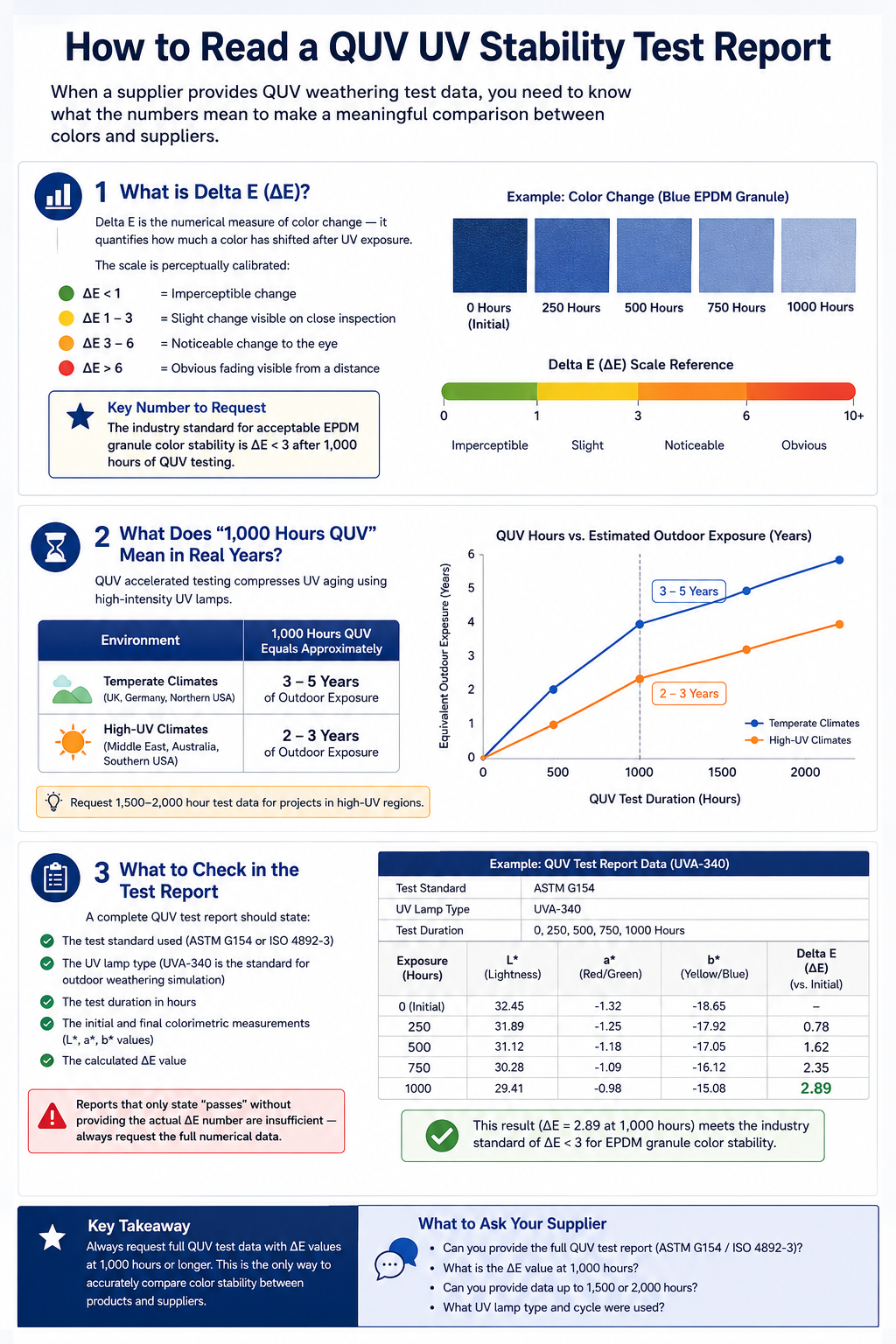
When a supplier provides QUV weathering test data, you need to know what the numbers mean to make a meaningful comparison between colors and suppliers.
Delta E is the numerical measure of color change — it quantifies how much a color has shifted after UV exposure. The scale is perceptually calibrated: ΔE <1 = imperceptible change; ΔE 1–3 = slight change visible on close inspection; ΔE 3–6 = noticeable change to the eye; ΔE >6 = obvious fading visible from a distance. The industry standard for acceptable EPDM granule color stability is ΔE <3 after 1,000 hours of QUV testing.
Key Number to Request
QUV accelerated testing compresses UV aging using high-intensity UV lamps. Approximately 1,000 hours of QUV testing corresponds to 3–5 years of outdoor exposure in temperate climates (UK, Germany, Northern USA). For high-UV environments (Middle East, Australia, Southern USA), 1,000 QUV hours roughly equates to 2–3 years of outdoor exposure. Request 1,500–2,000 hour test data for projects in high-UV regions.
Context for Interpretation
A complete QUV test report should state: the test standard used (ASTM G154 or ISO 4892-3); the UV lamp type (UVA-340 is the standard for outdoor weathering simulation); the test duration in hours; the initial and final colorimetric measurements (L*, a*, b* values); and the calculated ΔE value. Reports that only state “passes” without providing the actual ΔE number are insufficient — always request the full numerical data.
Request Full Data
Color Recommendations by Application
| Application | Recommended Colors | Avoid | Reason |
|---|---|---|---|
| School Playground | Red, Blue, Green, Yellow, Orange | White, Light Pink | Vibrant colors for play zones; avoid low-stability lights |
| Public Park Playground | Red, Green, Blue, Dark Red | White, Bright Yellow (wear layer) | High traffic — prioritise durability over novelty colors |
| Running Track (outdoor) | Dark Red / Terracotta, Dark Blue | Bright colors, White | Global standard colors; iron oxide pigments most durable |
| MUGA Sports Court | Green, Blue, Red, Dark Grey | White, Yellow (as base) | Sport-standard colors; line marking clarity required |
| Indoor Gym | Any — Black, Grey, Dark Green popular | No restrictions indoors | No UV exposure — color choice is purely aesthetic |
| Landscaping (high UV) | Dark Green, Brown, Terracotta, Charcoal | White, Bright Yellow, Light Beige | Earth tones use iron oxide pigments — most UV resistant |
| Hospital / Sensory Play | Calm blues, greens, soft reds | Bright contrasting combinations | Therapeutic environment — avoid visual overstimulation |
Surface Temperature by Color: The Heat Factor
Color also affects how hot the EPDM surface gets in direct sunlight — a practical safety consideration for children’s barefoot play areas and a maintenance factor for all surfaces.
| Color | Approx. Surface Temp (30°C air, direct sun) | Barefoot Safety |
|---|---|---|
| Black | 65–75°C | 🚩 Not recommended for barefoot areas |
| Dark Red / Dark Green | 55–65°C | ⚠ Caution in extreme heat climates |
| Standard Red / Blue / Green | 50–60°C | ⚠ Monitor in high-UV climates |
| Yellow / Orange | 45–55°C | ✅ Generally acceptable |
| White / Light Beige | 35–45°C | ✅ Coolest option — best for hot climates |
For playgrounds in the Middle East, North Africa, or Southern Asia where summer air temperatures regularly exceed 35°C, consider specifying lighter standard colors (reds, blues, greens rather than black or dark green) for the wear layer to keep surface temperatures at safer levels for barefoot play. Some projects use white or light beige borders around play equipment for this reason, accepting the UV stability trade-off.
Custom Colors: What You Need to Know
Custom colors are justified when your project requires a specific brand color (school colors, corporate identity, sports club livery), a Pantone-matched shade not available in the standard range, or a unique design that differentiates the facility. For most playground and sports surface projects, the 20–40 standard colors available from major suppliers cover all practical needs.
Consider Carefully
Custom color production requires a dedicated formulation run — typically adding $0.30–$0.80/kg to standard color pricing and 2–4 weeks of additional lead time. Minimum order quantities are higher, typically 1,000–2,000 kg per custom color. Once formulated, reorders of the same custom color are faster and cheaper — the supplier retains the formulation record.
Higher Cost + Lead Time
Custom colors may not have the same UV stability track record as standard colors. A reputable supplier will conduct QUV testing on any new custom formulation before production — request this test data before confirming the custom color order. Be particularly cautious with custom light colors and custom pastels, which are inherently harder to stabilise against UV fading.
Request QUV Data First
Multi-Color Playground Design: Practical Guidelines
Multi-color playground designs are popular for schools, public parks, and themed play areas. Here are the practical guidelines for specifying them correctly:
Mixing granules from different suppliers or production batches introduces color inconsistency at boundaries. Even nominally identical colors from different manufacturers can differ visibly. For multi-color designs, order all colors from the same supplier in the same order wherever possible.
Digital color charts and on-screen representations cannot accurately show how EPDM granule colors look in natural light. Always request physical samples of all colors in your design and review them together outdoors in natural daylight before confirming the specification.
If you mix a very UV-stable color (dark red, iron oxide) with a less stable color (bright yellow, organic pigment) in the same design, the differential fading over time will make the design look increasingly mismatched. Choose colors from the same UV stability tier — or accept that less stable colors will need refreshing more often.
Color boundaries in wet-pour EPDM require careful installation technique to achieve clean lines. Discuss boundary detailing with your installer — straight lines are achieved using temporary edge formers, while curved designs require skilled hand-cutting. Poor boundary work significantly reduces the visual quality of multi-color installations.
Frequently Asked Questions
Summary: Choosing the Right EPDM Color for Your Project
Color selection is both a visual and a technical decision. The right color for your project depends on your application, climate, traffic level, and maintenance expectations. Getting it right at specification stage avoids premature fading, unexpected resurfacing costs, and disappointed clients.
Article #10 · Series: best EPDM granules supplier · ← Back to Pillar Guide
Request Free EPDM Color Samples & UV Stability Data
We supply 50+ standard colors with full QUV test reports (ΔE values per color), physical sample packs, and competitive FOB pricing. Custom colors available from 1,000kg.