

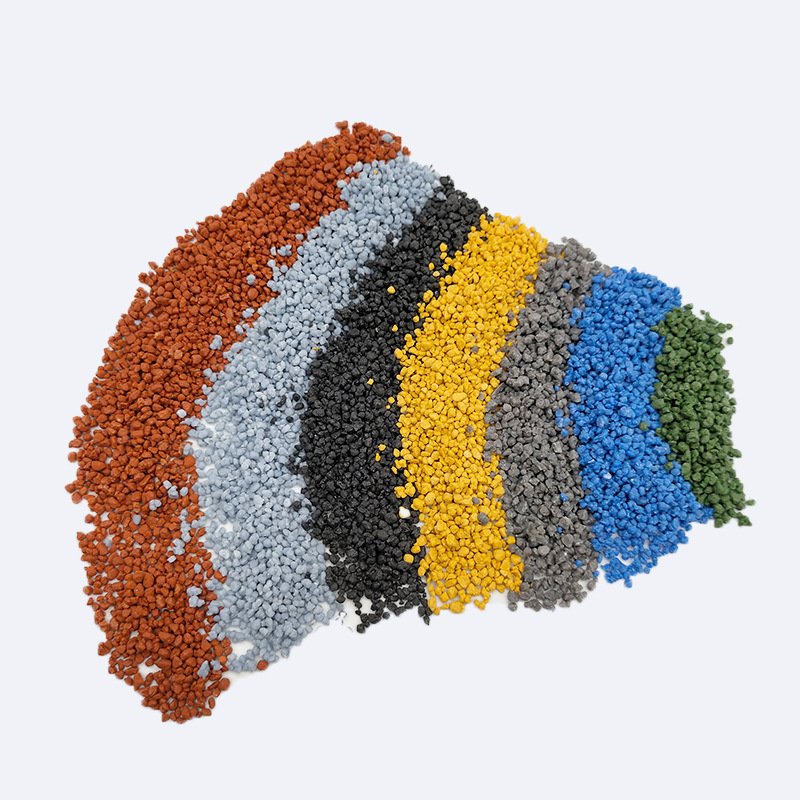
A correctly specified and installed EPDM granule surface lasts 10–20 years outdoors. But lifespan varies significantly based on granule quality, UV exposure, foot traffic, binder ratio, and maintenance routine. This guide explains exactly what determines longevity — and what you can do to maximise it.
Years expected lifespan
for quality installation
QUV test hours for
UV resistance standard
Recommended maintenance
frequency for longevity
Virgin EPDM granule surfaces typically last 10–15 years under normal conditions, with well-maintained premium installations reaching 15–20 years. The main factors that shorten lifespan are low-quality granules (recycled blends), inadequate binder ratio, poor substrate preparation, extreme UV environments, and neglected maintenance. With the right specification and annual care, 15 years is a realistic target for most outdoor installations.
For full supplier selection guidance and specifications, see our EPDM Granules Complete Buyer’s Guide.
What Determines How Long EPDM Granules Last?
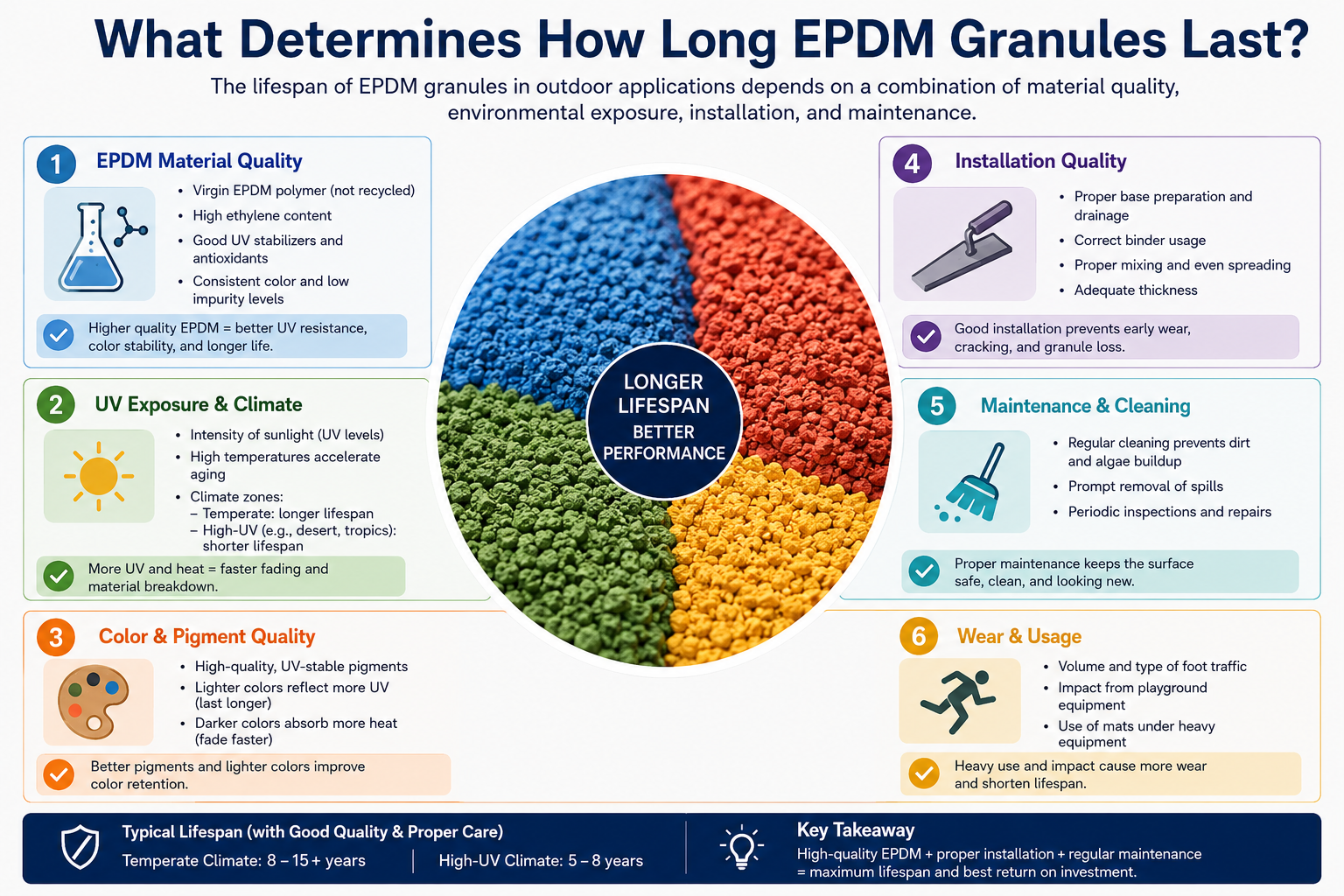
Lifespan is not determined by a single factor — it is the product of several variables acting together. Understanding each one helps you make specification and maintenance decisions that extend surface life.
This is the single biggest lifespan variable. Virgin EPDM granules contain 100% fresh polymer with colorfast integral pigment — engineered specifically for outdoor durability. Recycled-blend products mix in SBR or lower-grade polymer, which ages faster, fades earlier, and becomes brittle more quickly. Installations using genuine virgin EPDM consistently outperform blended products by 3–7 years in the same environment.
Highest Impact Factor
UV radiation is the primary degradation mechanism for outdoor rubber surfaces. Installations in high-UV environments — Middle East, South Asia, equatorial regions, high-altitude sites — age faster than those in temperate Northern European climates. A surface that lasts 15 years in the UK may need resurfacing at 10–12 years in Dubai. For high-UV regions, always specify granules with QUV test results of 1,000+ hours and request UV stabiliser content data from your supplier.
High Impact
The polyurethane binder holds the granules together and largely determines whether the surface stays intact or begins to crumble, crack, or delaminate. Underbinding below 12% leaves granules poorly bonded — the surface begins shedding within 2–3 years. Overbinding above 20% creates a rigid surface that cracks under thermal expansion. The correct ratio of 14–16% by weight gives the optimal balance of bond strength and flexibility for long-term durability.
High Impact
A lightly used residential garden path will outlast a high-traffic school playground by 5–8 years with identical materials. Spike-soled footwear accelerates surface wear. Heavy wheeled equipment causes localised compression damage. High-traffic installations should specify a slightly thicker wear layer (15mm instead of 12mm) and use a higher-grade PU binder to extend service life.
Medium–High Impact
EPDM wet-pour surfaces are only as durable as the substrate beneath them. A poorly prepared or unstable base — cracked asphalt, inadequate drainage falls, frost-heave susceptible ground — causes the surface layer to crack, lift, and delaminate within a few years regardless of granule quality. Proper substrate preparation is a prerequisite for achieving the expected 10–20 year lifespan.
Medium–High Impact
Annual cleaning and minor crack repair significantly extend surface life. Organic debris retains moisture against the surface and accelerates polymer degradation. Small cracks left unrepaired allow water infiltration, which expands during freeze-thaw cycles and rapidly enlarges the damage. Surfaces with regular maintenance routinely reach 15+ years; neglected surfaces often require full replacement at 7–8 years.
Medium Impact
Expected Lifespan by Application and Environment
| Application | Traffic Level | Climate | Expected Lifespan |
|---|---|---|---|
| School Playground | High | Temperate (Europe/UK) | 10–15 years |
| Public Park Playground | Medium–High | Temperate | 12–18 years |
| Residential Garden | Low | Temperate | 15–20+ years |
| Running Track (sandwich) | High | Temperate | 10–15 years |
| MUGA Sports Court | High | Temperate | 10–14 years |
| Indoor Gym Flooring | High | Indoor (no UV) | 15–25 years |
| Playground (Middle East / High UV) | Medium | High UV, extreme heat | 7–12 years |
| Landscaping / Decorative | Low–Medium | Any | 12–20 years |
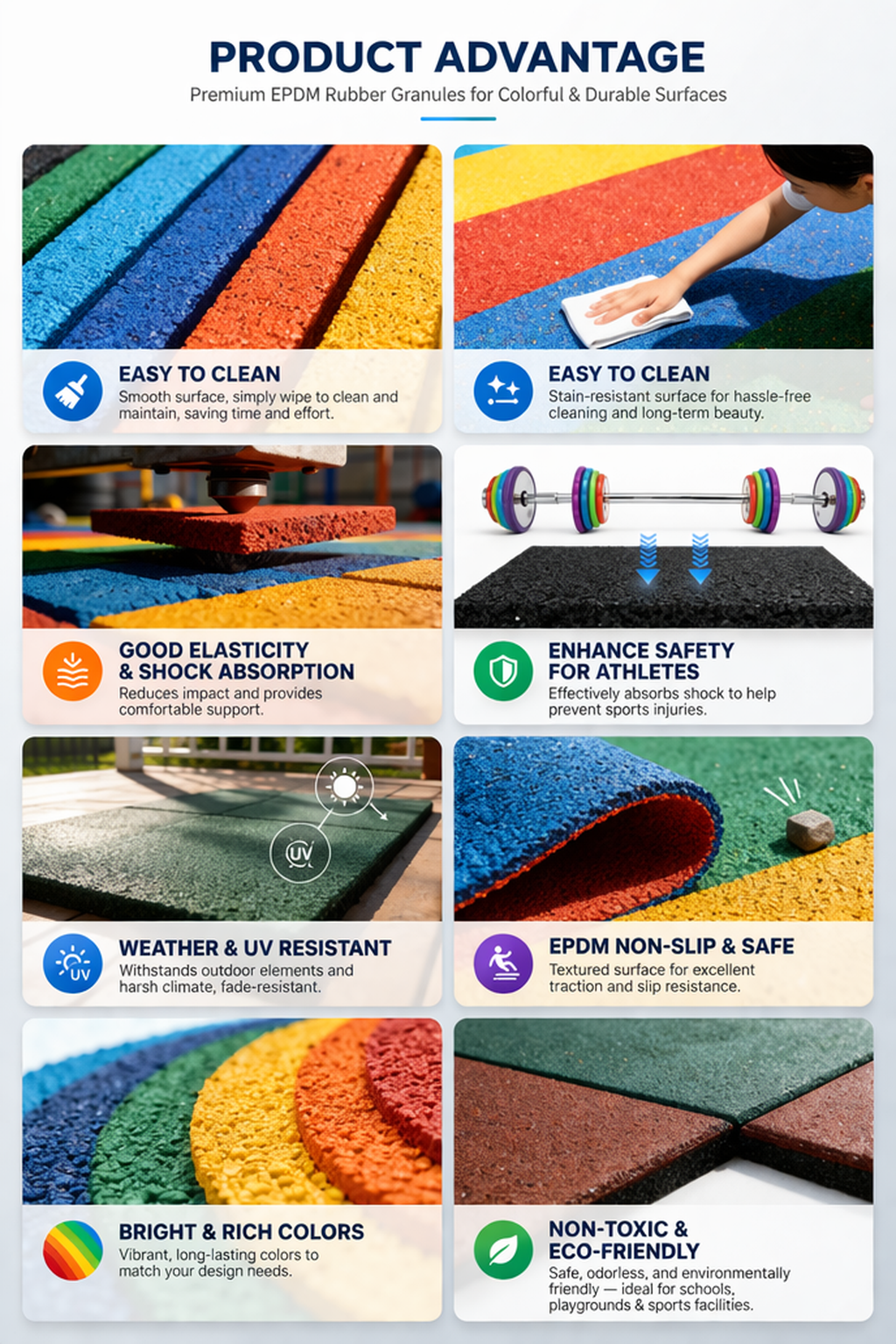
Indoor EPDM surfaces last significantly longer than outdoor installations because UV degradation is eliminated. The primary indoor wear mechanism is mechanical abrasion — much slower than UV-driven polymer breakdown. Indoor EPDM surfaces routinely exceed 20 years with proper maintenance.
Signs Your EPDM Surface Is Reaching End of Life
| Sign | What It Indicates | Action Required |
|---|---|---|
| Colour fading | UV pigment degradation — age or quality issue | Monitor; plan resurfacing |
| Granule shedding | PU binder failure — underbinding or binder aging | Repair or resurfacing |
| Surface cracking | Thermal stress, substrate movement, or binder aging | Crack repair if minor; resurfacing if widespread |
| Edge delamination | Substrate movement or drainage failure | Fix substrate + relay affected sections |
| Algae / moss growth | Drainage or maintenance neglect | Deep clean + biocide + improve drainage |
| Surface hardening | Polymer embrittlement from advanced UV aging | EN 1177 re-test; plan resurfacing |
| EN 1177 CFH failure | Safety standard no longer met | Immediate resurfacing — do not delay |
Annual Maintenance Routine to Maximise Lifespan
Pressure wash the entire surface to remove winter debris, algae, and organic material using a mild pH-neutral cleaner. Avoid acid or alkaline cleaners that can degrade the PU binder. After cleaning, conduct a full visual inspection for cracks, delaminating edges, and granule loss. Document findings with photographs for your maintenance record.
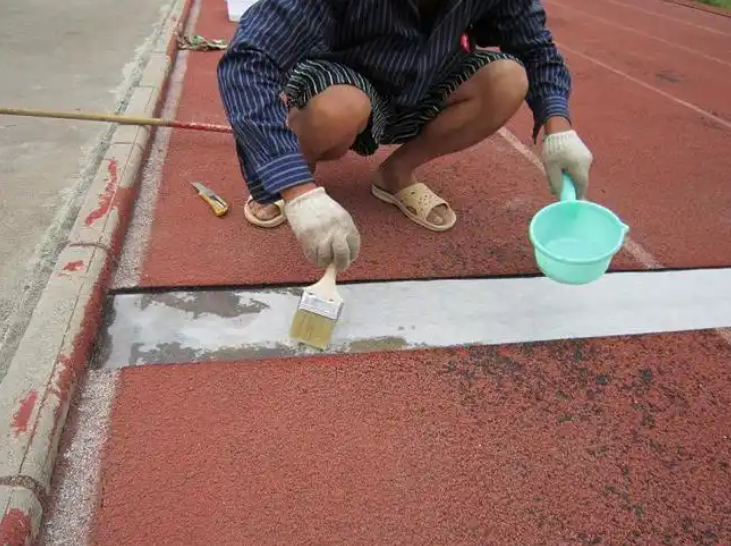
Address any cracks identified during the spring inspection while the surface is dry and warm. Small cracks under 3mm can be filled with EPDM-compatible PU sealant. Larger cracks or delaminating sections should be cut out and re-poured with matching granule material. Summer installation ensures proper binder cure before the following winter.
Ensure surface drainage channels and perimeter drains are clear before winter rainfall. Clear leaf accumulation regularly — it traps moisture against the surface and promotes algae growth. Apply a biocide treatment if algae or moss is present to prevent re-establishment over winter.
For playground surfaces, commission an EN 1177 impact attenuation re-test to confirm the surface still meets the required Critical Fall Height. This provides documented safety evidence and protects the site owner from liability. Some insurers require this documentation as a condition of public liability cover.
Virgin vs Blended EPDM: The Lifespan Difference
✅ UV stabilisers fully active — consistent with QUV test data
✅ Integral pigment throughout — colour stable for 10–15 years
✅ Consistent polymer quality — predictable aging behaviour
✅ Tensile strength maintained throughout design life
✅ 10–20 year lifespan achievable with proper maintenance
⚠ Variable UV stabiliser content — may fade within 3–5 years
⚠ Weaker integral colour — earlier visible fading
⚠ Inconsistent polymer quality — unpredictable aging
⚠ Earlier embrittlement and granule shedding
⚠ Realistic lifespan 5–10 years — 30–50% shorter than virgin
Frequently Asked Questions
Summary: Maximising Your EPDM Surface Lifespan
Ten to twenty years is achievable — but only when the right materials, installation, and maintenance decisions are made from the start. The most common cause of premature surface failure is poor specification at the procurement stage, not wear or UV alone.
Article #9 · Series: best EPDM granules supplier · ← Back to Pillar Guide
Source Long-Lasting Virgin EPDM Granules
We supply 100% virgin EPDM granules with full UV stability data, EN 1177 certification, and material composition documentation. Built for 15+ year outdoor performance.