

Most schools and clubs do not set out to build a running track that hurts athletes or fades within three years. They want better training conditions, lower injury rates, and a surface that looks professional. Yet the conversation almost always starts with the same mistake: the track is treated as a painted line system rather than a high-performance training surface.
The Pattern We See Over and Over
When a school or sports club decides to upgrade its running track, the visible items dominate the budget discussion: the lane markings, the drainage, the fencing, the timing system. The surface itself is frequently reduced to “whatever is cheapest and looks red.”
By the time the contract is signed, the floor decision has usually been narrowed to one of three common options:
– recycled SBR rubber mixed with a cheap binder
– existing asphalt left with a thin paint coating
– low-grade coloured granules that fade and harden within two seasons
All three look acceptable in the brochure. All three fail the actual job a running track is supposed to do.
What Actually Goes Wrong
For the Athlete
Every stride on a track generates forces several times body weight. The surface either absorbs part of that impact or sends it straight back into the joints.
A hard, low-quality surface produces excessive vibration and inconsistent energy return. Athletes develop shin splints, knee pain, and compensatory running form. A soft, poorly compacted recycled rubber surface does the opposite: it feels spongy, drains energy, and forces runners to over-stride.
Neither surface is honest. Both teach movement patterns that only work on that particular track.
For Long-Term Performance
UV exposure, temperature cycles, and daily use quickly reveal the difference between virgin EPDM and cheaper alternatives. Colours fade, granules loosen, and the surface becomes slippery when wet. Clubs then spend money on annual repairs that never fully restore the original performance.
The Four Surfaces That Quietly Undermine Most Tracks
| Surface | What the Athlete Feels | What Happens Over Time | Long-term Reality | Verdict |
|---|---|---|---|---|
| Recycled SBR rubber | Inconsistent bounce, often too soft or too hard | Rapid colour fade and granule loss | Looks permanent until the surface starts shedding | Avoid for competition or high-use training |
| Painted asphalt | Very hard, high impact return | Cracks and becomes slippery when wet | Requires constant patching | Worst common option for athletes |
| Low-grade coloured granules | Acceptable at first, then becomes hard and dusty | UV degradation within 2–3 years | Looks good on day one, disappointing by year three | False economy |
| 100% virgin EPDM granules | Consistent, medium-firm, shock-absorbing | Excellent UV and weather resistance | 8–12 years outdoor life with proper installation | Recommended for schools and clubs |
The first three options are chosen because they feel cheaper on the initial quote. The fourth option is chosen when a school or club finally treats the track surface as training equipment rather than a decorative layer.
Why the Wrong Surface Keeps Getting Chosen
Three practical reasons keep repeating:
1. **Budget timing.** The structural and marking works are approved first. By the time the surface material is discussed, the remaining money feels tight.
2. **Visibility bias.** Committees can see the lines and the fences. They cannot easily see the difference between virgin EPDM and recycled rubber underfoot until athletes start complaining.
3. **Assumption that “any red surface is fine.”** This is the most damaging one. A running track is not just a coloured path. It is the primary training environment for most athletes throughout the year.
Once the wrong surface is down, the cost of fixing it later is higher. You are now dealing with partial removal, re-priming, and disruption to the school or club calendar.
What a Proper Running Track Surface Needs to Deliver
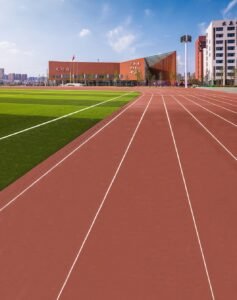
A good school or club track surface has three non-negotiable jobs:
– Provide consistent energy return and shock absorption that protects joints while still feeling responsive
– Maintain colour and structural integrity under UV, rain, frost, and heavy use
– Allow section repair or resurfacing without full reconstruction
100% virgin EPDM granules (typically 1–3 mm) bound into a 13 mm wear layer over a suitable base meet all three at a cost most schools and clubs can absorb within a realistic project budget.
Standard granule size for athletic tracks
Recommended wear layer thickness
Expected outdoor service life with proper care
- Material: 100% virgin EPDM polymer with UV-stable pigments — never recycled tyre rubber for the wear layer.
- Colour: Dark red / terracotta remains the most stable and traditional choice for athletics.
- Base: Properly prepared asphalt or concrete with correct drainage and crack repair.
- Binder: High-quality polyurethane binder formulated for outdoor sports surfaces.
- Certification: CE, SGS, ISO 9001, REACH and PAH compliance as minimum standards.
The Cost Reality Most Committees Miss
A typical 400 m school track requires several tonnes of high-quality EPDM granules. When ordered direct from a manufacturer with stable production capacity, the material cost is significantly lower than many local quotes that include multiple mark-ups.
Compare that figure to:
– the annual cost of repairing a fading or shedding surface
– physiotherapy and lost training time caused by hard or inconsistent tracks
– the lost development value of athletes training on a surface that does not prepare them for competition
The “cheap” track surface is rarely the economical one once you look past the initial invoice.
The facilities that contact us after the track is already built almost always say the same thing: they wish the surface material had been specified properly at the planning stage. Retrofitting is still possible and still worthwhile, but it is more disruptive and more expensive than getting the specification right before the first binder is poured.
What It Comes Down To
Most schools and clubs do not build disappointing running tracks because they don’t care. They build them because the surface is treated as a finishing layer instead of the most important piece of training equipment on the site.
The markings, the fencing, and the drainage matter. But the surface under every footstrike decides how every athlete feels at the end of a session and how the facility performs five years later. Get that wrong and the rest of the investment under-delivers.
The fix is not exotic or prohibitively expensive. It is simply deciding that the track surface belongs in the same conversation as the structural works — before the order is placed.
If you are planning a new track or already living with a surface that feels hard, inconsistent, or is starting to fade, start with samples. Feel the difference. That short practical step prevents the most common and most expensive mistake facilities make with athletic tracks.
Full specifications, current pricing, and free samples: jflysports.com/contact-us
Free Samples for Your Track Surface Decision
We supply 100% virgin EPDM granules in the full athletics colour range (including traditional dark red), multiple particle sizes, and complete technical documentation. Free samples dispatched within 5 business days. No minimum order for samples.