

Most manufacturers accept a minimum of 50–200m² per color and thickness for standard EPDM interlocking tiles. For projects below 50m², local distributors are more practical. For projects above 300m², direct manufacturer import from Asia delivers the best per-m² cost. Understanding the MOQ, container economics, and import duty structure before requesting quotes prevents the most common budget surprises in tile procurement.
For the complete buyer’s guide, see our EPDM Interlocking Rubber Tiles Complete Buyer’s Guide.
MOQ and Supply Tier Overview
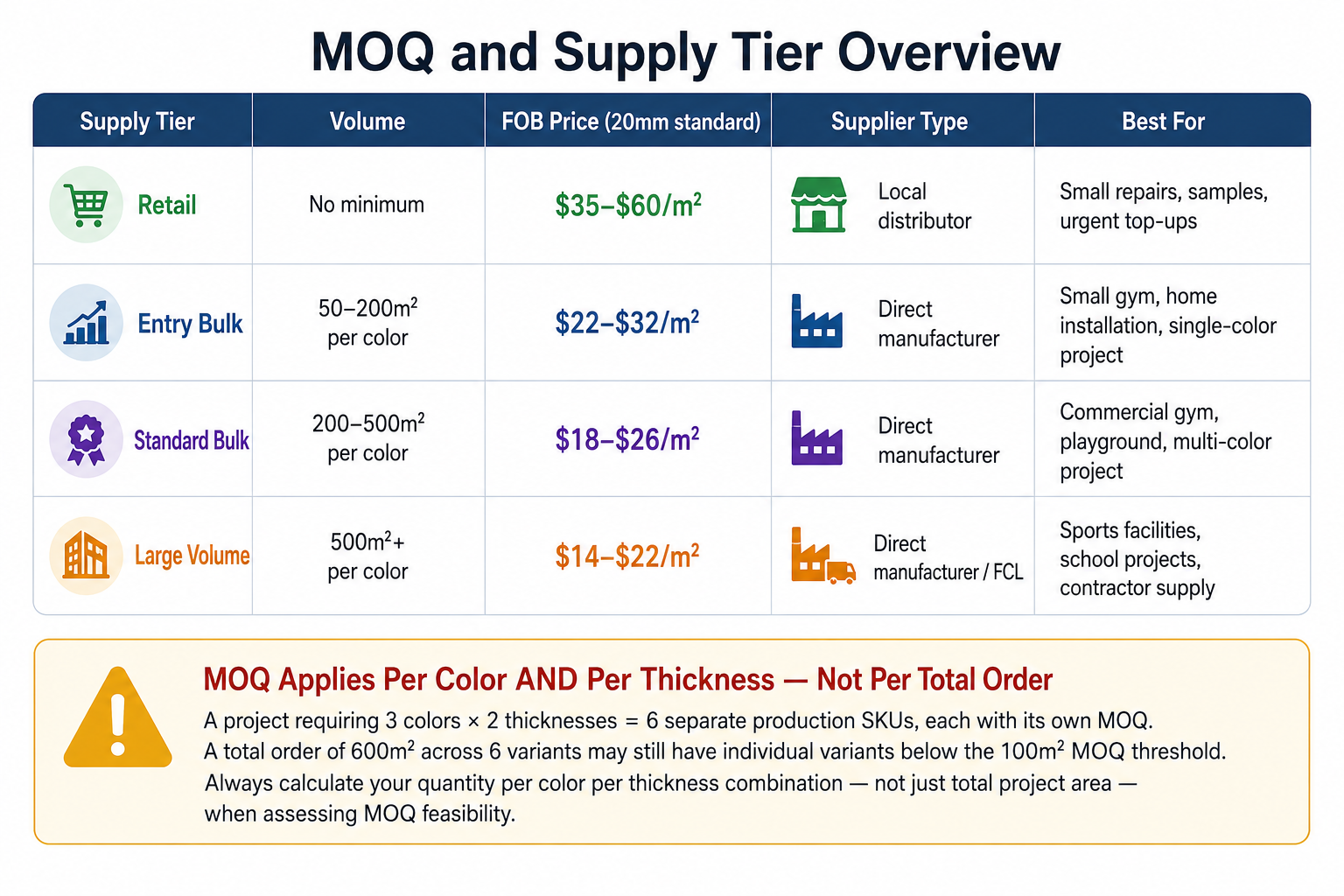
| Supply Tier | Volume | FOB Price (20mm standard) | Supplier Type | Best For |
|---|---|---|---|---|
| Retail | No minimum | $35–$60/m² | Local distributor | Small repairs, samples, urgent top-ups |
| Entry Bulk | 50–200m² per color | $22–$32/m² | Direct manufacturer | Small gym, home installation, single-color project |
| Standard Bulk | 200–500m² per color | $18–$26/m² | Direct manufacturer | Commercial gym, playground, multi-color project |
| Large Volume | 500m²+ per color | $14–$22/m² | Direct manufacturer / FCL | Sports facilities, school projects, contractor supply |
A project requiring 3 colors × 2 thicknesses = 6 separate production SKUs, each with its own MOQ. A total order of 600m² across 6 variants may still have individual variants below the 100m² MOQ threshold. Always calculate your quantity per color per thickness combination — not just total project area — when assessing MOQ feasibility.
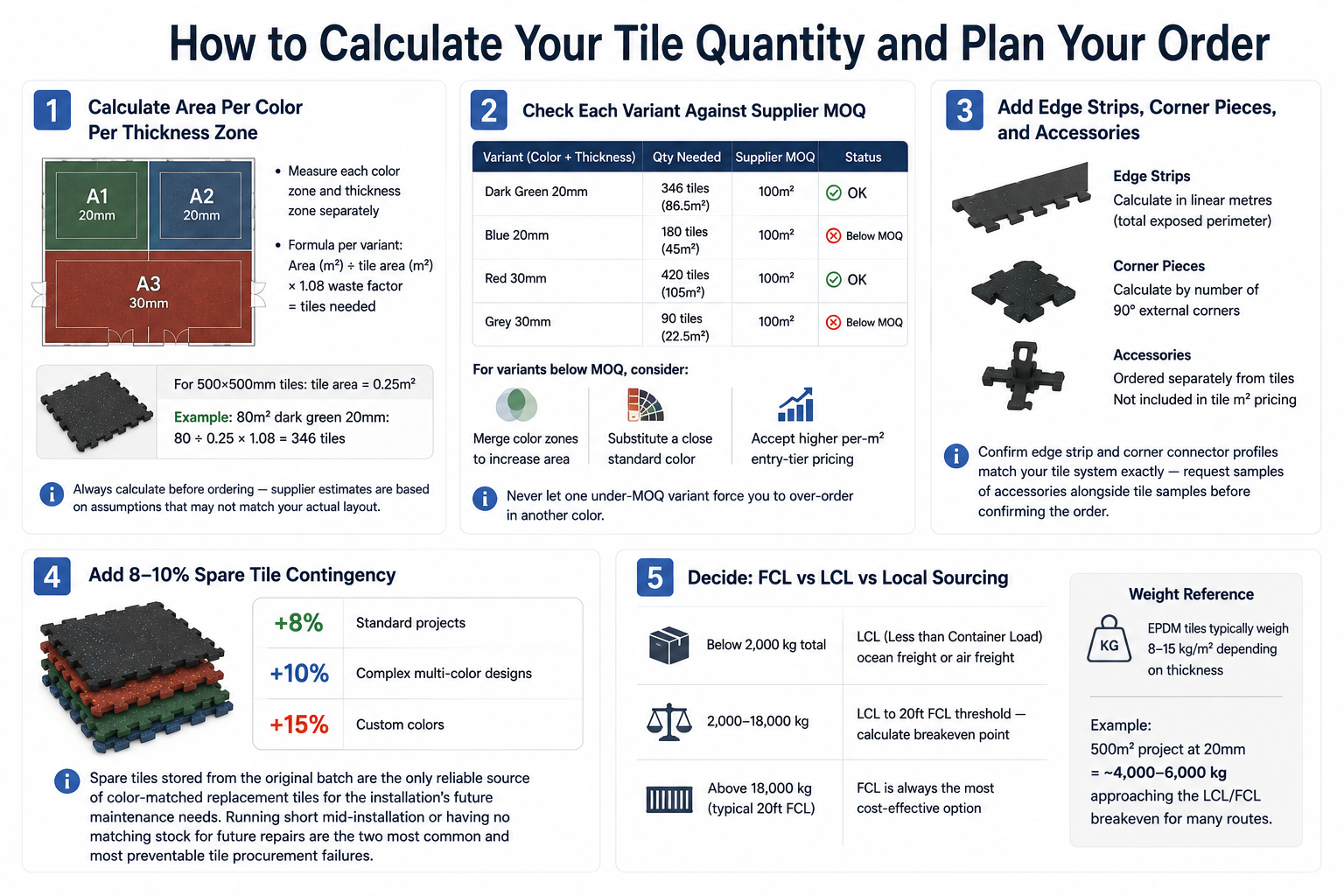
How to Calculate Your Tile Quantity and Plan Your Order
Shipping Cost and Import Duty Reference (2025)
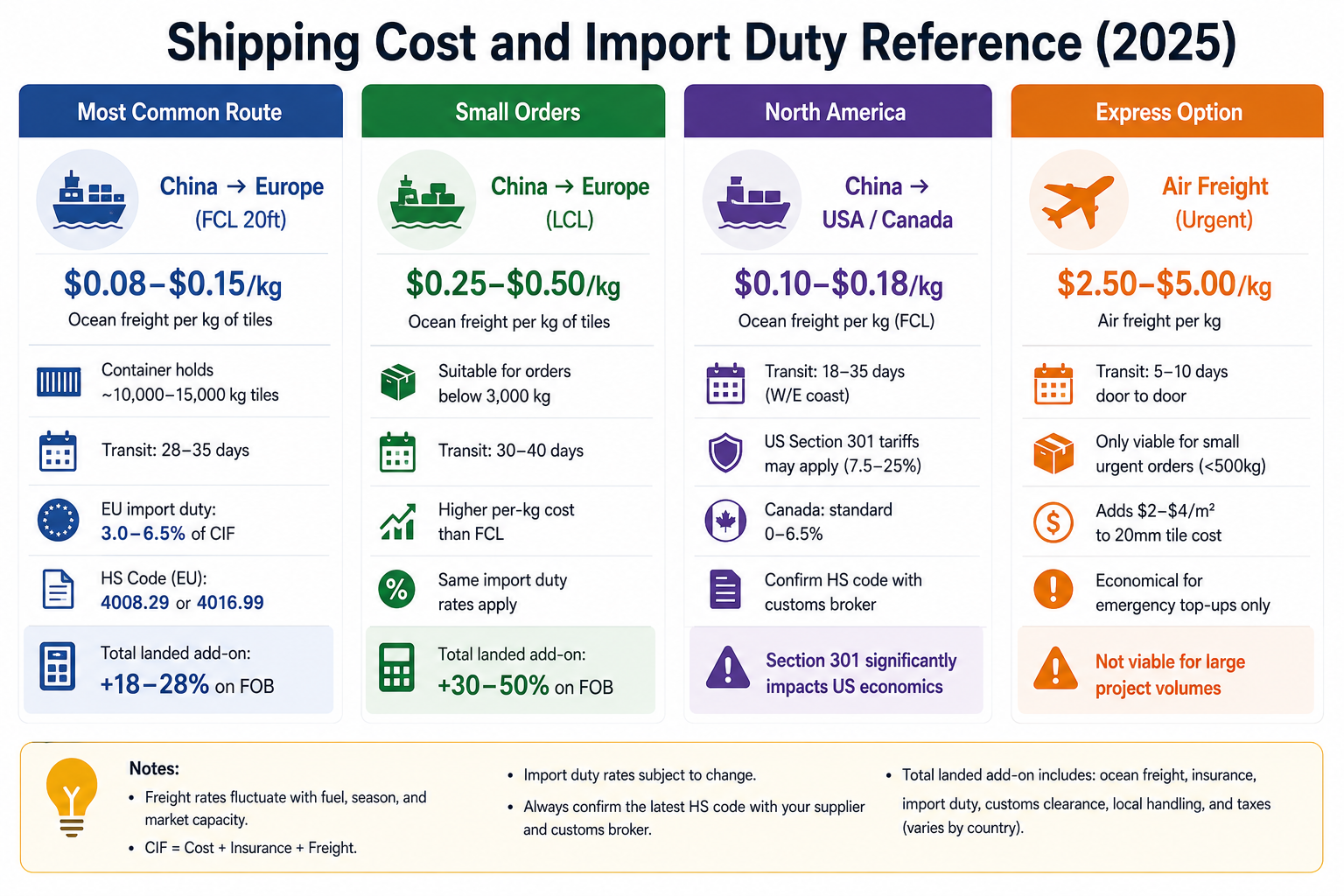
China → Europe (FCL 20ft)
$0.08–$0.15/kg
Ocean freight per kg of tiles
- Container holds ~10,000–15,000 kg tiles
- Transit: 28–35 days
- EU import duty: 3.0–6.5% of CIF
- HS Code (EU): 4008.29 or 4016.99
- Total landed add-on: +18–28% on FOB
China → Europe (LCL)
$0.25–$0.50/kg
Ocean freight per kg of tiles
- Suitable for orders below 3,000 kg
- Transit: 30–40 days
- Higher per-kg cost than FCL
- Same import duty rates apply
- Total landed add-on: +30–50% on FOB
China → USA / Canada
$0.10–$0.18/kg
Ocean freight per kg (FCL)
- Transit: 18–35 days (W/E coast)
- US Section 301 tariffs may apply (7.5–25%)
- Canada: standard 0–6.5%
- Confirm HS code with customs broker
- Section 301 significantly impacts US economics
Air Freight (Urgent)
$2.50–$5.00/kg
Air freight per kg
- Transit: 5–10 days door to door
- Only viable for small urgent orders (<500kg)
- Adds $2–$4/m² to 20mm tile cost
- Economical for emergency top-ups only
- Not viable for large project volumes
MOQ and Shipping Mistakes to Avoid
| Mistake | What Goes Wrong | Prevention |
|---|---|---|
| Calculating MOQ by total project not by variant | Individual color/thickness combinations fall below MOQ — order rejected or repriced | Calculate m² per color per thickness before requesting any quote |
| No spare tiles ordered | Future repair tiles unavailable — product discontinued, color changed, or batch variation | Always order 8–10% extra and store from same batch |
| Comparing FOB prices without landed cost model | Budget undershoots by 20–35% when freight and duty added | Always build a landed cost model before project approval |
| Not ordering accessories with tiles | Edge strips and corners unavailable locally — project delayed waiting for separate shipment | Order all accessories in the same shipment as tiles |
| Phased orders without batch confirmation | Phase 2 tiles from a different batch cause color mismatch with installed Phase 1 | Request supplier to reserve stock from same batch for all phases of a project |
Frequently Asked Questions
EPDM interlocking tile weight depends primarily on thickness. Approximate weights: 10mm ≈ 4–6 kg/m²; 15mm ≈ 6–8 kg/m²; 20mm ≈ 8–12 kg/m²; 30mm ≈ 12–18 kg/m²; 40mm ≈ 16–24 kg/m²; 50mm ≈ 20–30 kg/m². These weights are relevant for three purposes: calculating structural load capacity for rooftop installations; estimating total shipment weight for freight cost calculation; and confirming that the container’s road weight limit is not exceeded for heavy tile orders.
Mixed orders of different colors and thicknesses ship in the same container without any issue — each variant is packed in separate clearly labelled cartons within the same shipment. The commercial invoice and packing list must itemise each variant separately (product code, color, thickness, quantity, unit price). This detailed documentation is essential for customs clearance and for your own receiving verification when the shipment arrives. Never accept a single-line commercial invoice for a multi-variant order.
Before accepting a delivery: photograph the container exterior before opening; check the container seal number matches the Bill of Lading; inspect the top layer of tiles on unloading and note any damage on the delivery receipt before the driver leaves. For damaged goods claims: contact your freight forwarder and cargo insurer within 3 days of delivery; provide photographic evidence and a written damage report; the supplier is typically responsible for manufacturing defects while the insurer covers transit damage. Always purchase cargo insurance — the standard freight forwarder liability cap is far below the actual cargo value.
Yes — if both products come from the same manufacturer, consolidating into a single FCL shipment is the most cost-effective approach. Container freight cost is per box, not per product — adding tiles to a granule order (or vice versa) does not materially increase the freight cost if the container has remaining capacity. Confirm with your freight forwarder that the combined cargo description, HS codes, and commercial invoice structure correctly reflect both product types for customs purposes.
Tell us your required thickness, colors, total area, and destination — we will provide a complete breakdown including FOB price, freight estimate, import duty guidance, and lead time. Accessories included in the same quote.