

EPDM interlocking tiles are the better choice for any application requiring color, outdoor UV stability, or certified child safety. SBR recycled rubber tiles are the better choice when budget is the primary constraint and black color is acceptable. This guide gives you the complete comparison so you can specify the right material for your exact project — without overpaying for performance you do not need or under-specifying where it matters.
Colors available
in EPDM tiles
Typical price premium
of EPDM over SBR
EPDM outdoor lifespan
vs 6–10 yrs for SBR
Choose EPDM when color is required, the surface is outdoors, children will have skin contact, or chemical safety certification (PAH, REACH) is mandatory.Choose SBR when the surface is indoor only, black color is acceptable, budget is the primary driver, and child skin contact certification is not required.
For the complete EPDM interlocking rubber tile buyer’s guide, see our EPDM Interlocking Rubber Tiles Complete Buyer’s Guide.
EPDM vs SBR: Full Head-to-Head Comparison
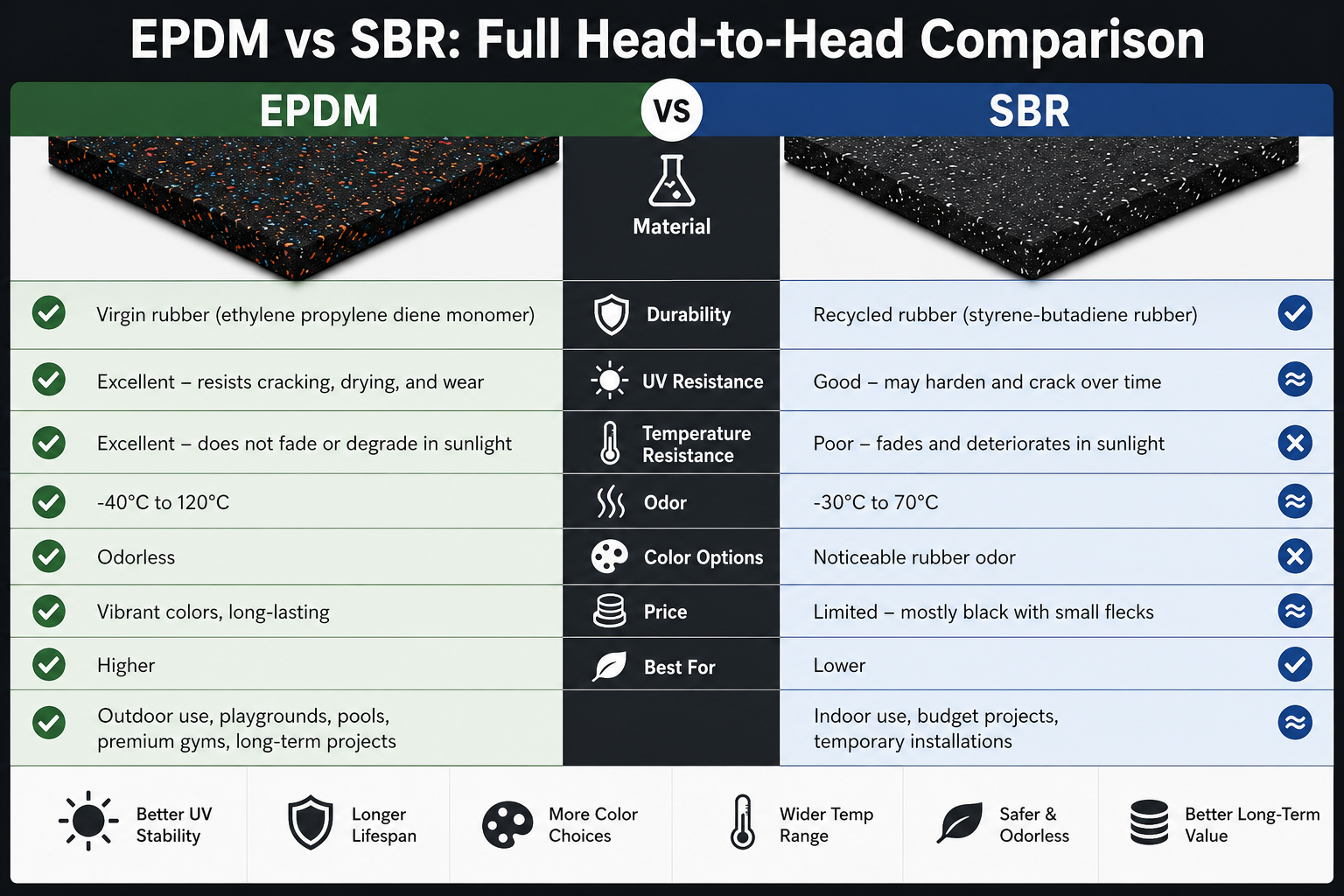
| Factor | EPDM Interlocking Tiles | SBR Recycled Rubber Tiles | Winner |
|---|---|---|---|
| Material Source | 100% virgin EPDM polymer | Recycled car tire rubber | EPDM — no recycled content |
| Color Range | 20+ standard colors | Black / dark grey only | ✅ EPDM — full palette |
| UV Resistance | Excellent — stable 10–18 years outdoors | Moderate — surface greys and fades 5–8 yrs | ✅ EPDM — significantly better |
| PAH Chemical Safety | Below ZEK 01.4-08 (certified virgin) | Must verify — may contain tire-derived PAHs | ✅ EPDM — safer default |
| REACH Compliance | Standard for virgin EPDM | Verify per manufacturer | ✅ EPDM — easier to certify |
| Child Skin Contact | ✅ Safe when PAH certified | ⚠ Requires specific PAH verification | ✅ EPDM — playground preferred |
| Shock Absorption | Excellent | Excellent | 🤝 Equal — same performance |
| EN 1177 Playground | Available — certified products | Available — certified products | 🤝 Both available |
| Price (20mm, standard) | $18–$28/m² | $10–$18/m² | ✅ SBR — lower cost |
| Outdoor Appearance at 10 Years | Retains original color — ΔE <3 | Surface greys and dulls — still functional | ✅ EPDM — better appearance |
| Odor (new tiles) | Mild rubber smell — fades quickly | Stronger tire rubber odor — fades in weeks | ✅ EPDM — less intrusive |
| Best For | Playgrounds, premium gyms, outdoor courts, pool surrounds, color-designed spaces | Indoor gyms, weightlifting areas, garages, cost-sensitive projects | Application-dependent |
When EPDM Is Clearly the Better Choice
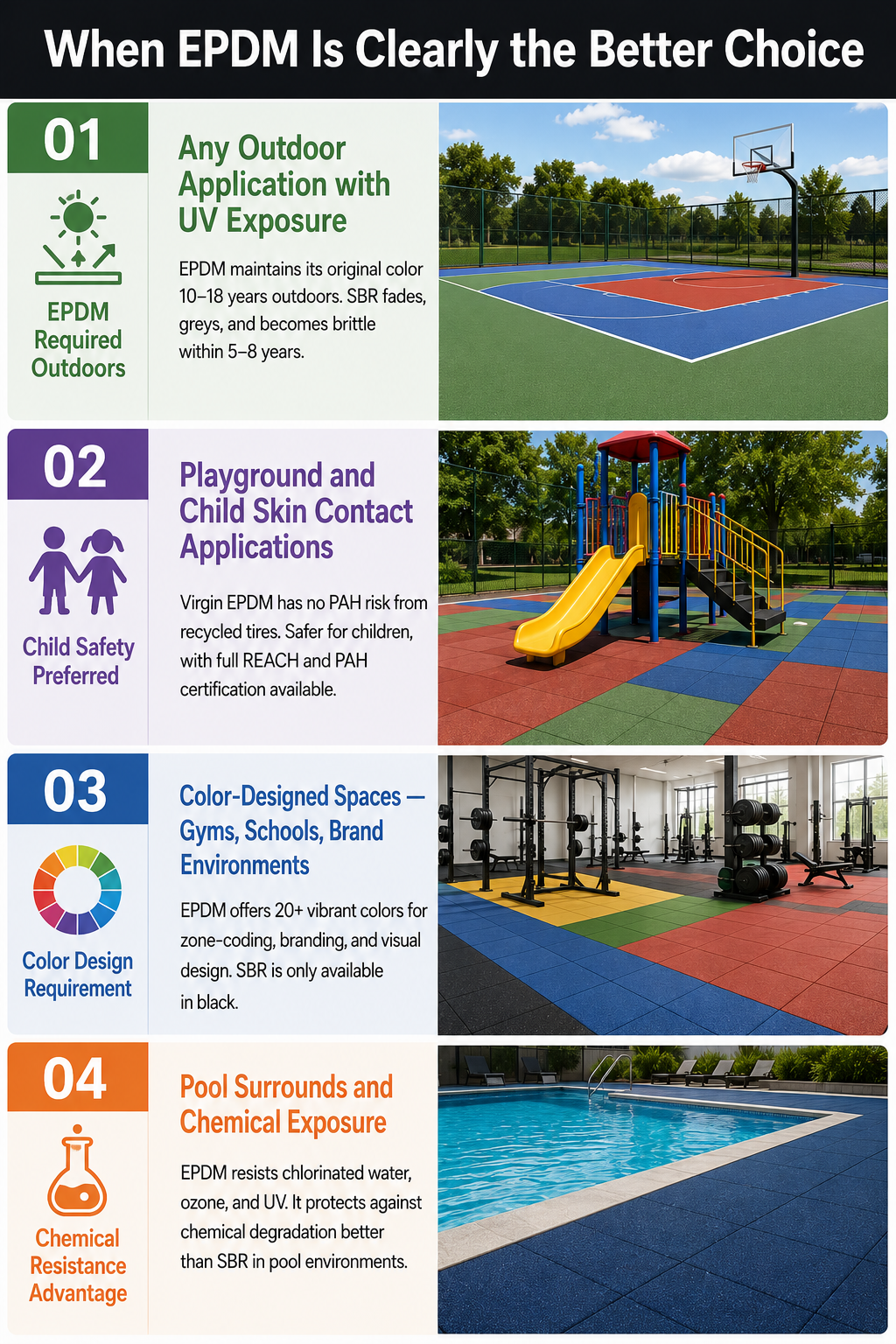
This is the clearest EPDM advantage. SBR recycled rubber tiles lose surface color and texture outdoors through UV degradation — within 5–8 years in temperate climates, the surface greys, becomes slightly brittle, and loses the defined appearance it had when new. EPDM’s virgin polymer with integral pigmentation maintains its original color for 10–18 years in the same outdoor conditions. For any permanent outdoor installation — courts, playgrounds, pool surrounds, rooftop terraces — EPDM is the only specification that delivers long-term visual quality.
EPDM Required Outdoors
SBR tiles are manufactured from recycled car tires, which can contain residual PAH (Polycyclic Aromatic Hydrocarbon) compounds from tire manufacturing oils. While certified SBR tiles are available with PAH testing below ZEK 01.4-08 limits, virgin EPDM tiles — which contain no recycled tire-derived content — have no inherent PAH risk. For any surface where children will have direct skin contact, EPDM is the safer and simpler specification: no PAH risk from material composition, full REACH and PAH certification straightforward to obtain.
Child Safety Preferred
SBR tiles are simply not an option when color matters. Black is the only practical SBR color — any gym, school, or facility that requires zone-color-coding, brand identity integration, or visual differentiation between activity areas must specify EPDM. The 20+ color range of EPDM interlocking tiles enables the kind of designed interior environments that modern fitness facilities, schools, and public spaces demand.
Color Design Requirement
EPDM’s inherent resistance to chlorinated water, ozone, and UV makes it significantly better suited to pool environments than SBR. SBR tiles exposed to pool chemicals over years show accelerated surface degradation. EPDM’s chemical resistance profile — the same properties that make it the preferred material for outdoor seals, gaskets, and weatherstripping — extends tile lifespan significantly in aquatic environments.
Chemical Resistance Advantage
When SBR Is the Better Choice
For an indoor commercial gym where the floor will be black (as most gym owners prefer for weight areas), SBR tiles deliver identical shock absorption performance to EPDM at approximately half the price. The UV stability advantage of EPDM is irrelevant indoors. The color advantage is irrelevant if black is the chosen color. For indoor weight rooms with no child contact requirement, SBR is the rational economic choice — the performance is equivalent and the cost saving is real.
Best Value for Indoor Gyms
Garage workshop floors, loading areas, and industrial facilities typically require black rubber flooring for oil-resistance, heavy load capacity, and anti-fatigue properties — not color, not UV stability. SBR tiles exceed all these requirements at the lowest possible cost. For any application where appearance is secondary to function and the environment is indoor, SBR is almost always the economically correct choice.
Industrial / Garage Applications
For event flooring, temporary fitness setups, pop-up gym installations, and any application where the floor will be used for less than 3 years, SBR’s lower unit cost makes economic sense. The longer-term UV and color advantages of EPDM do not apply to short-term use cases. Hire the cheapest adequate material — SBR for indoor temporary use fits this brief exactly.
Short-Term or Temporary
True Cost Comparison Over 10 Years (300m² Gym Floor)
| Cost Factor | EPDM Tiles (20mm) | SBR Tiles (20mm) |
|---|---|---|
| Initial material cost (300m²) | $6,000–$8,400 | $3,000–$5,400 |
| Replacements needed (10 years) | 5–8% spot replacement | 8–15% spot replacement (indoor) |
| Replacement cost (10 years) | $300–$672 | $240–$810 |
| Appearance at year 10 | Color retained — professional appearance | Functional — surface dulled |
| Full replacement needed? | No — 15+ yr indoor lifespan | Possible at 10–12 yrs if appearance matters |
| Total 10-year cost (indoor) | $6,300–$9,072 | $3,240–$6,210 |
| Verdict (indoor) | Higher cost — justified by color and appearance | Lower cost — correct for black indoor gyms |
For outdoor applications, SBR tiles typically require full replacement at 6–10 years due to UV degradation and surface dulling — while EPDM maintains performance for 12–18 years. Over a 15-year outdoor lifecycle, EPDM’s higher initial cost is offset by avoiding one full replacement cycle. For outdoor permanent installations, EPDM delivers lower total lifecycle cost despite higher upfront price.
Frequently Asked Questions
Summary: EPDM vs SBR — The Decision in 30 Seconds
Article #3 · Series: best EPDM interlocking rubber tiles · ← Back to Buyer’s Guide
Compare EPDM and SBR Tile Samples Side by Side
We supply both EPDM and SBR interlocking rubber tiles with full certification documentation. Request physical samples of both materials for direct comparison before committing to your specification.
Request Material Comparison Samples
Read the Full Buyer’s Guide