

Pickleball has exploded in popularity across all age groups, but the physical demands of the game — constant lateral movement, quick stops, lunges and repetitive impact — place significant stress on players’ joints. As a result, more clubs, community facilities, schools and homeowners are choosing a cushioned pickleball court instead of a traditional hard acrylic surface. A well-engineered cushioned system combines the reliable ball response of acrylic with meaningful shock absorption, creating a surface that is both high-performing and significantly kinder to the body.
What Is a Cushioned Pickleball Court?
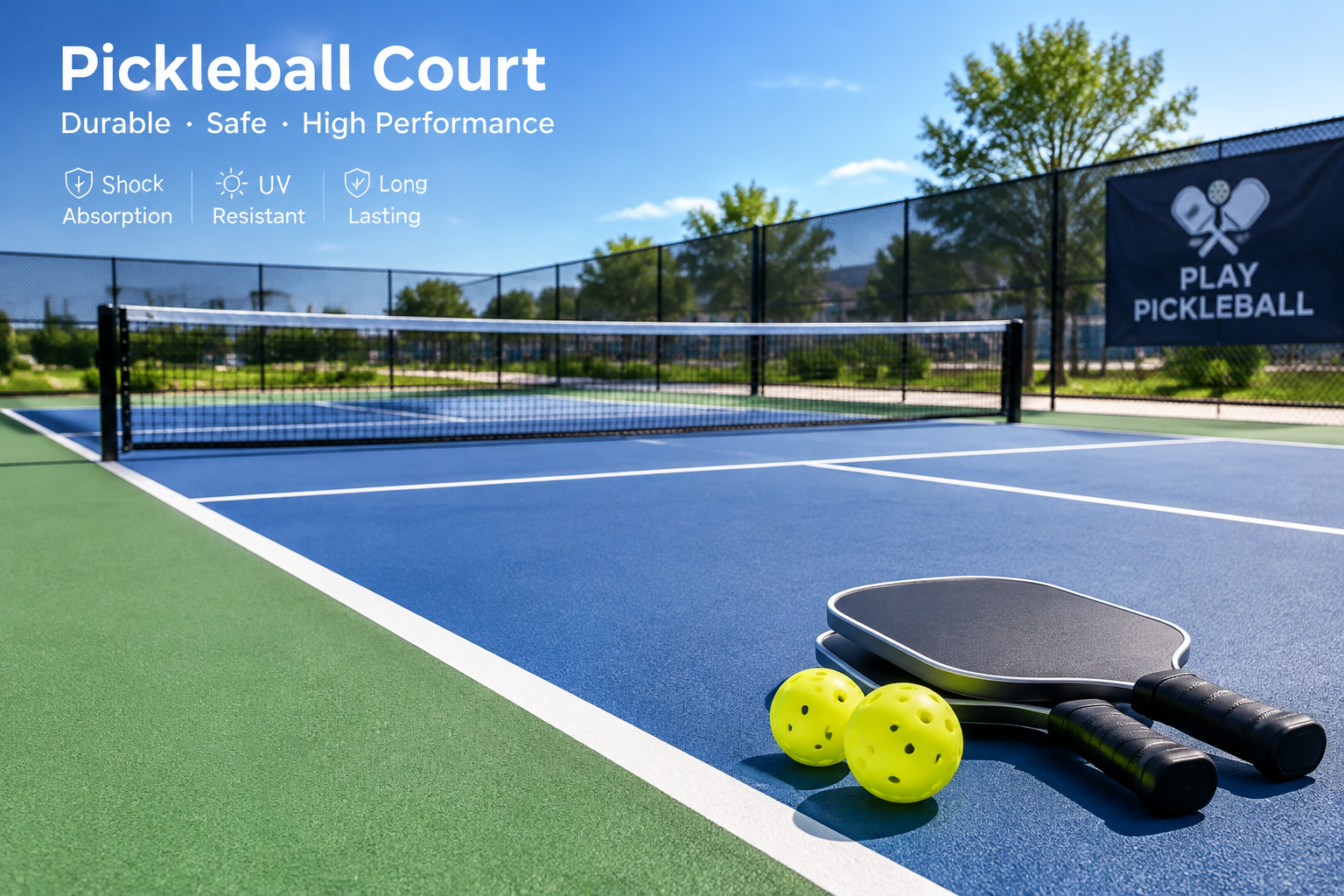
A cushioned pickleball court is a multi-layer sports surface system built on a stable concrete or asphalt base. Unlike a standard hard court, where the acrylic color and texture coats are applied directly onto the base, a cushioned system incorporates one or more resilient rubberized layers between the base and the final playing surface.
These cushion layers are typically made from carefully selected rubber granules (often EPDM or SBR) bound with flexible acrylic or elastomeric binders. The total cushion thickness usually ranges from 4 mm to 8 mm, depending on the desired level of comfort and the intensity of expected use. Over these cushion layers, a complete multi-coat acrylic system is applied — including primer, filler, color coats and a durable wear layer — to deliver consistent traction, color retention and ball response.
The result is a surface that still looks and plays like a professional hard court, yet feels noticeably more forgiving underfoot. When correctly specified and installed, a cushioned pickleball court maintains true, predictable bounce while absorbing a meaningful portion of the impact forces that would otherwise be transmitted directly into a player’s knees, ankles, hips and lower back.
Why Cushioned Surfaces Are Gaining Rapid Preference in Pickleball
Pickleball is unique among racket sports because it attracts an unusually wide age range. Many players are over 40, and a large percentage play multiple times per week. On a hard court, the cumulative impact of hundreds of direction changes and landings each session can lead to fatigue, soreness and, over time, increased risk of joint issues.
A cushioned pickleball court addresses this reality directly. By dissipating energy on landing and during lateral movements, the surface reduces the peak forces that reach the joints. Players frequently report that they can play longer sessions with less post-game discomfort, which in turn increases court utilization and player satisfaction.
Clubs and facility managers also benefit. Higher comfort levels often translate into better member retention, higher booking rates and a stronger reputation as a player-friendly venue. For residential owners, a cushioned court offers a premium experience that protects the whole family and adds long-term value to the property.
Key Performance Differences: Hard Acrylic vs Cushioned Pickleball Court
Facility owners and players evaluating surfaces typically focus on four main criteria: comfort, ball behavior, durability and total cost of ownership. The table below summarizes the practical differences.
| Feature | Standard Hard Acrylic | Cushioned Pickleball Court |
|---|---|---|
| Impact Absorption | Minimal – forces transmitted almost directly | 15–30 % force reduction with quality systems |
| Player Comfort | Firm, traditional hard-court feel | Noticeably more forgiving underfoot |
| Ball Bounce & Speed | Fast, consistent, high rebound | Nearly identical when cushion thickness and density are correctly calibrated |
| Traction (Wet & Dry) | Excellent with proper texture | Excellent – texture is determined by the acrylic top system |
| Best Suited For | Competitive players prioritizing pure speed | Clubs, communities, mixed-age groups, frequent recreational play |
| Initial Cost | Lower | Higher, but often better lifecycle value |
| Long-Term Joint Protection | Limited | Significantly improved |
How the Cushion Layer Affects Real-World Performance
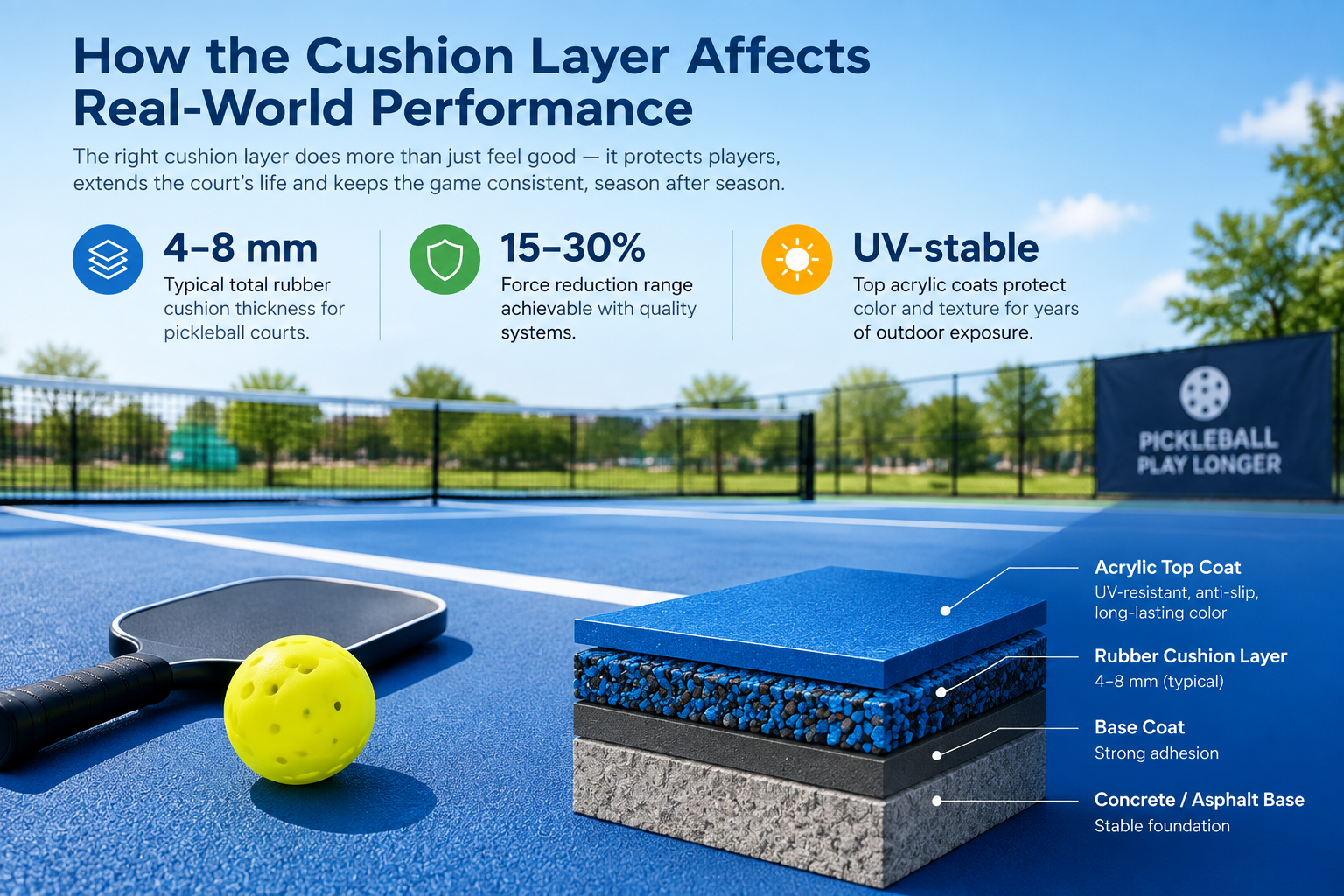
Typical total rubber cushion thickness for pickleball courts
Force reduction range achievable with quality systems
Top acrylic coats protect color and texture for years of outdoor exposure
1. Impact Absorption and Player Comfort
Every time a player plants a foot, changes direction or lands after a lunge, energy is generated. On a hard court, most of that energy travels upward through the body. On a cushioned pickleball court, the rubber layers compress slightly and dissipate a portion of the force. This reduction is especially valuable during long sessions or for players with existing joint sensitivity.
The benefit is not limited to older players. Younger athletes who train frequently also experience less cumulative fatigue, allowing them to maintain higher intensity for longer periods.
2. Ball Bounce Consistency
One of the most common concerns about cushioned surfaces is whether the ball will still bounce true. When the cushion thickness, density and uniformity are tightly controlled, modern systems deliver rebound height and speed that are virtually indistinguishable from a standard hard court. Overly soft or uneven cushions can create dead spots, which is why professional installers insist on precise layer application and quality materials.
3. Adhesion and Long-Term Structural Integrity
The interface between the rubber cushion and the acrylic color system is critical. Temperature changes, intensive foot traffic and UV exposure all create shear forces. Premium systems use compatible primers and interlocking layer designs that resist delamination and maintain structural integrity for many seasons.
Ideal Applications for Cushioned Pickleball Courts
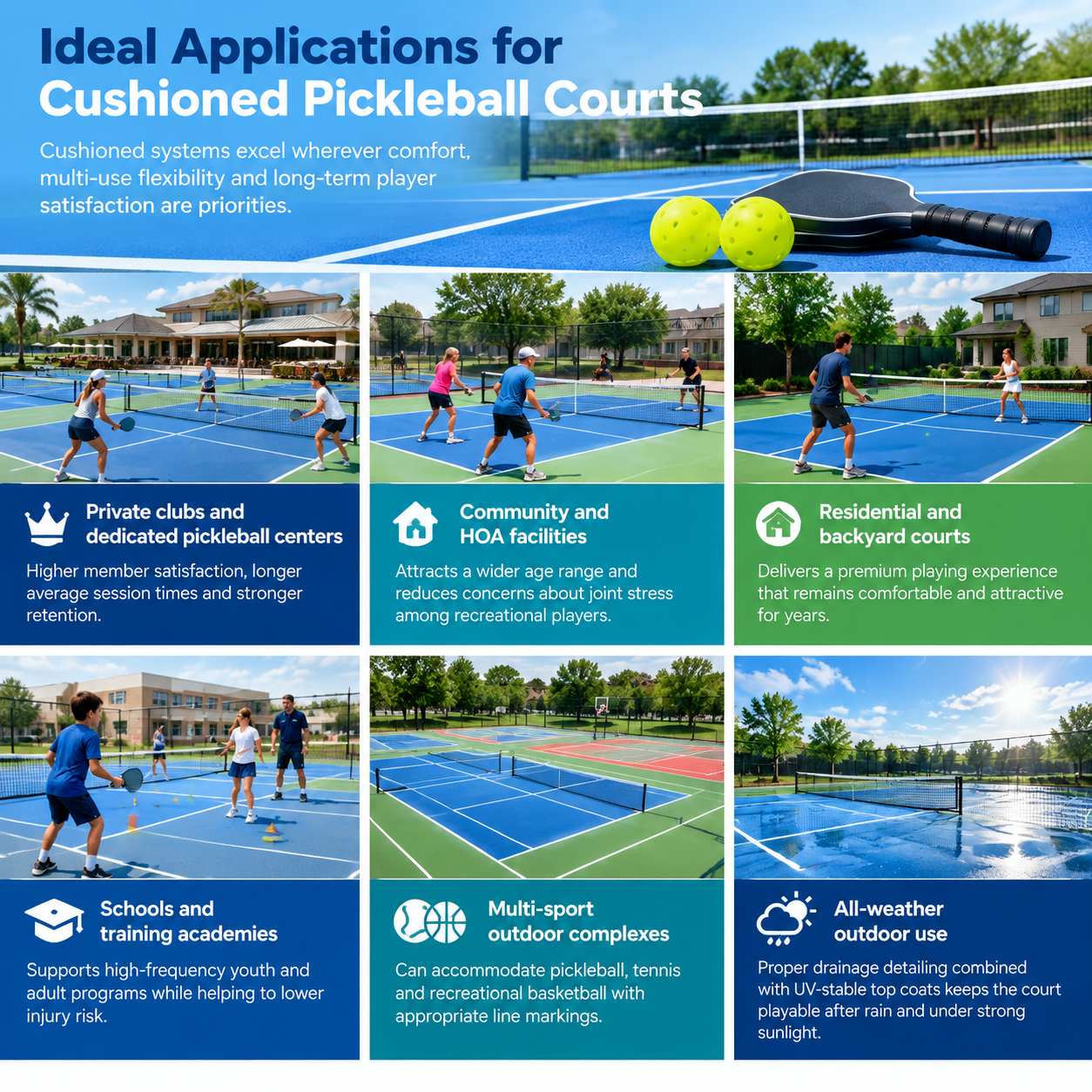
Cushioned systems excel wherever comfort, multi-use flexibility and long-term player satisfaction are priorities:
- Private clubs and dedicated pickleball centers — Higher member satisfaction, longer average session times and stronger retention.
- Community and HOA facilities — Attracts a wider age range and reduces concerns about joint stress among recreational players.
- Residential and backyard courts — Delivers a premium playing experience that remains comfortable and attractive for years.
- Schools and training academies — Supports high-frequency youth and adult programs while helping to lower injury risk.
- Multi-sport outdoor complexes — Can accommodate pickleball, tennis and recreational basketball with appropriate line markings.
- All-weather outdoor use — Proper drainage detailing combined with UV-stable top coats keeps the court playable after rain and under strong sunlight.
Specification Checklist for a High-Performance Cushioned Pickleball Court
Before approving any project, facility managers and owners should confirm the following points:
- Documented force-reduction / shock-absorption values appropriate for the intended users
- Complete system from a single source: rubber cushion + compatible primer + multi-layer acrylic color and wear coats
- UV-stable pigments and resins supported by accelerated ageing data
- Wet and dry slip-resistance coefficients after ageing
- Recommended total dry-film thickness and cushion thickness matched to expected usage intensity
- Clear base preparation requirements (asphalt or concrete) and joint detailing guidelines
- Maintenance schedule and expected color / performance retention under local climate conditions
- Independent laboratory test reports for both force reduction and ball rebound
Maintenance and Long-Term Performance
A quality cushioned pickleball court is relatively low-maintenance, but proper care significantly extends its service life and appearance. Regular sweeping or blowing removes abrasive debris. Periodic washing with mild detergent and water keeps the surface clean and free of contaminants that can affect traction. Resurfacing of the acrylic color and wear coats is typically recommended every 5–8 years, depending on climate and usage intensity. The underlying cushion layers, when correctly installed, generally retain their resilience for a much longer period.
Because the cushion system is protected by the acrylic top coats, UV degradation of the rubber is minimized. This combination of shock absorption and surface durability is one of the key reasons facilities increasingly view cushioned systems as a higher-value long-term investment rather than a simple cost upgrade.
Comfort and Performance Can — and Should — Coexist
A high-quality cushioned pickleball court does not force facility owners or players to sacrifice ball response or durability in exchange for comfort. When the rubber cushion layers, primer adhesion and UV-stable acrylic top coats are engineered as one integrated system, the court delivers reduced joint impact, reliable traction, consistent bounce and long-term visual appeal.
Clubs, communities and homeowners who specify a complete cushioned system rather than a low-cost add-on consistently achieve better player experience, higher utilization and lower lifecycle costs. In a sport that continues to attract players of all ages and fitness levels, that combination is becoming the new standard.
For technical data sheets, system recommendations or project-specific advice on cushioned pickleball courts, contact our team today.
Choose a Cushioned Pickleball Court That Protects Players and Performs for Years
Our professional cushioned acrylic systems are engineered for shock absorption, consistent ball response, excellent color retention and reliable all-weather performance — ideal for clubs, community facilities, schools and residential pickleball courts.
Request Technical Data & Quotation
View Full Product Range →