

In the competitive world of school running track procurement, few phrases sound more reasonable — and few create more long-term risk — than “mainly EPDM,” “EPDM-based,” or “high EPDM content.” These words appear frequently in quotations. They feel close enough to the real requirement. In practice, they are among the most dangerous claims a buyer can accept.
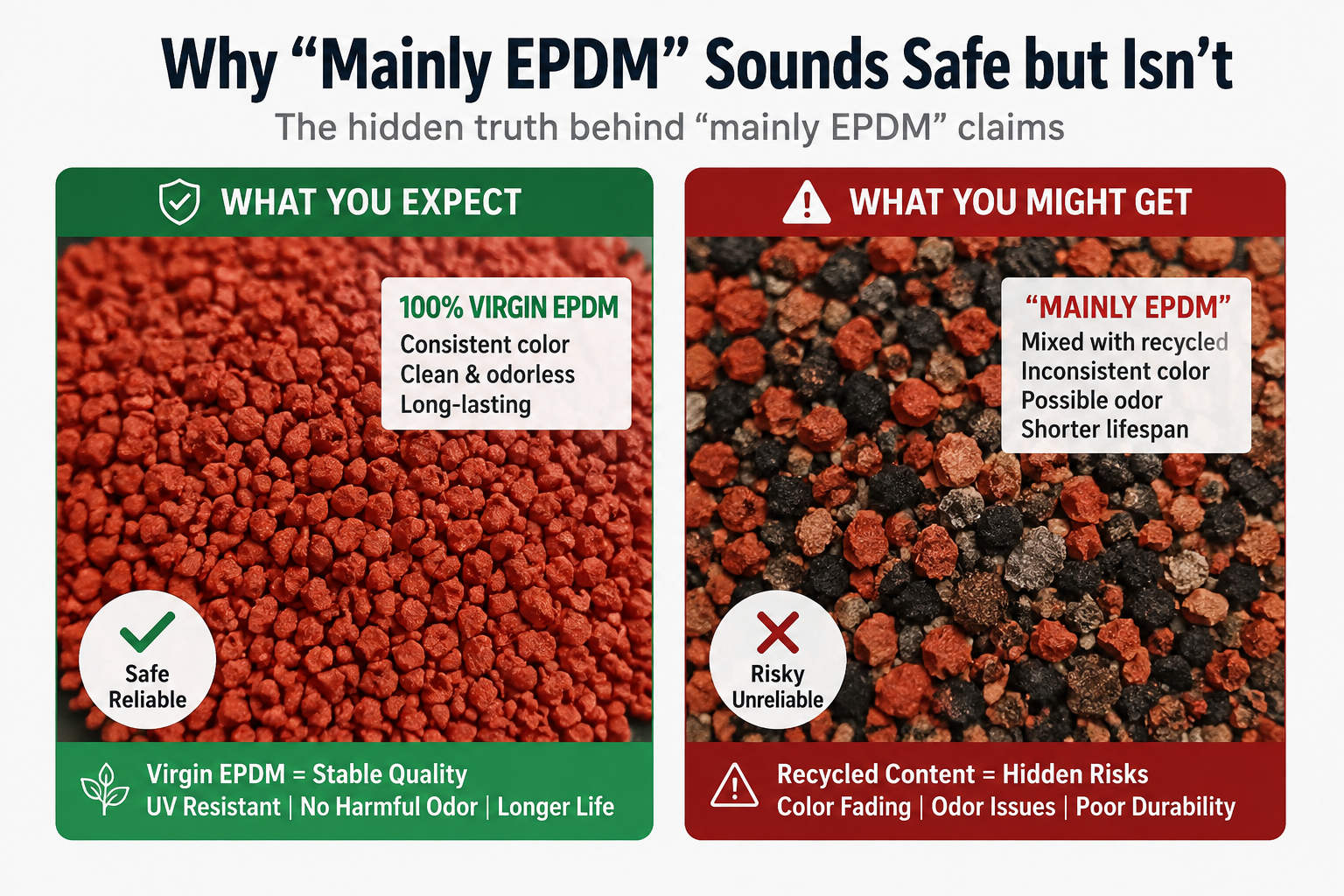
A school running track is expected to serve students for 8 to 12 years. The surface must resist UV radiation, repeated wet-dry cycles, heavy foot traffic, and seasonal temperature swings. The only material proven to deliver consistent performance in the wear layer is 100% virgin colored EPDM granules.
When a supplier writes “mainly EPDM,” they are almost never describing pure virgin material. The phrase is deliberately flexible. It allows the inclusion of recycled SBR rubber, lower-grade polymers, fillers, or blended compounds that reduce cost while still permitting the word “EPDM” to appear in the description.
On handover day the surface can look acceptable. Colour appears uniform. The texture feels correct. Within one or two summers the differences become visible and measurable: granules begin to shed, colour fades unevenly, impact absorption becomes inconsistent, and the surface starts to break down earlier than projected.
What the Vague Language Usually Hides
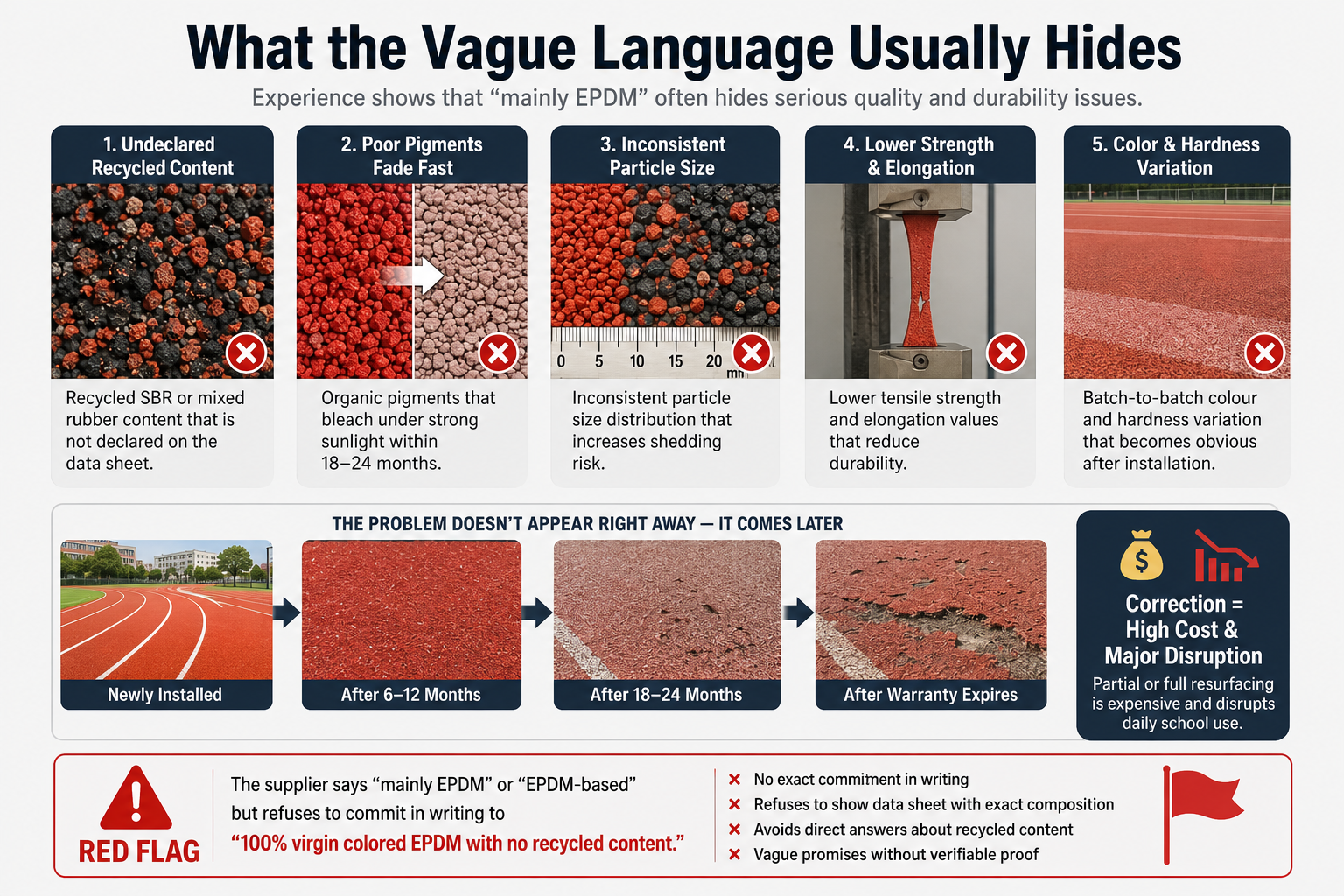
Experience across many school and municipal projects shows a clear pattern. Quotations that avoid the exact wording “100% virgin EPDM” frequently contain one or more of the following:
- Recycled SBR or mixed rubber content that is not declared on the data sheet
- Organic pigments that bleach under strong sunlight within 18–24 months
- Inconsistent particle size distribution that increases shedding risk
- Lower tensile strength and elongation values that reduce durability
- Batch-to-batch colour and hardness variation that becomes obvious after installation
These issues rarely appear in the first few months. They emerge after the warranty period for pure workmanship has begun to expire and after the track is already in daily educational use. Correcting them then requires partial or full resurfacing — an expensive and disruptive process.
The Real Cost of Accepting “Close Enough”
Procurement teams often focus on unit price. The difference between a pure virgin EPDM quotation and a “mainly EPDM” quotation can look attractive on a spreadsheet. That short-term saving is almost always recovered several times over in maintenance, earlier resurfacing, and loss of surface performance.
Typical consequences include:
– Faster and uneven colour fading, especially in high-UV regions
– Progressive granule loss that creates a rough, unsafe surface
– Reduced shock absorption consistency across the track
– Higher long-term maintenance costs and more frequent closures for repair
– Difficulty claiming under warranties that cover only workmanship and exclude material performance
Once the track is installed, the school owns the problem. The supplier who used flexible language has already delivered according to the accepted description.
How to Protect the Project
The solution is simple and requires no special technical expertise. Insist on precise language and written confirmation.
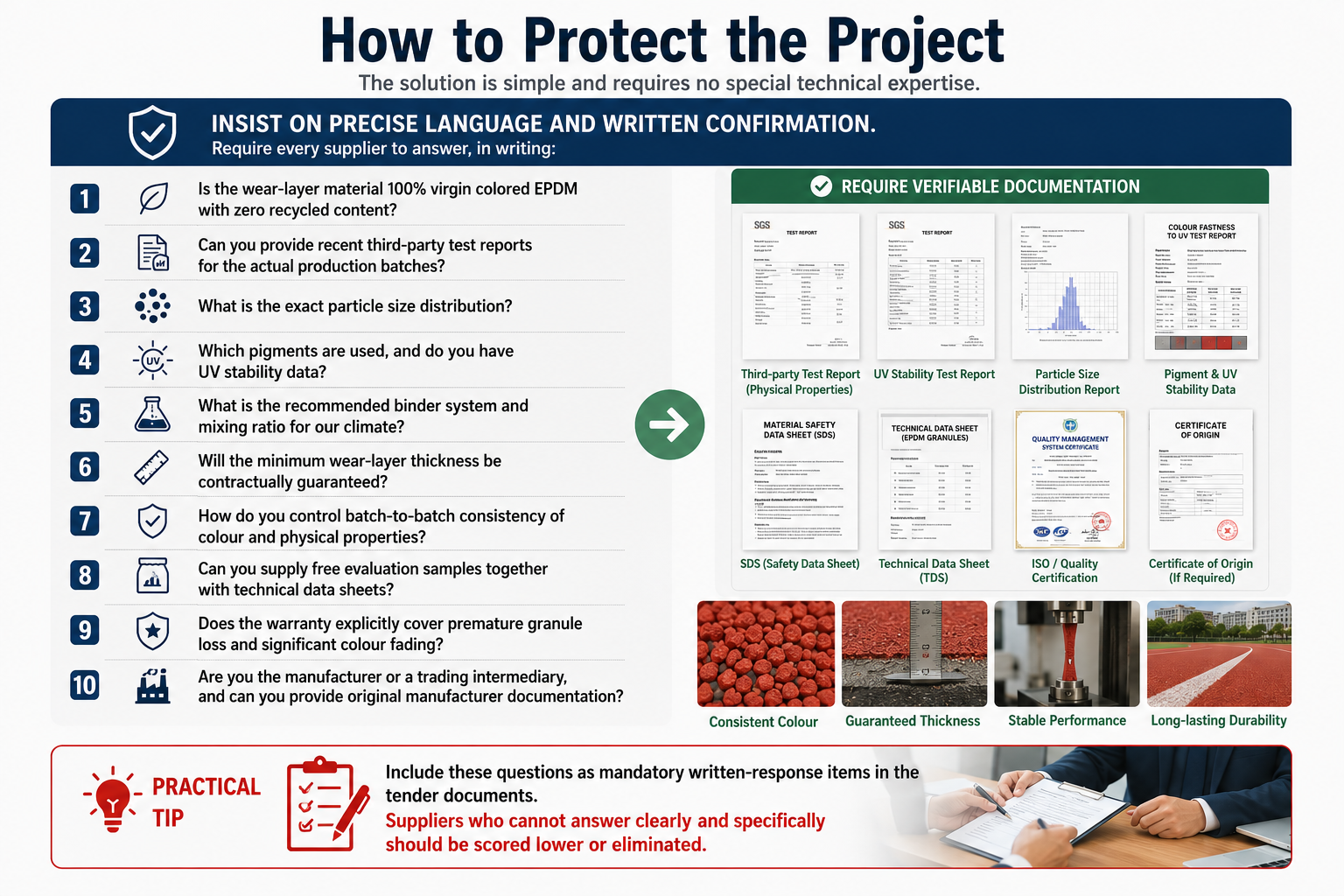
Require every supplier to answer, in writing:
1. Is the wear-layer material 100% virgin colored EPDM with zero recycled content?
2. Can you provide recent third-party test reports for the actual production batches?
3. What is the exact particle size distribution?
4. Which pigments are used, and do you have UV stability data?
5. What is the recommended binder system and mixing ratio for our climate?
6. Will the minimum wear-layer thickness be contractually guaranteed?
7. How do you control batch-to-batch consistency of colour and physical properties?
8. Can you supply free evaluation samples together with technical data sheets?
9. Does the warranty explicitly cover premature granule loss and significant colour fading?
10. Are you the manufacturer or a trading intermediary, and can you provide original manufacturer documentation?
Clear Standards vs. Flexible Claims
| Aspect | 100% Virgin EPDM | “Mainly EPDM” / EPDM-based |
|---|---|---|
| Polymer content | Pure virgin EPDM only | Often blended with recycled rubber or fillers |
| Colour stability | UV-stable inorganic pigments | Frequently uses cheaper organic pigments |
| Granule retention | High, consistent performance | Higher shedding risk within 1–3 years |
| Documentation | Full recent third-party reports available | Often generic or outdated certificates |
| Long-term risk | Predictable 8–12 year service life | Elevated risk of early failure |
Precision Protects the Investment
“Mainly EPDM” is not a technical specification. It is a commercial phrase designed to keep options open for the seller while transferring risk to the buyer.
Schools and project teams that insist on the exact wording “100% virgin colored EPDM” and require supporting data consistently achieve longer service life, better colour retention, and fewer maintenance interruptions.
The difference is decided at the procurement stage — not after the track is already under the feet of students.
Specify Pure Performance from the Start
Request free evaluation samples of 100% virgin colored EPDM granules together with full technical data sheets. Compare particle shape, colour uniformity, and documentation before any contract is signed.