

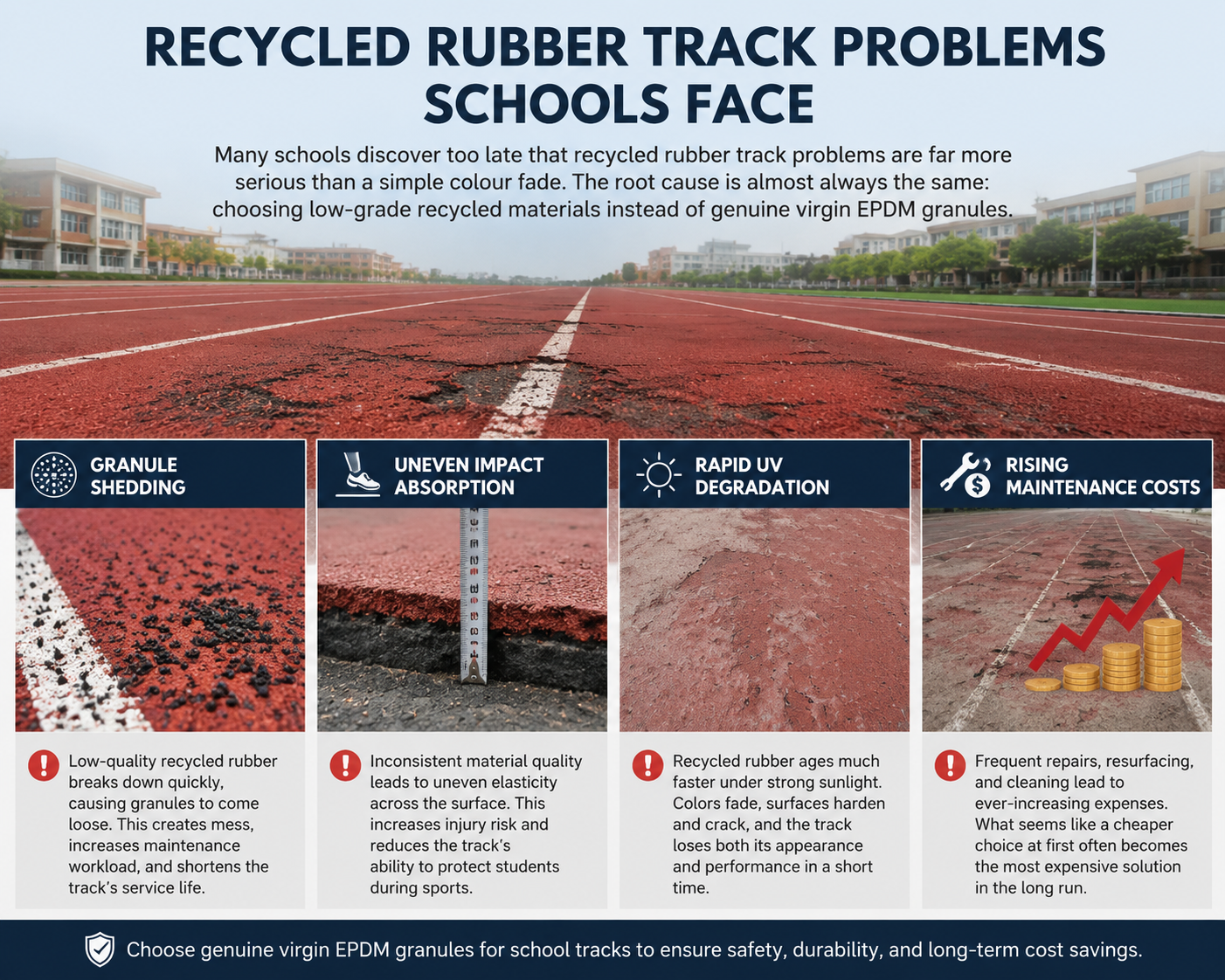
Many schools discover too late that recycled rubber track problems are far more serious than a simple colour fade. Granule shedding, uneven impact absorption, rapid UV degradation and rising maintenance costs frequently appear within just two to three years. The root cause is almost always the same: choosing low-grade recycled materials instead of genuine virgin EPDM granules for school track surfaces. Understanding these issues before installation is the only reliable way to avoid expensive corrections later.
The Most Common Recycled Rubber Track Problems Schools Face
Recycled rubber (mainly SBR crumb or mixed recycled content) is frequently offered as a budget-friendly option for school running tracks. In reality, it introduces a predictable set of performance and durability problems that become visible after the first one or two seasons of heavy student use.
The most frequently reported issues include:
- Rapid colour fading – Organic pigments commonly used in recycled or “economy” granules bleach quickly under sunlight and wet-dry cycles, leaving the track looking worn and unprofessional within 18–24 months.
- Granule shedding – Inconsistent particle size, residual oils and weaker binder adhesion cause granules to loosen and wash away, creating bare patches and increasing the risk of athletes slipping.
- Uneven hardness and soft spots – Recycled streams contain particles of varying density and elasticity, resulting in hard and soft zones across the same track. Athletes and coaches notice the inconsistency immediately.
- Declining impact absorption – As the surface breaks down, shock absorption becomes less reliable, contributing to higher rates of shin splints and joint complaints among student athletes.
- Short service life – Many recycled systems require significant repairs or full resurfacing after only 3–5 years, turning the original low quote into a higher total cost of ownership.
Why Virgin EPDM Granules for School Track Surfaces Perform Better
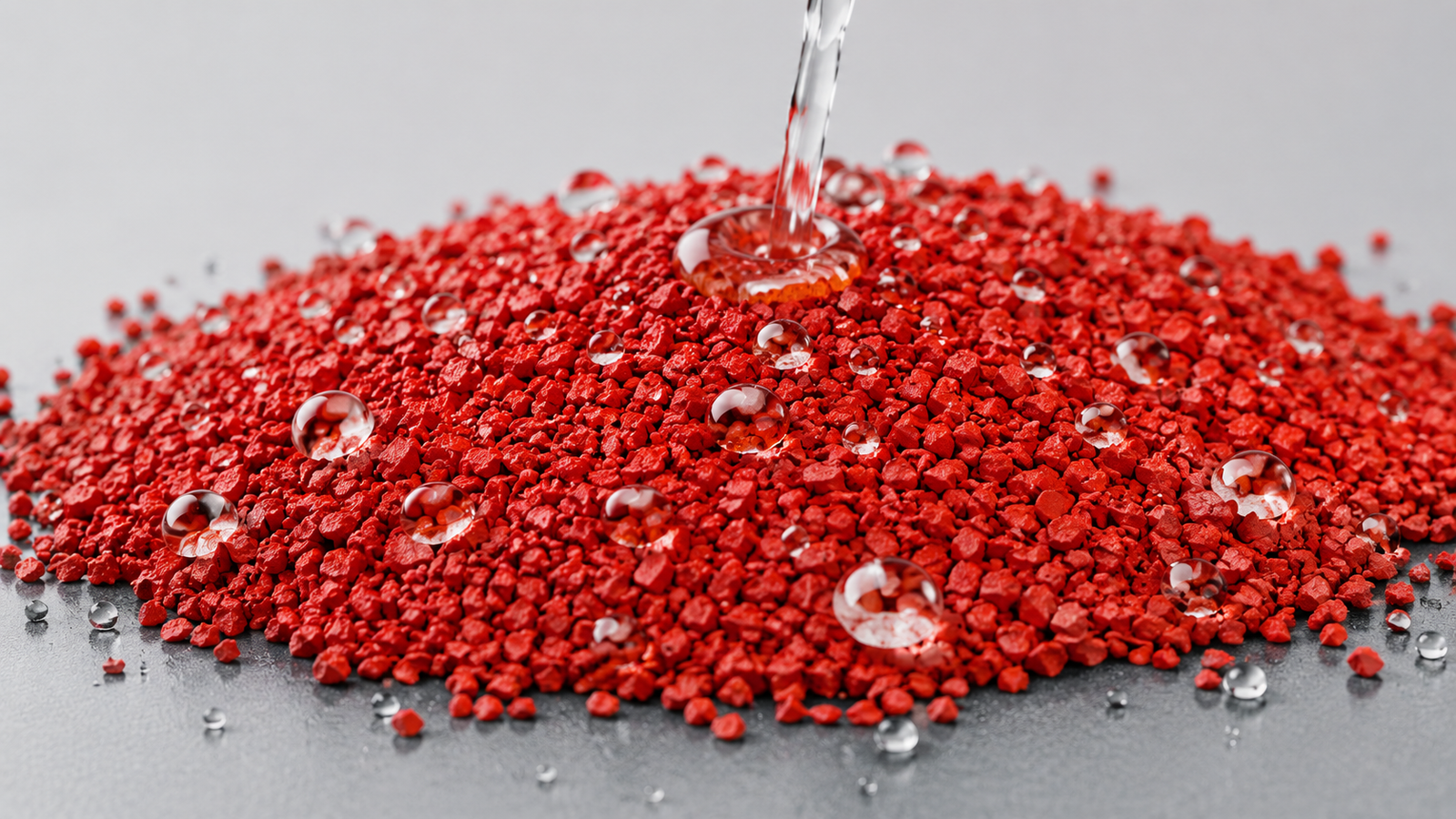
Virgin EPDM granules are manufactured from new EPDM polymer, compounded with UV-stable inorganic pigments and processed to a tightly controlled particle size (typically 1–3 mm for athletic wear layers). Because the entire production process is controlled by a specialist manufacturer, the resulting granules deliver consistent colour, elasticity and durability batch after batch.
Key advantages of virgin EPDM granules for school track applications include:
- Excellent long-term colour retention even under strong UV exposure
- Uniform particle shape and size that produce a consistent surface feel
- Reliable and stable impact absorption that supports daily student training
- Stronger adhesion with moisture-curing polyurethane binders
- Realistic outdoor service life of 8–12 years when correctly installed
Side-by-Side Comparison: Recycled Rubber vs Virgin EPDM Granules
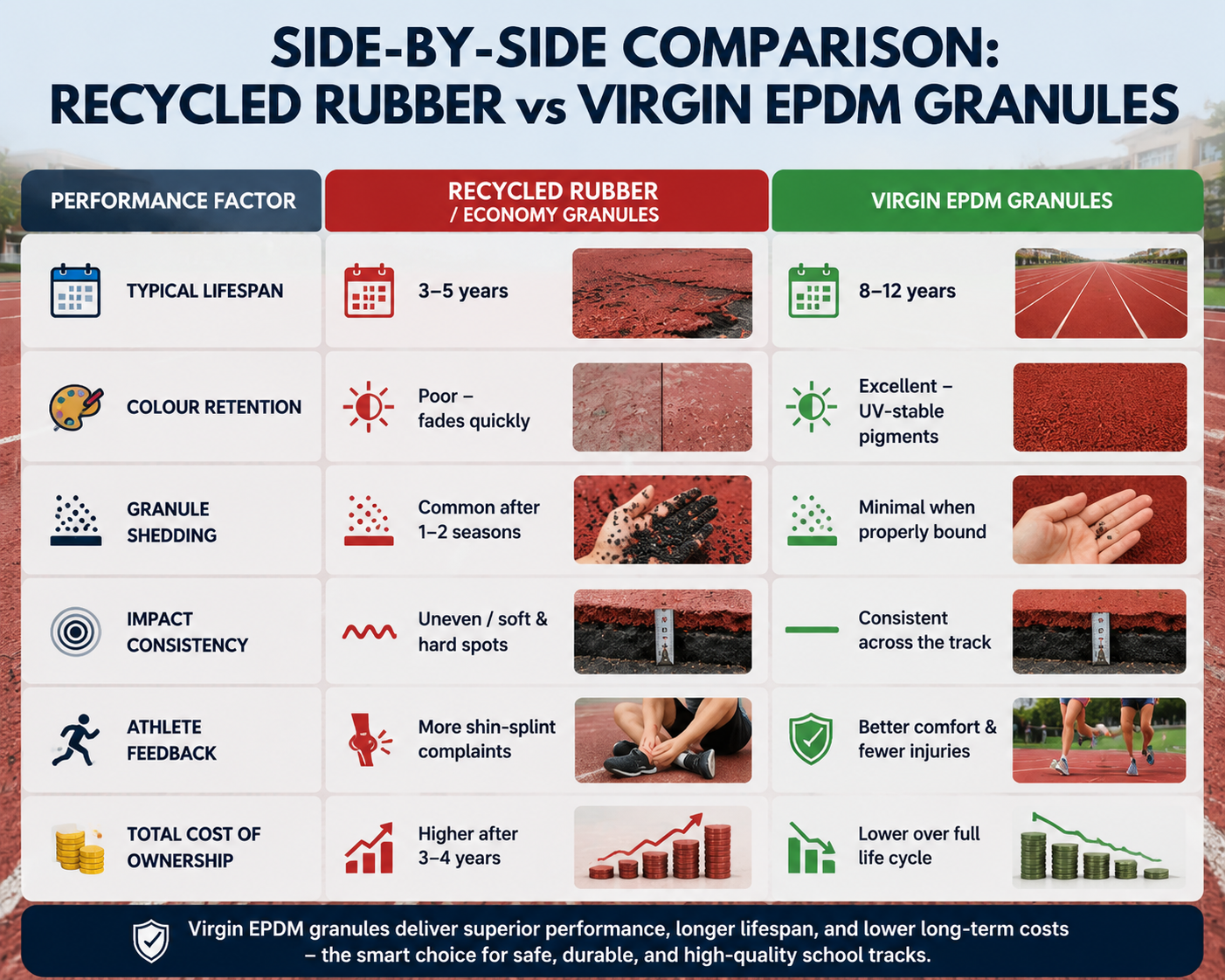
| Performance Factor | Recycled Rubber / Economy Granules | Virgin EPDM Granules |
|---|---|---|
| Typical lifespan | 3–5 years | 8–12 years |
| Colour retention | Poor – fades quickly | Excellent – UV-stable pigments |
| Granule shedding | Common after 1–2 seasons | Minimal when properly bound |
| Impact consistency | Uneven / soft & hard spots | Consistent across the track |
| Athlete feedback | More shin-splint complaints | Better comfort & fewer injuries |
| Total cost of ownership | Higher after 3–4 years | Lower over full life cycle |
The data above reflect real-world school track performance rather than laboratory ideal conditions. When virgin EPDM granules are specified and installed correctly, the higher initial material cost is normally recovered through reduced maintenance, fewer repairs and a much longer interval before full resurfacing is required.
How to Specify Virgin EPDM Granules Correctly
Simply writing “EPDM granules” in a tender document is not enough. To avoid receiving mixed or recycled content, schools should include clear technical requirements:
- Polymer type: 100% virgin EPDM only in the wear layer – no recycled content permitted
- Particle size: Precisely controlled 1–3 mm distribution with sieve analysis provided
- Pigments: UV-stable inorganic pigments (preferably dark red or terracotta for athletics)
- Documentation: Recent third-party reports for REACH, PAH, heavy metals and UV resistance
- Binder system: Moisture-curing polyurethane formulated for outdoor sports surfaces
- Wear-layer thickness: Minimum 13 mm for standard school track applications
Recommended Technical Parameters for School Tracks
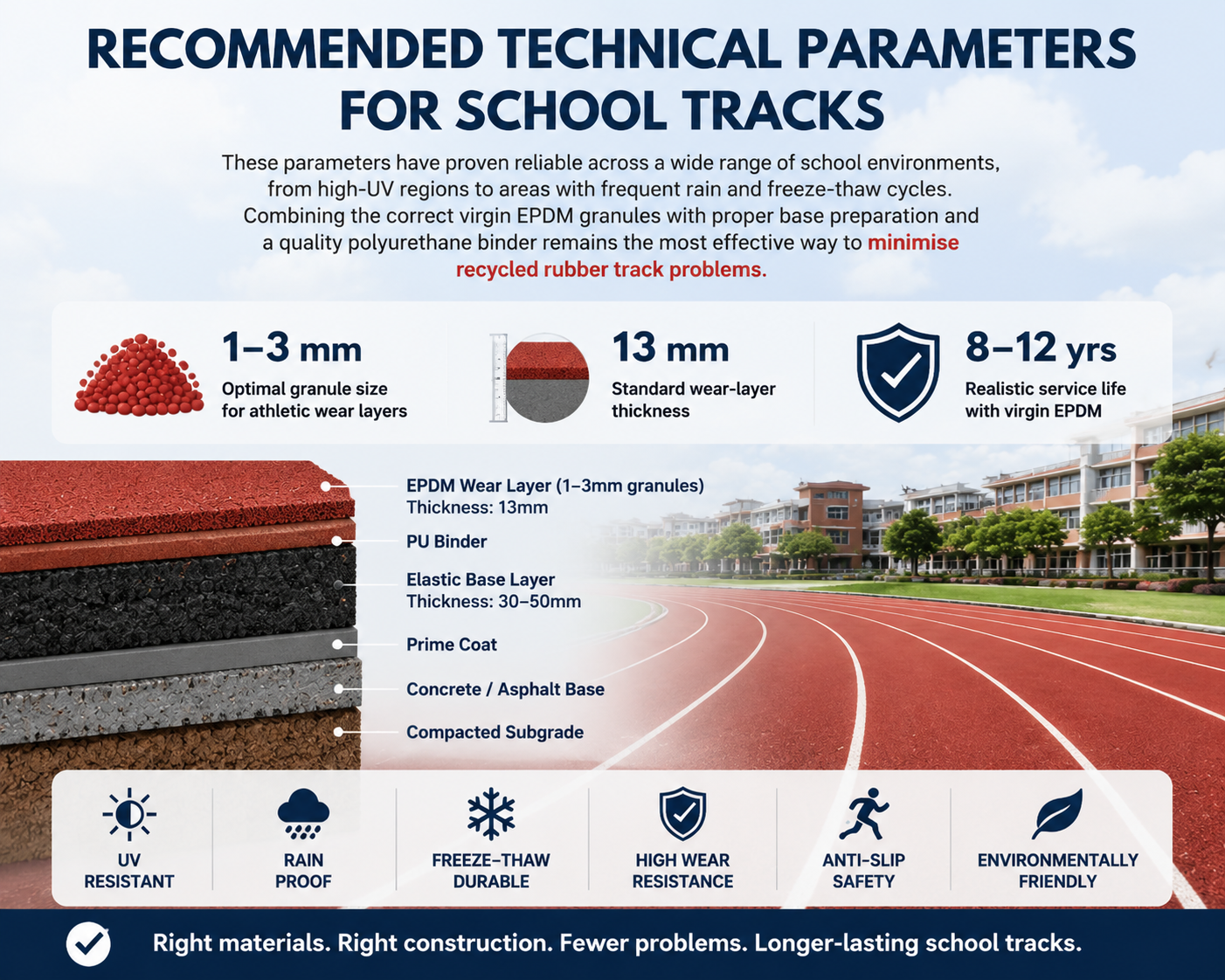
Optimal granule size for athletic wear layers
Standard wear-layer thickness
Realistic service life with virgin EPDM
These parameters have proven reliable across a wide range of school environments, from high-UV regions to areas with frequent rain and freeze-thaw cycles. Combining the correct virgin EPDM granules with proper base preparation and a quality polyurethane binder remains the most effective way to minimise recycled rubber track problems.
Total Cost of Ownership: The Real Financial Picture
Focusing only on the initial quote is the most expensive decision many schools make. Recycled rubber systems may appear 15–30% cheaper at the tender stage, yet they frequently require patch repairs, partial resurfacing or complete replacement within a few years. When the costs of maintenance, athlete injury management and lost training time are added, the cheaper option almost always becomes the more expensive one.
In contrast, tracks built with quality virgin EPDM granules for school track use typically deliver 8–12 years of reliable service with only routine cleaning and minor upkeep. The result is a lower total cost of ownership and far less disruption to the school’s athletic programme.
Facilities teams that switched from recycled or economy granules to genuine virgin EPDM consistently report the same experience: the surface stays cleaner, colour remains stable, athletes complain less about hard or soft spots, and the need for emergency repairs drops dramatically. Most conclude that specifying the right material from the beginning would have been significantly cheaper than correcting the problems later.
Making the Right Choice for Your School
Recycled rubber track problems are predictable and avoidable. The most effective solution is to specify and install genuine virgin EPDM granules for school track surfaces from the outset.
Virgin EPDM granules deliver superior colour retention, consistent impact absorption, minimal granule loss and a service life that actually matches the expectations of schools, coaches and athletes. These advantages translate directly into lower long-term costs and better protection for the students who use the track every week.
If your school is planning a new track or preparing to resurface an existing one, request samples and full technical data from manufacturers who specialise in athletic-grade virgin EPDM. Physical comparison remains the clearest way to separate marketing claims from real performance.
Technical specifications, current pricing and free sample packs are available at jflysports.com/contact-us.
Request Free Virgin EPDM Granules Samples
We produce 100% virgin colored EPDM granules in standard athletic colours and multiple size ranges. Sample packs include technical data sheets and are shipped within five working days. No minimum order quantity for evaluation samples.