

Cricket is one of the few sports where the playing surface is treated as a technical variable in the game itself — and yet, the areas surrounding that surface are almost universally neglected. The pitch gets obsessive care. The outfield is managed. Everything else — the practice nets, the pavilion surrounds, the changing room floors, the boundary path — is often left to whoever is cheapest at the time. This guide is about fixing that.
First, Understand What a Cricket Ground Actually Requires
A cricket ground is not one surface. It is five or six distinct surfaces, each with completely different demands — and confusing them is where most facility managers go wrong.
The playing pitch itself is a specialist’s domain: curated clay soil, meticulous rolling, grass height measured in millimetres. No rubber surface product belongs anywhere near a match pitch. That’s not what this article is about.
But everything surrounding that pitch — the run-up zones, the practice facilities, the outfield edges, the player corridors, the spectator areas — all of those are legitimate candidates for modern rubber and synthetic flooring systems. And most cricket grounds are still using poured concrete, cracked tarmac, or bare mud in these areas because nobody has ever made the case for doing better.
Here is that case.
EPDM Rubber Tiles
EPDM Rubber Tiles
Artificial Turf System
Interlocking Tiles
EPDM Rubber Tiles
EN 1177 EPDM
Practice Net Floors: The Most Under-Specified Surface at Every Cricket Club
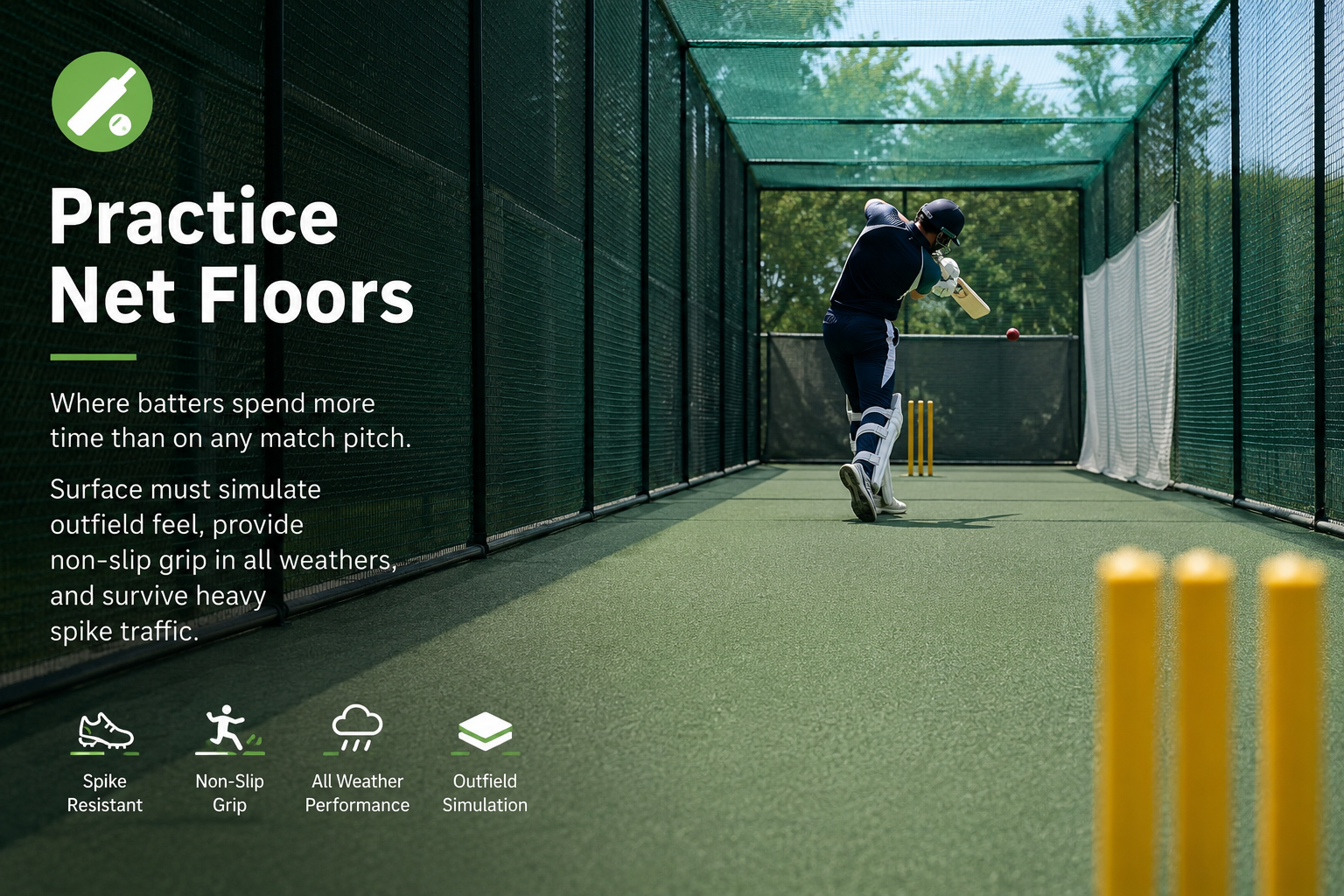
Ask a cricket club where their practice nets are laid and you’ll often hear one of two answers: tarmac, or concrete. Both are wrong, and every player who has batted in those nets knows it — the uneven bounce, the hard surface underfoot during long sessions, the way the ball skids unpredictably off an aged surface.
The purpose of a practice net is to simulate match conditions and build reliable technique. A surface that produces unpredictable bounce or tires out batters faster than a real pitch does is actively working against that goal.
What the Surface Needs to Do
-
Consistent pace and bounce: The ball should behave the same on the 100th delivery as on the first. Cracked tarmac and uneven concrete both produce irregular bounce that trains bad habits.
-
Spike grip: Batting in soft spikes or rubber-soled shoes requires a surface that provides traction without becoming slippery when wet. EPDM rubber tiles perform this well — the granule texture grips spikes cleanly in all weather.
-
Impact cushioning for long sessions: A batter spending three hours in the nets on concrete develops knee and ankle fatigue that has nothing to do with cricket. A 20–25mm rubber surface provides meaningful cushioning over extended practice sessions.
-
Durability under repeated bowling impact: The bowling crease area receives extreme localised impact from fast bowlers landing repeatedly in the same spot. A rubber tile surface distributes this load and maintains structural integrity; concrete cracks and tarmac deforms.
Pavilion and Changing Rooms: Where Hygiene and Safety Have to Coexist
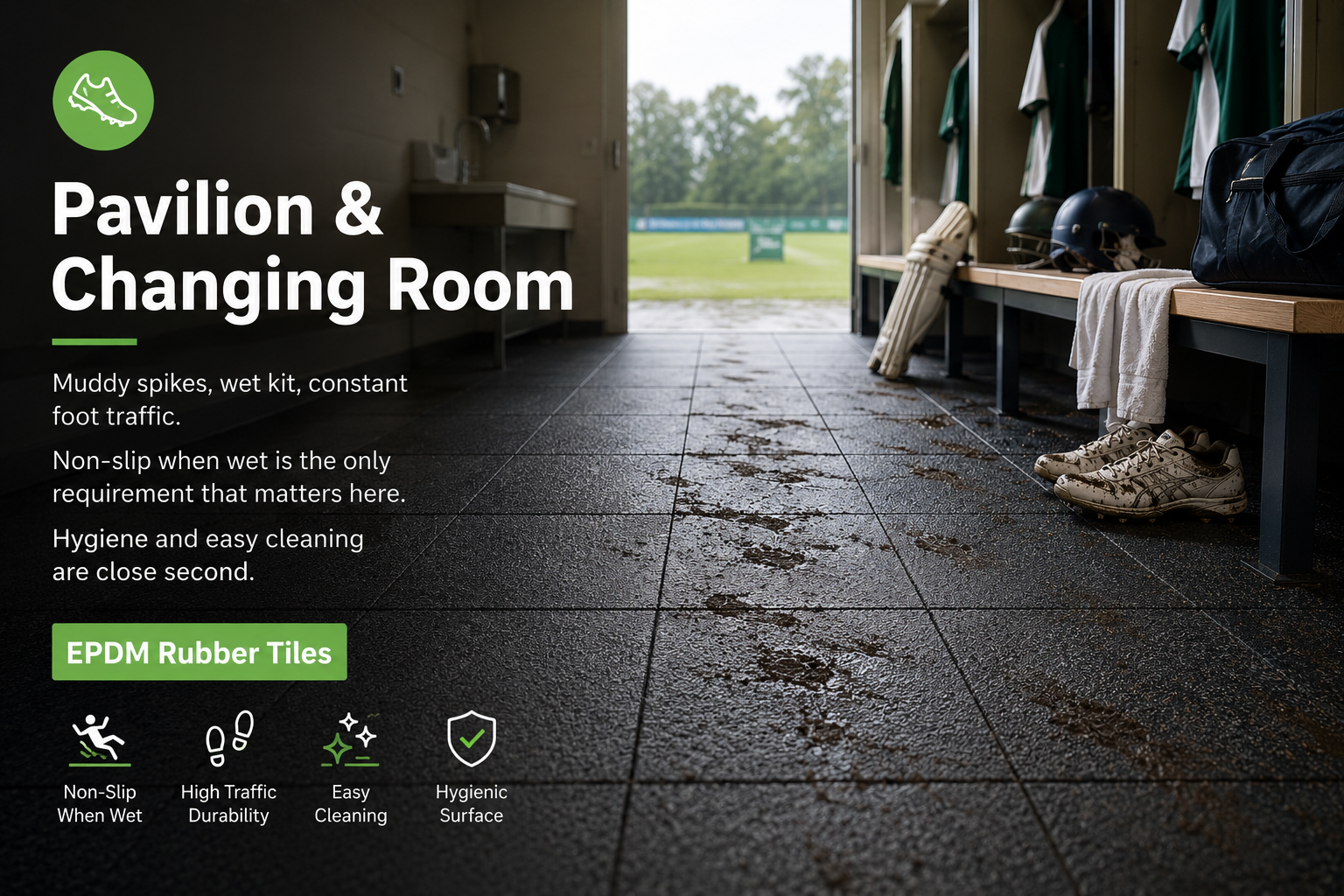
Cricket changing rooms are among the most demanding flooring environments in any sport. Players arrive from the field with mud-packed spikes, wet kit, and grass stains. The floor takes a constant cycle of wet and dry, heavy boots and bare feet, and needs to be cleaned quickly between sessions.
The most common changing room flooring at cricket clubs is bare concrete, painted concrete, or vinyl sheeting. All three become dangerously slippery when wet. Vinyl lifts at the edges under spike traffic. Painted concrete chips, leaving rough patches that catch bare feet.
EPDM rubber tiles solve all three problems simultaneously. The textured granule surface maintains slip resistance when wet — which in a cricket changing room means almost always. The tiles interlock without adhesive, meaning they can be lifted for cleaning beneath and replaced individually if a tile is damaged by a particularly aggressive boot stud. And unlike vinyl, EPDM doesn’t lift at the edges under repeated spike impact.
What to Specify for Changing Rooms
15mm EPDM tiles in a mid-tone neutral — dark grey or slate — for the main changing area. Open-grid drainage base tiles for shower areas where water volume is higher. Edge strips along all transitions to external corridor surfaces. Keep the color choice practical: light colors show dirt; very dark colors show chalk from boots. Mid-grey is the most maintenance-friendly choice for a cricket changing room.
If the facility has a junior section, verify PAH and REACH certification for any tiles in areas where children will be in direct contact — standard practice for any surface with regular child use.
Artificial Practice Pitches: A Different Product Entirely
Let’s be clear about something that causes a lot of confusion in the market: an artificial cricket pitch is not the same product as a rubber sports tile, and the two should not be conflated.
An artificial pitch — the kind used for school and club practice wickets — consists of a polyurethane or rubber shock pad base layer, topped with a specifically engineered artificial turf surface that replicates the pace and bounce characteristics of a natural cricket pitch. The specification is technical and product-specific: different surfaces produce different ball behaviour, and choosing incorrectly for your local conditions and playing standard produces a practice facility that trains the wrong habits.
The market for artificial cricket pitches contains significant variation in quality. Budget surfaces use generic artificial turf pile heights and densities that were never designed for cricket — they produce low, skiddy deliveries that look nothing like a real pitch. Performance surfaces are engineered with specific pile characteristics, backing systems, and shock pad configurations that produce realistic pace and bounce across a wide range of temperatures and weather conditions.
If you’re specifying an artificial practice pitch, ask the supplier for: the recommended shock pad thickness for your expected bowling pace range; independent bounce and pace test data if available; and a list of comparable facilities using the same product — ideally facilities at your level of play so the comparison is meaningful.
Boundary Paths and Public Areas: The Safety Surface Nobody Budgets For
Every cricket ground has a player and official walkway running around at least part of the boundary — and at most grounds, this surface is bare compacted earth, worn grass, or crumbling tarmac. On match days, umpires, fielding substitutes, and groundstaff walk this circuit dozens of times. Spectators stand and walk along it. Elderly members use it as the main route around the ground.
A single slip on a wet boundary path is a serious incident. At a professional or semi-professional ground, it’s also a liability event.
EPDM interlocking tiles for boundary path applications don’t need to be elaborate. A single color — dark green to blend with the outfield — at 20mm thickness over a compacted hardcore base provides a defined, all-weather, non-slip surface that requires essentially no maintenance beyond occasional sweeping. The floating interlocking installation means no excavation of the existing surface, and the tiles can be lifted temporarily if groundstaff need access for pitch irrigation infrastructure or boundary cable runs.
How the Zones Come Together: Specifying a Whole Ground
| Zone | Recommended Surface | Thickness | Key Cert | Approx. Cost (FOB) |
|---|---|---|---|---|
| Practice net floor | EPDM interlocking tiles | 20–25mm | PAH + REACH | $18–$28/m² |
| Changing room main | EPDM interlocking tiles | 15mm | PAH + REACH | $14–$20/m² |
| Shower / wet area | EPDM open-grid drainage tiles | 15mm | PAH + REACH | $16–$24/m² |
| Boundary path | EPDM interlocking tiles | 20mm | PAH + REACH | $18–$26/m² |
| Junior play area | EN 1177 certified EPDM tiles | 40mm | EN 1177 + PAH + REACH | $34–$50/m² |
| Artificial practice pitch | Cricket-specific turf system | Varies | Pace + bounce data | Quote required |
Three Questions Worth Asking Before You Specify Anything
1. Does your ground host juniors? If children under 18 use any part of the facility — junior cricket, after-school sessions, community use — the surfaces they contact need PAH and REACH certification. For any area with play equipment, EN 1177 is required. This isn’t optional and it’s not negotiable; it’s the legal baseline for child safety compliance.
2. Is the installation permanent or seasonal? EPDM interlocking tiles are fully removable. If your ground is shared with another club or another sport during winter months, or if you need to remove the practice net flooring for ground maintenance, the floating tile system allows this without any damage to the surface or substrate beneath. Factor this flexibility into your decision — it’s one of the reasons rubber tiles consistently outperform poured alternatives in multi-use facilities.
3. What’s your realistic maintenance budget per year? A rubber tile surface at a cricket ground requires almost no maintenance: sweep regularly, pressure wash annually, replace individual damaged tiles as needed. Poured surfaces require crack-filling, repainting, and eventual full resurfacing. Over ten years, the maintenance cost difference is typically significant — and it rarely gets factored into the initial specification decision.
The Honest Summary
Cricket clubs and grounds invest serious money in their pitch, their squares, and their outfield — and spend almost nothing on the surfaces that players and officials use every single day. The changing room floor, the practice net surface, the boundary path: these are not afterthoughts. They affect player safety, training quality, and the impression the ground makes on visitors.
EPDM interlocking rubber tiles address most of these areas with a single product system — consistent specification, matching colors, one supplier relationship, one documentation set. That simplicity has real value when you’re managing a facility on a limited committee budget with volunteer groundstaff.
The pitch will always get the attention it deserves. Give the rest of the ground the same thought — and it will show.
For full pricing, samples, and certification documentation, contact us at jflysports.com/contact-us — or read the EPDM Interlocking Tiles Buyer’s Guide →
Flooring for Every Part of Your Cricket Ground
We supply EPDM interlocking rubber tiles for practice nets, changing rooms, boundary paths, and junior play areas — with full PAH, REACH, and EN 1177 documentation where required. Free samples. Competitive pricing from 50m².
Request Samples & Ground Specification
Read the Buyer’s Guide