

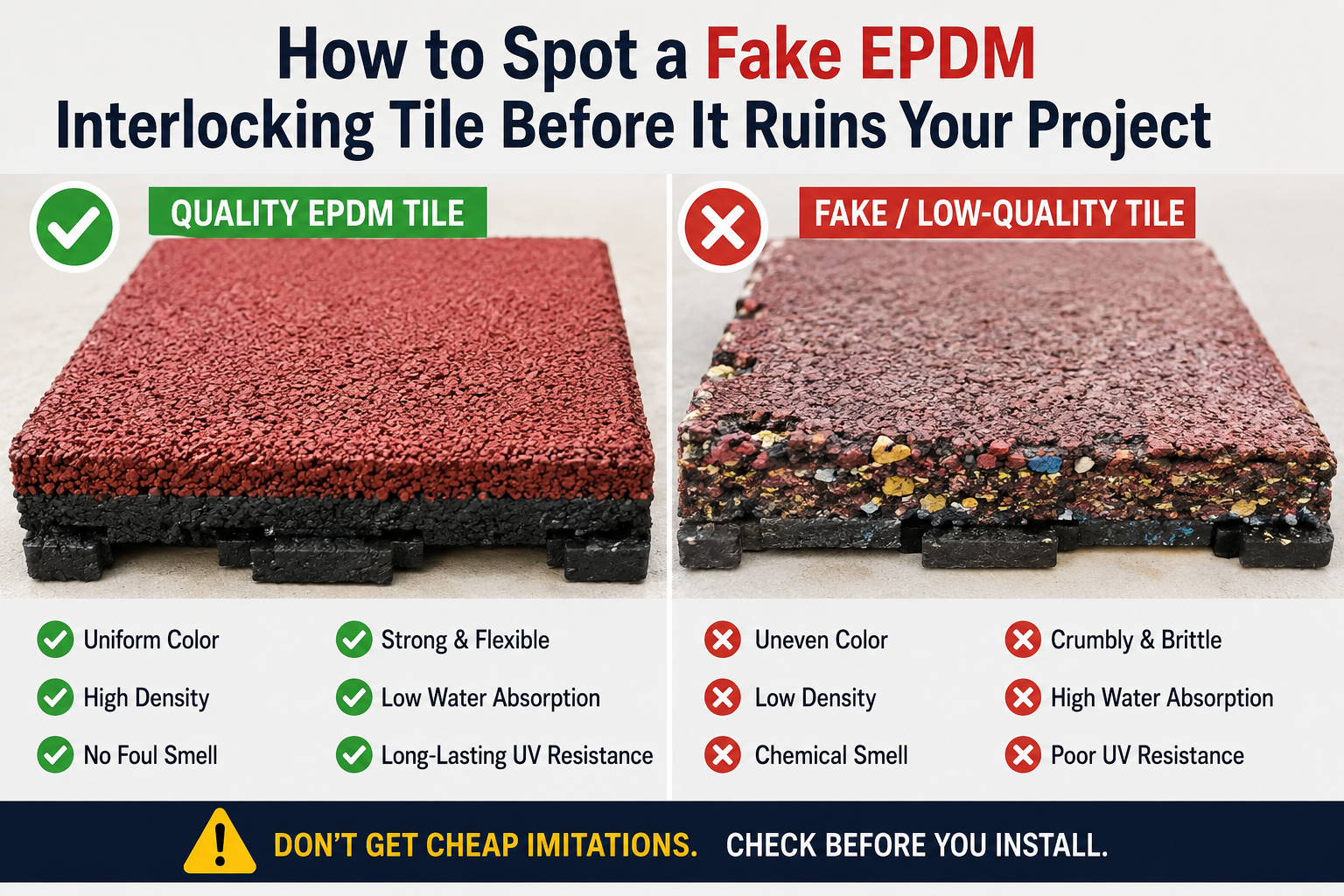
Every week, somewhere in the world, a school playground gets resurfaced with tiles that look exactly like EPDM — but aren’t. The tiles install fine, look good for a season, then start fading, cracking, and failing EN 1177 re-tests. The project manager is confused. The budget is gone. The playground gets closed. None of this needed to happen. Here is how to make sure it doesn’t happen to you.
The Problem Isn’t Dishonest Suppliers. It’s That You Can’t Tell the Difference.
This is the uncomfortable truth about the EPDM interlocking tile market: a tile containing 60% virgin EPDM and 40% recycled SBR looks identical to a 100% virgin tile on the day it’s delivered. Same color. Same texture. Same dimensions. The factory took a certified product formulation and quietly adjusted the raw material ratio to reduce costs — and nobody checks.
It’s not always deliberate fraud. Sometimes it’s a factory substituting raw materials mid-production run when virgin EPDM spot prices spike. Sometimes it’s a distributor selling last season’s stock mixed with new product. Sometimes it’s a trading company sourcing from whichever factory is cheapest that week.
The result is the same: your surface underperforms, fades early, and may fail chemical safety requirements for children’s environments. And by the time you find out, the tiles are installed, the project is signed off, and the supplier is very difficult to reach.
What “Fake EPDM” Actually Means
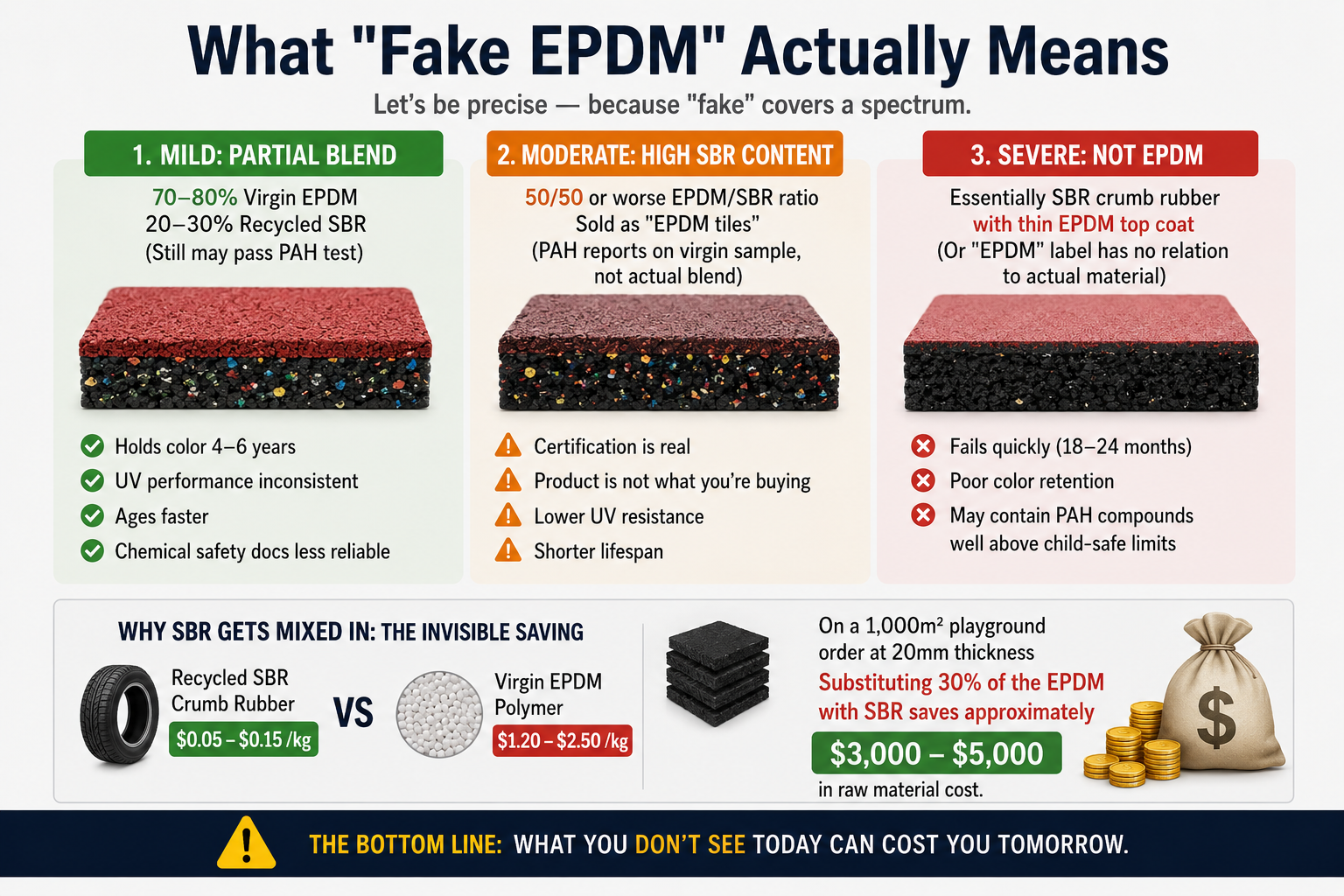
Let’s be precise — because “fake” covers a spectrum.
At the mild end: tiles labelled as “EPDM” that contain 70–80% virgin EPDM blended with 20–30% recycled SBR crumb rubber. These tiles might still pass a PAH test. They’ll probably hold their color reasonably well for 4–6 years. But they age faster, the UV performance is inconsistent, and the chemical safety documentation is less reliable than it appears.
In the middle: tiles with 50/50 or worse EPDM/SBR ratios, sold as “EPDM tiles” with PAH reports that were conducted on a virgin-content sample — not the actual production blend. The certification is technically real. The product it describes is not what you’re buying.
At the severe end: tiles that are essentially SBR crumb rubber with a thin EPDM top coat, or tiles where the “EPDM” label has no relationship to the actual material at all. These fail quickly, often within 18–24 months, and may contain PAH compounds well above child-safe limits.
The Five Signals You Can Catch Before the Tiles Arrive
You cannot reliably identify a blended tile by looking at it. But you can identify a blended-tile supplier long before you place an order. Here is where to look.
Signal 1: The Price
Virgin EPDM interlocking tiles have a real material cost floor. In 2025, 20mm virgin EPDM interlocking tiles from a legitimate Asian manufacturer should be priced at $18–$26/m² FOB. If you’re being quoted $10–$13/m² for “virgin EPDM” 20mm tiles, the math doesn’t work. Either the material isn’t what it claims to be, or the quality control processes aren’t in place to ensure it is.
This doesn’t mean the most expensive supplier is best. But it does mean there’s a floor below which you should be asking hard questions.
Signal 2: The Speed of Certification Response
A manufacturer who produces certified virgin EPDM tiles has a documentation system that runs constantly — test reports are updated annually, declarations of conformity are maintained, material composition certificates are filed by product line. When you ask for these documents, they exist and they arrive within 24–48 hours.
A manufacturer who is blending materials without proper documentation will hedge. “We can provide that after you confirm the order.” “Our R&D department is updating the certificate.” “Let me check with our quality team.” These aren’t necessarily lies — but they’re signals that the documentation infrastructure you need doesn’t exist in a usable form.
Signal 3: PAH Report Specificity
This is the most important document check. Ask the supplier for the PAH test report, then look at three things:
- Is the issuing laboratory ISO/IEC 17025 accredited? (You can verify this on the accreditation body’s website — UKAS, DAkkS, CNAS, A2LA depending on country.)
- Does the report describe the specific product and color you’re buying — not a generic “EPDM rubber product”?
- What are the individual benzo[a]pyrene and total PAH values? They should be comfortably below ZEK 01.4-08 limits, not at the limit.
A report for “EPDM rubber compound, red, 40mm tile, batch XY-2024” from a named accredited lab tells you something real. A report for “EPDM rubber product” from a lab you can’t find on any accreditation register tells you nothing.
Signal 4: The Odor of the Sample
Request physical tile samples before any order — this is non-negotiable. When the sample arrives, open it and smell it. Virgin EPDM has a mild, clean rubber smell that fades within a few hours in open air. Recycled SBR crumb rubber has a stronger, sharper, more persistent petroleum-like odor. A sample with a strong smell that doesn’t fade after several hours of airing is almost certainly not 100% virgin EPDM.
This isn’t a laboratory test. It’s a field check — imperfect but fast. Use it as a screening step, not a final verification.
Signal 5: The Material Composition Certificate
Ask for it by name. “Please provide a material composition certificate confirming 100% virgin EPDM polymer content with no recycled SBR.” This is a standard document that any legitimate manufacturer produces as part of their quality management system. It’s not a certification — it’s an internal declaration that should be provided on company letterhead, signed by a quality or technical director, and specific to the product you’re buying.
If a supplier doesn’t have this document, or provides a generic statement that doesn’t address SBR content specifically, don’t order. Full stop.
The Three Tests You Can Run When the Tiles Arrive
Even after a careful pre-order evaluation, run these checks when your first trial order arrives. They take 20 minutes and they’ve caught problems that slipped through the documentation stage.
-
The Visual Spread TestSpread 20–30 granules from the tile surface (if loose surface granules are present) or cut a small piece from the tile edge and examine the cross-section. Virgin EPDM granules are uniformly colored throughout — cut a granule in half and the interior color matches the exterior. Recycled SBR particles often have a different interior color or texture, and you’ll sometimes see black or dark grey particles mixed into a supposedly colored tile if the SBR content is high enough.
-
The Dimensional CheckMeasure the tile at five points: each corner and the centre. Record thickness. Acceptable variance is ±0.3mm. A tile that measures 20.4mm at one corner and 19.1mm at another is telling you the manufacturing process lacks the quality control to produce consistent output — which also tells you the material formulation control is likely inconsistent. Consistent dimensions are a proxy for consistent production standards overall.
-
The Connection Consistency TestConnect all four sides of your sample tile to additional tiles and check the joint at each connection. A flush, firm connection on all four sides with consistent resistance means the connector profiles are within dimensional tolerance across the tile. If one side engages easily and another requires force, or if connected tiles rock slightly, the connector profiles are inconsistent — which means you’ll have installation problems at scale that cannot be corrected once tiles are laid.
What Happens When You Skip This Process
The most common story we hear from buyers who’ve had problems goes like this: they found a supplier online, got a competitive quote, received a certificate attached to an email, and placed the order because the price was right and the timeline was tight. The tiles arrived looking correct. Installation went fine. The client was happy.
Then, at the 3-year maintenance inspection, the playground safety inspector notes that several tiles in the equipment zones have hardened and the surface is no longer achieving the required CFH. The tiles are replaced under warranty claim — but the supplier disputes it, pointing out that EN 1177 wasn’t explicitly specified in the purchase order. Meanwhile, the PAH report that was provided turns out to be for a different product entirely. The playground closes for two weeks during the dispute. Legal fees follow.
The original saving on tile price: approximately $3,000. The total cost of the dispute, replacement, and operational closure: significantly more.
A Practical Verification Checklist
Here is the exact sequence to follow before placing any EPDM interlocking tile order. It takes one to two weeks. It prevents the scenario above.
| Stage | What to Request | Pass Signal | Fail Signal |
|---|---|---|---|
| Initial enquiry | Price + material composition certificate + PAH report (color-specific) | Documents provided within 48hrs, lab name visible on report | Price only, documents “available after order,” or no lab accreditation visible |
| Document check | Verify lab accreditation on national body website | Lab found in accreditation register, active status confirmed | Lab not found, accreditation expired, or lab is the manufacturer’s own facility |
| Sample request | Two full tiles per color/thickness + edge strip piece | Full tiles dispatched within 5 days with tracking number | Only chips or photos sent, no tracking number, takes more than 10 days |
| Sample evaluation | Odor, dimensions, connection, color in daylight, visual purity | Mild smell, consistent dimensions ±0.3mm, flush connections all sides | Strong persistent odor, dimension variance >0.5mm, loose or step connections |
| Trial order | 50–100m² with COA per batch | Shipment matches sample, COA provided, all documents match PO spec | Color variation from sample, no COA, documents differ from agreed spec |
The Bottom Line
The tiles that ruin projects look exactly like the tiles that don’t. The only reliable way to distinguish them is through documentation, physical sampling, and a systematic pre-order verification process — not visual inspection of the finished product.
That process takes one to two weeks and costs nothing beyond your time. The alternative — discovering the problem after installation — costs significantly more in every dimension: money, time, reputation, and in playground safety applications, potential liability.
The best EPDM interlocking tile suppliers expect these questions. They answer them quickly, with data, because they’ve built the quality systems that make the answers easy. Use that response quality as your primary supplier signal — it tells you more than any certificate ever will.
For the full specification, pricing, and supplier evaluation framework, see our EPDM Interlocking Rubber Tiles Complete Buyer’s Guide →
We Show Our Working
Material composition certificate, PAH reports (color-specific, accredited lab), REACH declaration, EN 1177 CFH test reports, dimensional tolerance specification, UV stability data per color — all provided before you commit to anything. Free samples dispatched within 5 business days.