

EPDM interlocking rubber tiles for playground use must be EN 1177 certified at the specific thickness and Critical Fall Height required for your equipment. Specifying the right tile is not a material preference — it is a safety and legal compliance requirement. This guide explains exactly how EN 1177 applies to interlocking tiles, how to read CFH test reports, and what to request from your supplier.
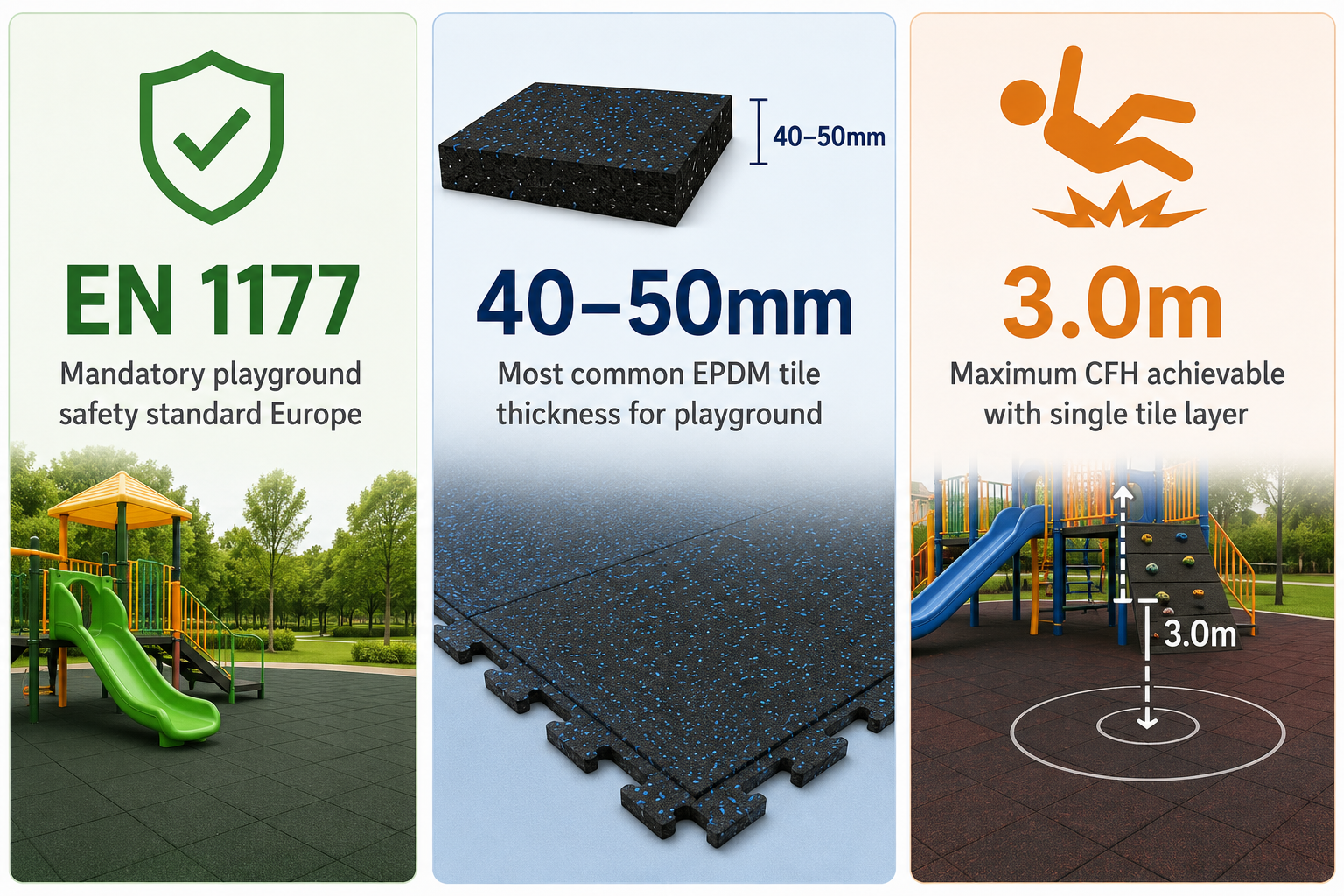
Mandatory playground
safety standard Europe
Most common EPDM tile
thickness for playground
Maximum CFH achievable
with single tile layer
For playground use, specify 40mm EN 1177 certified virgin EPDM interlocking tiles for equipment up to 1.5m fall height, or 50mm tiles for equipment up to 2.5–3.0m. Always verify the actual CFH value from the EN 1177 test report for your specific tile product — never assume CFH from thickness alone. Additionally require PAH certification (ZEK 01.4-08) and REACH compliance documentation.
For the complete buyer’s guide including pricing, colors, and supplier selection, see our EPDM Interlocking Rubber Tiles Complete Buyer’s Guide.
Understanding EN 1177 for Interlocking Tiles
EN 1177:2018 is the European standard for impact attenuating surfacing beneath playground equipment. It defines the Critical Fall Height (CFH) — the maximum height from which a child can fall onto the surface without sustaining a life-threatening head injury. The standard mandates that the surfacing system under any piece of playground equipment must be certified for a CFH at least equal to the maximum free-fall height of that equipment.
For interlocking rubber tiles, EN 1177 certification is product-specific and thickness-specific. A 40mm tile from one manufacturer may achieve 1.5m CFH; a 40mm tile from a different manufacturer may achieve 1.2m CFH or 1.8m CFH depending on rubber density, hardness, and construction. This is why you must always request the EN 1177 test report for the specific tile product and thickness you are specifying — not a generic “EN 1177 compliant” declaration.
Typical CFH Values by Tile Thickness
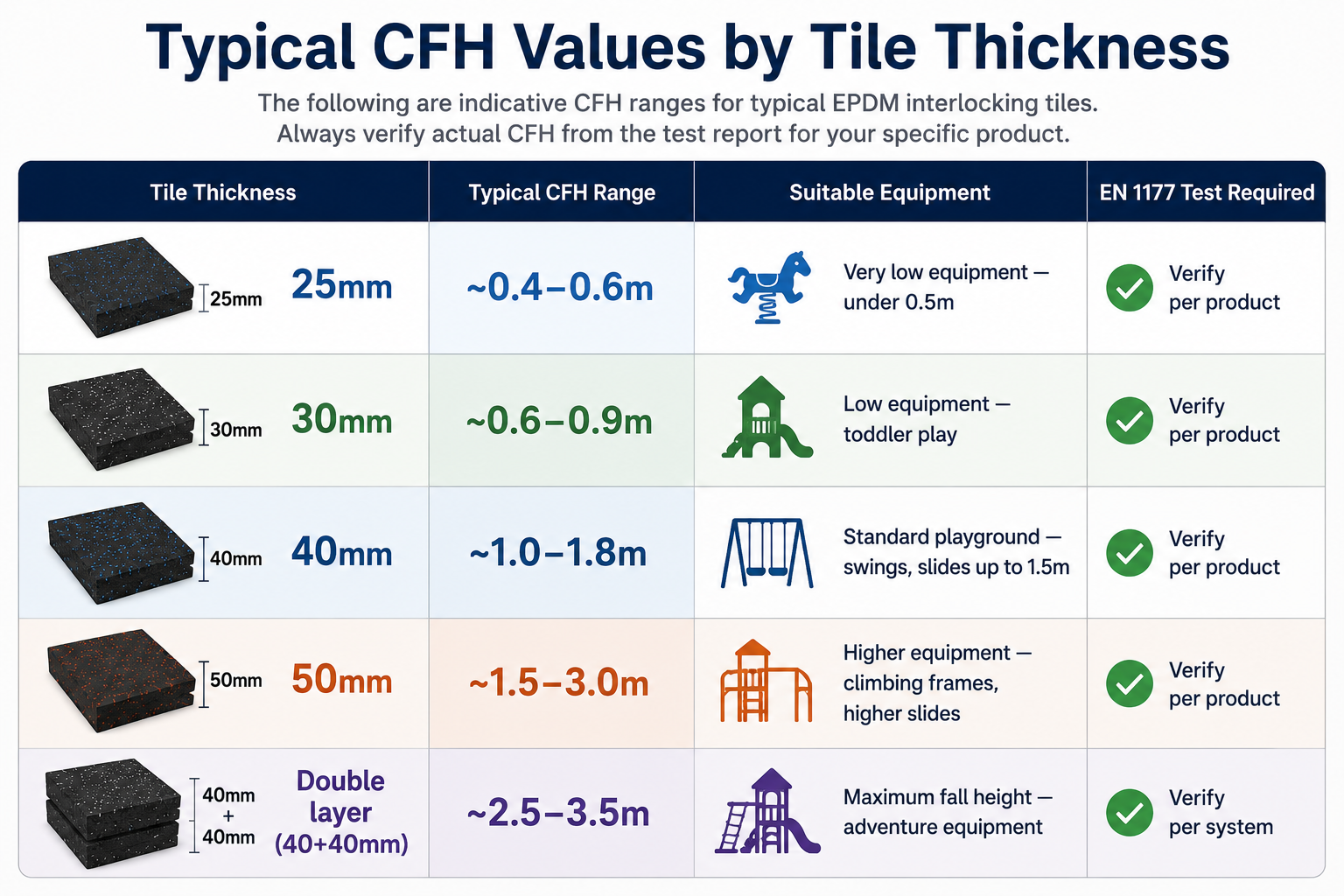
The following are indicative CFH ranges for typical EPDM interlocking tiles. Always verify actual CFH from the test report for your specific product.
| Tile Thickness | Typical CFH Range | Suitable Equipment | EN 1177 Test Required |
|---|---|---|---|
| 25mm | ~0.4–0.6m | Very low equipment — under 0.5m | ✅ Verify per product |
| 30mm | ~0.6–0.9m | Low equipment — toddler play | ✅ Verify per product |
| 40mm | ~1.0–1.8m | Standard playground — swings, slides up to 1.5m | ✅ Verify per product |
| 50mm | ~1.5–3.0m | Higher equipment — climbing frames, higher slides | ✅ Verify per product |
| Double layer (40+40mm) | ~2.5–3.5m | Maximum fall height — adventure equipment | ✅ Verify per system |
The same nominal thickness from different manufacturers can produce significantly different CFH values depending on rubber density and hardness. A supplier claiming “40mm EN 1177 compliant for 1.5m CFH” must back this with a full EN 1177 test report from an accredited laboratory — not a declaration letter or catalog specification sheet. Always verify with the actual test report before specifying.
How to Read an EN 1177 Test Report
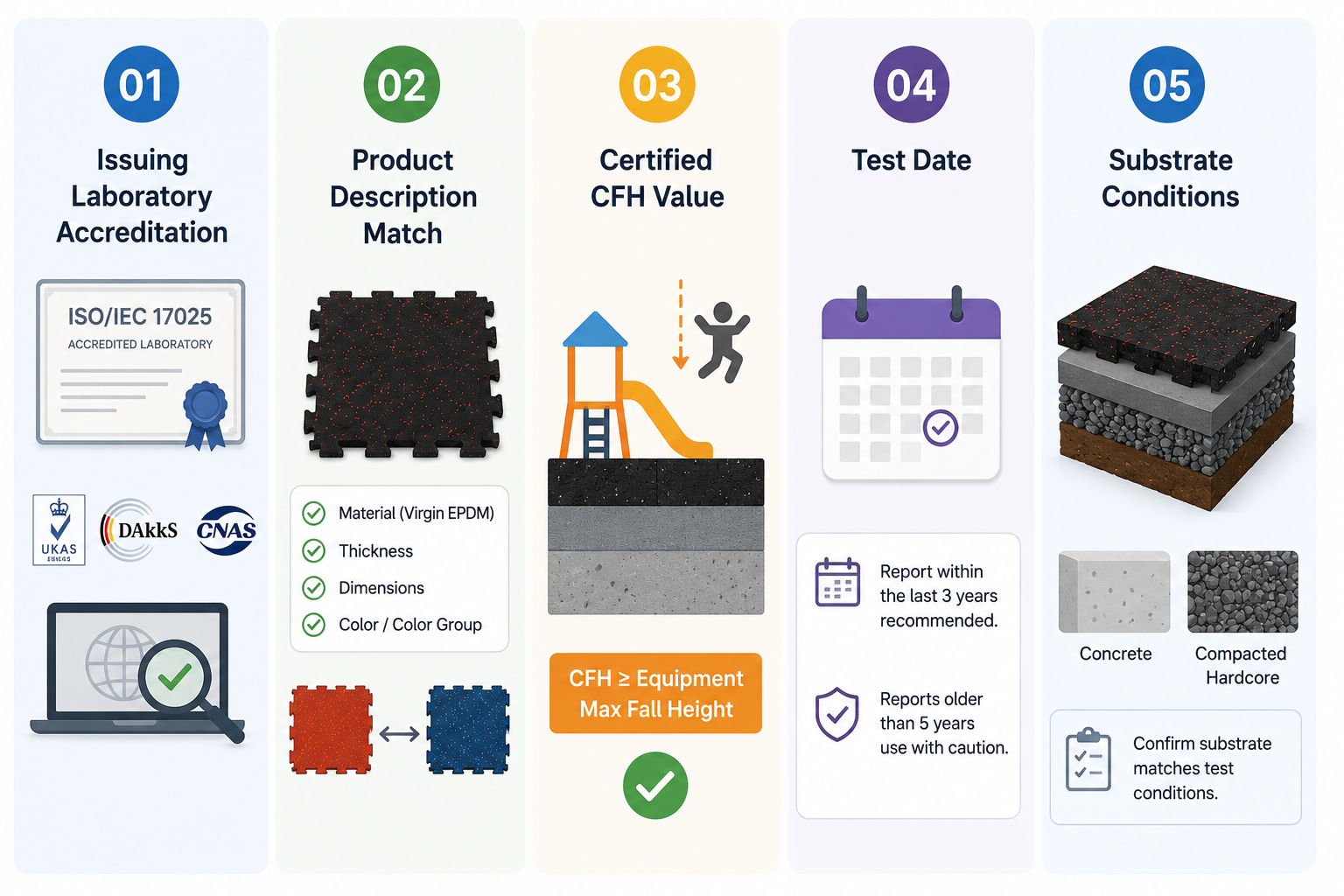
When your supplier provides an EN 1177 test report, check these five elements before accepting it as valid documentation for your project:
The laboratory must be accredited under ISO/IEC 17025 by a recognized national accreditation body. The accreditation body name and the laboratory’s accreditation number must appear on the report. Check the lab’s accreditation status independently through the national body’s website (UKAS for UK, DAkkS for Germany, CNAS for China). A test report from an unaccredited laboratory has no regulatory standing.
Confirm the product description in the report matches your specification: tile material (virgin EPDM), tile thickness, tile dimensions, and tile color or color group. If the report describes “40mm virgin EPDM 500×500mm red tile” and you are ordering blue tiles of the same product line, request a separate report for the blue color — or written confirmation from the manufacturer that the blue tile uses identical compound formulation to the tested red tile.
The report must state the actual tested CFH value in metres. This is the number you compare against your equipment’s maximum fall height. If the equipment has a maximum free-fall height of 1.2m, the tile system must have a certified CFH of 1.2m or greater. Confirm the CFH value applies to the tile in the installed configuration — some reports specify CFH for tiles installed over different substrate types.
EN 1177 test reports do not have a formal expiry date, but in practice, reports older than 5 years should be treated with caution — tile compound formulations can change over time. For new projects, request a report issued within the last 3 years where possible. For public sector procurement, confirm the required maximum report age with your client or specifier.
EN 1177 test reports specify the substrate conditions under which testing was conducted — typically concrete or compacted hardcore. If your playground substrate differs significantly from the test conditions (e.g., installed over asphalt with different stiffness characteristics), the certified CFH may vary slightly from the reported value. For safety-critical installations, confirm substrate conditions with the tile supplier or commission a site-specific EN 1177 test after installation.
Playground Layout: How to Specify Tile Zones Correctly
Different pieces of equipment on the same playground have different maximum fall heights — and therefore different CFH requirements. A correctly specified playground uses zone-specific tile specifications, not a single thickness throughout.
| Equipment Type | Typical Max Fall Height | Required CFH | Recommended Tile Thickness |
|---|---|---|---|
| Toddler play panel / activity wall | 0.4–0.6m | ≥0.6m | 30mm |
| Standard swing (seat) | 0.8–1.0m | ≥1.0m | 40mm |
| Slide (low, up to 1.2m platform) | 1.0–1.2m | ≥1.2m | 40mm |
| Climbing frame / net (up to 1.5m) | 1.5m | ≥1.5m | 40–50mm |
| Higher slide / tower (up to 2.0m) | 2.0m | ≥2.0m | 50mm |
| Adventure / high climbing (up to 3.0m) | 3.0m | ≥3.0m | 50mm double layer |
| Pathway / transition areas | No fall risk | Not required | 20–30mm (surfacing continuity) |
Frequently Asked Questions
Playground EPDM Tile Specification Summary
Article #7 · Series: best EPDM interlocking rubber tiles · ← Back to Buyer’s Guide
EN 1177 Certified EPDM Interlocking Tiles for Your Playground
We supply EN 1177 certified virgin EPDM interlocking tiles in 40mm and 50mm thickness with full PAH and REACH documentation. CFH values confirmed per product and thickness. Free physical samples.
Request EN 1177 Documentation & Samples
Read the Full Buyer’s Guide