

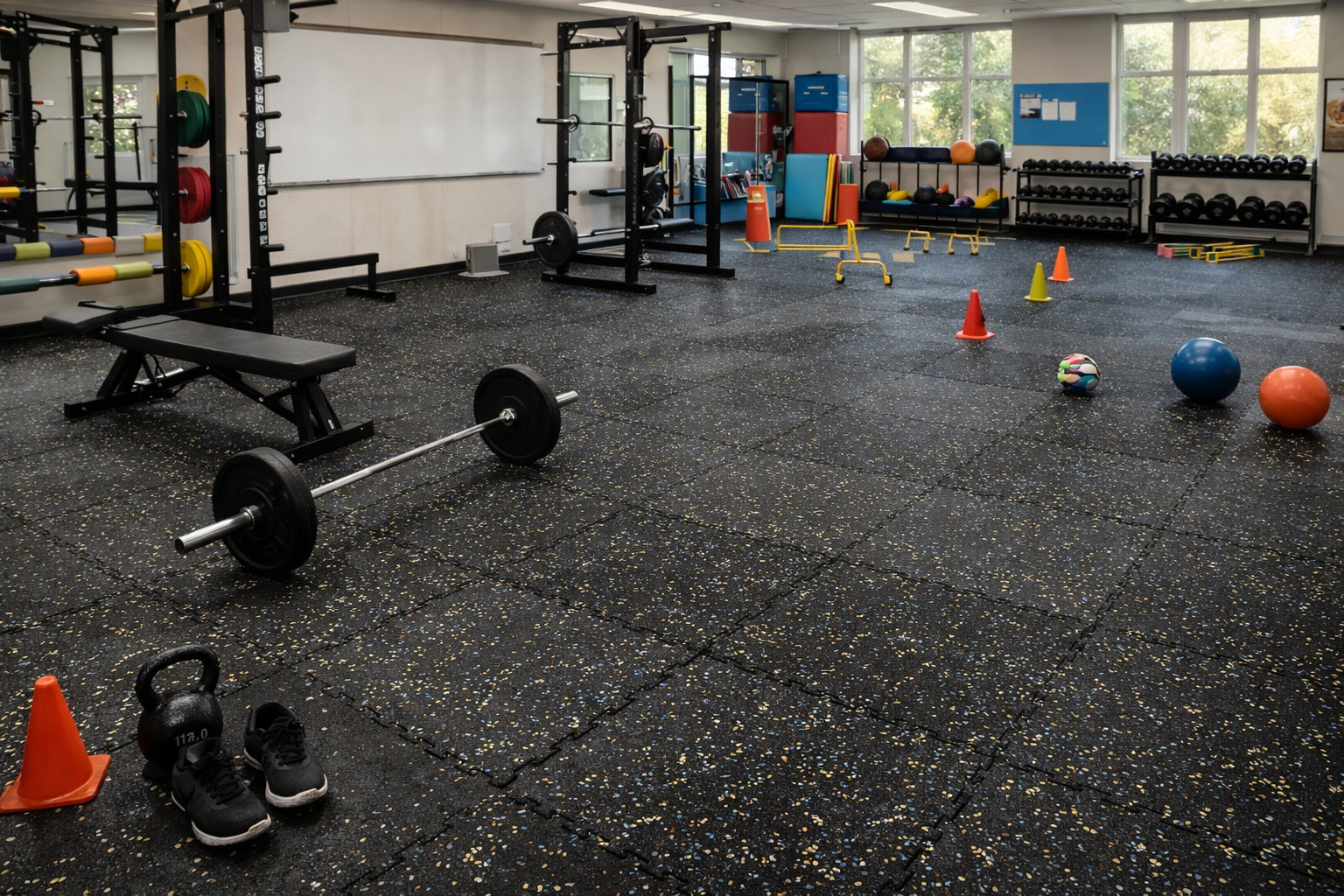
For most gym and sports applications, 20mm EPDM interlocking tiles are the standard specification. Playground safety zones require 40–50mm for EN 1177 compliance. Free weight and Olympic lifting areas need 40mm minimum. Choosing the wrong thickness is the single most common — and most expensive — specification error in interlocking tile procurement.
Standard for gym,
courts & outdoor use
Minimum for free weights
& playground EN 1177
Olympic lifting &
max CFH playground
10mm — yoga, stretching, light indoor use only.
20mm — cardio zones, outdoor courts, pool surrounds, general gym areas.
30–40mm — free weights, CrossFit, powerlifting, outdoor playground under equipment.
50mm — Olympic lifting platforms, maximum fall height playground zones.
For the full EPDM interlocking tile buyer’s guide including pricing, certifications, and supplier selection, see our EPDM Interlocking Rubber Tiles Complete Buyer’s Guide.
Thickness by Application: The Complete Reference Table
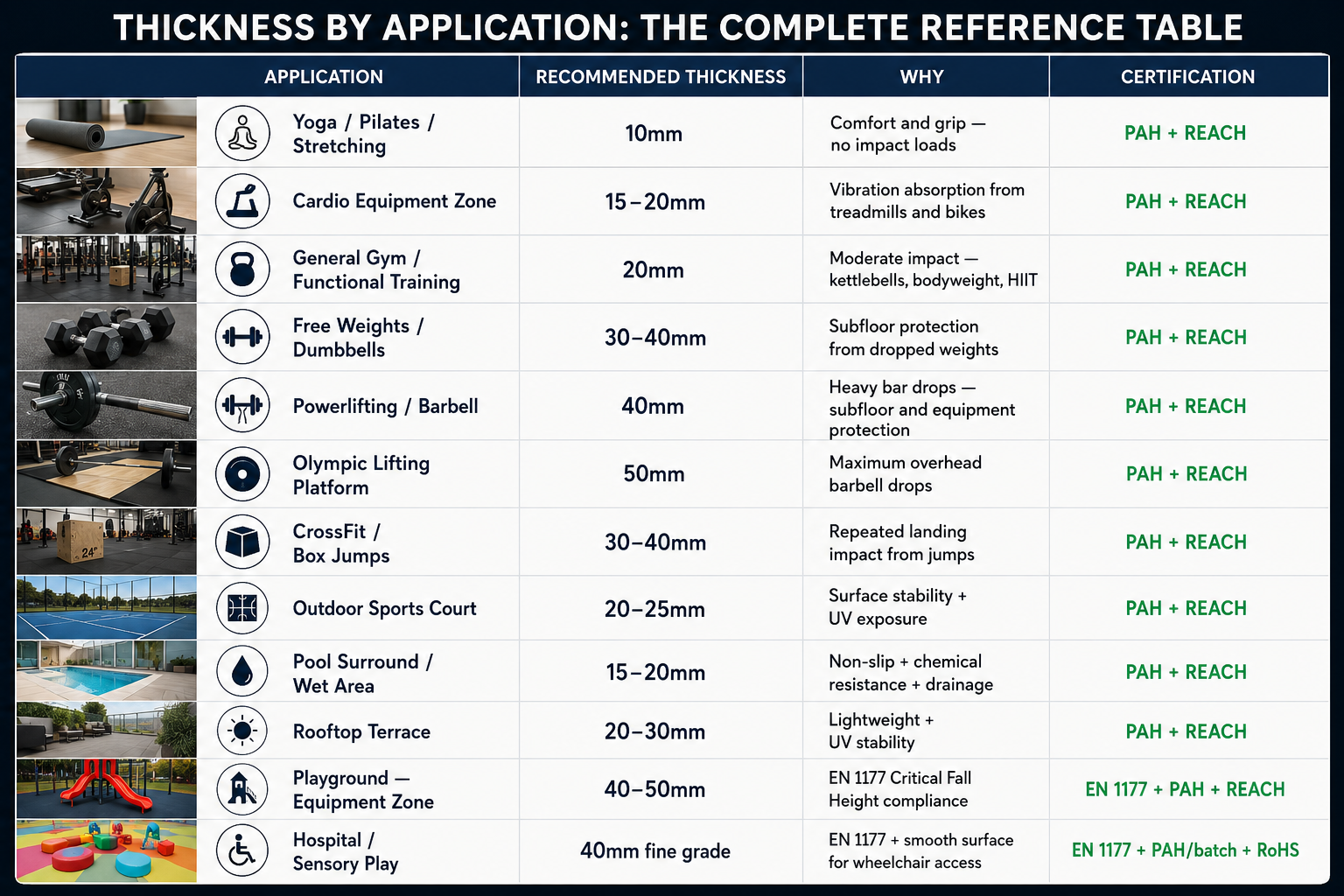
Different applications place fundamentally different demands on flooring thickness. Use this table as your starting specification — then refine based on your specific equipment loads and safety requirements.
| Application | Recommended Thickness | Why | Certification |
|---|---|---|---|
| Yoga / Pilates / Stretching | 10mm | Comfort and grip — no impact loads | PAH + REACH |
| Cardio Equipment Zone | 15–20mm | Vibration absorption from treadmills and bikes | PAH + REACH |
| General Gym / Functional Training | 20mm | Moderate impact — kettlebells, bodyweight, HIIT | PAH + REACH |
| Free Weights / Dumbbells | 30–40mm | Subfloor protection from dropped weights | PAH + REACH |
| Powerlifting / Barbell | 40mm | Heavy bar drops — subfloor and equipment protection | PAH + REACH |
| Olympic Lifting Platform | 50mm | Maximum overhead barbell drops | PAH + REACH |
| CrossFit / Box Jumps | 30–40mm | Repeated landing impact from jumps | PAH + REACH |
| Outdoor Sports Court | 20–25mm | Surface stability + UV exposure | PAH + REACH |
| Pool Surround / Wet Area | 15–20mm | Non-slip + chemical resistance + drainage | PAH + REACH |
| Rooftop Terrace | 20–30mm | Lightweight + UV stability | PAH + REACH |
| Playground — Equipment Zone | 40–50mm | EN 1177 Critical Fall Height compliance | EN 1177 + PAH + REACH |
| Hospital / Sensory Play | 40mm fine grade | EN 1177 + smooth surface for wheelchair access | EN 1177 + PAH/batch + RoHS |
What Each Thickness Level Actually Does
Understanding the engineering rationale behind each thickness tier helps you make the right decision when applications fall between categories.
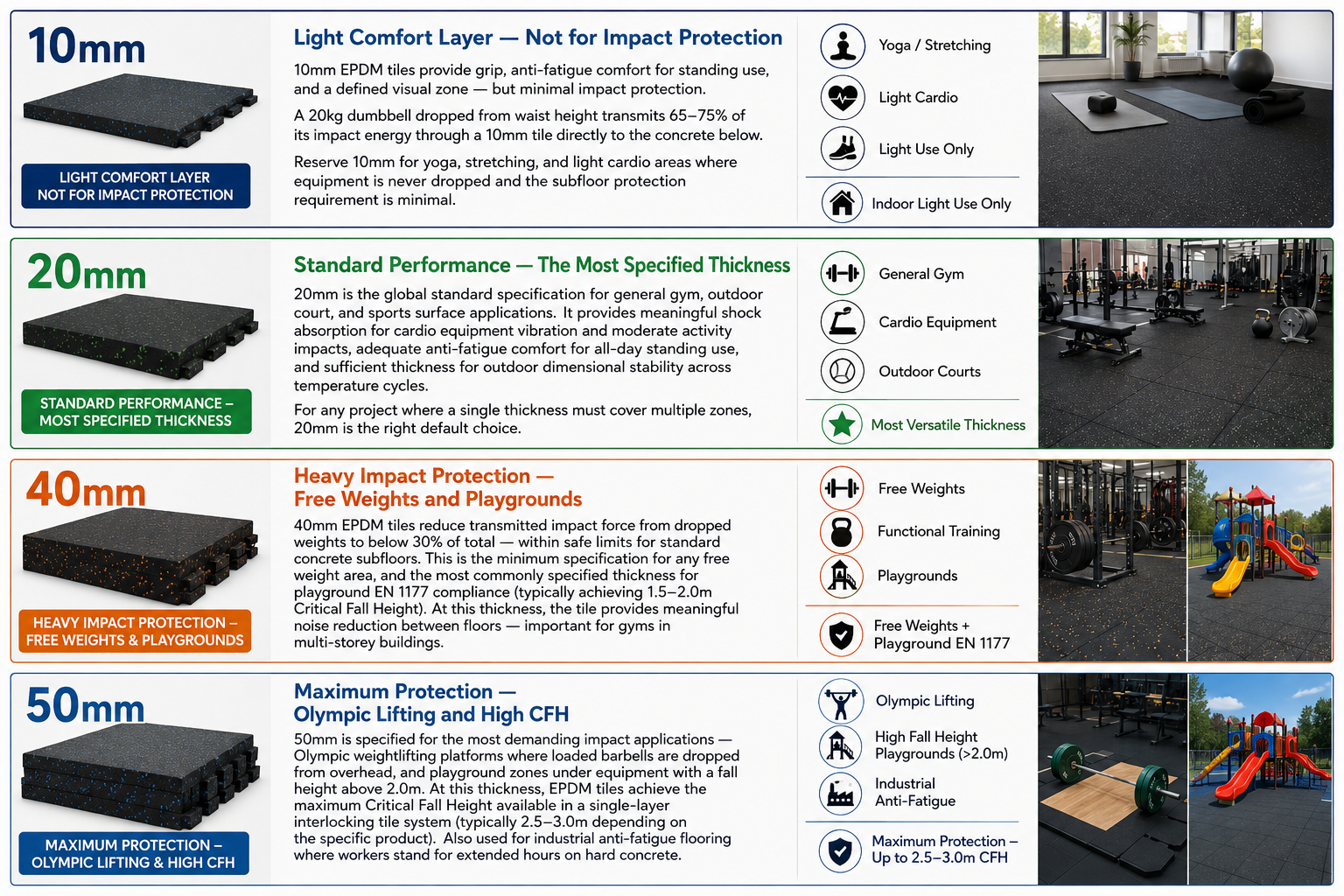
10mm EPDM tiles provide grip, anti-fatigue comfort for standing use, and a defined visual zone — but minimal impact protection. A 20kg dumbbell dropped from waist height transmits 65–75% of its impact energy through a 10mm tile directly to the concrete below. Reserve 10mm for yoga, stretching, and light cardio areas where equipment is never dropped and the subfloor protection requirement is minimal.
Indoor Light Use Only
20mm is the global standard specification for general gym, outdoor court, and sports surface applications. It provides meaningful shock absorption for cardio equipment vibration and moderate activity impacts, adequate anti-fatigue comfort for all-day standing use, and sufficient thickness for outdoor dimensional stability across temperature cycles. For any project where a single thickness must cover multiple zones, 20mm is the right default choice.
Most Versatile Thickness
40mm EPDM tiles reduce transmitted impact force from dropped weights to below 30% of total — within safe limits for standard concrete subfloors. This is the minimum specification for any free weight area, and the most commonly specified thickness for playground EN 1177 compliance (typically achieving 1.5–2.0m Critical Fall Height). At this thickness, the tile provides meaningful noise reduction between floors — important for gyms in multi-storey buildings.
Free Weights + Playground EN 1177
50mm is specified for the most demanding impact applications — Olympic weightlifting platforms where loaded barbells are dropped from overhead, and playground zones under equipment with a fall height above 2.0m. At this thickness, EPDM tiles achieve the maximum Critical Fall Height available in a single-layer interlocking tile system (typically 2.5–3.0m depending on the specific product). Also used for industrial anti-fatigue flooring where workers stand for extended hours on hard concrete.
Olympic Lifting / Max Playground CFH
Playground Thickness and Critical Fall Height (EN 1177)
For playground applications, thickness selection is not a preference — it is a calculation based on the Critical Fall Height (CFH) required for your equipment. EN 1177 mandates that the surface attenuates impact from the maximum fall height to below life-threatening injury thresholds.
| EPDM Tile Thickness | Typical CFH Achieved | Suitable Equipment Height | EN 1177 Test Required |
|---|---|---|---|
| 30mm | ~0.6–0.8m | Low equipment — under 0.6m | ✅ Yes — verify per product |
| 40mm | ~1.0–1.5m | Standard playground equipment | ✅ Yes — verify per product |
| 50mm | ~1.5–3.0m | Higher equipment — slides, climbing frames | ✅ Yes — verify per product |
The CFH values above are indicative only. The actual Critical Fall Height for any specific EPDM tile product depends on the tile’s rubber density, hardness, and construction — not just thickness. Always verify CFH with the EN 1177 test report for the specific tile product and thickness you are specifying. Under-specifying playground tile thickness is a serious safety and liability risk.
Thickness Mistakes That Cost Money
Specifying 10mm throughout a gym to save cost — subfloor damage within 12 months in weight zones
Using one thickness for the entire playground without calculating CFH per equipment zone
Ordering without physical samples — actual thickness can vary from specification in low-quality tiles
Forgetting transition ramp strips between different thickness zones — creates trip hazard
Not keeping spare tiles — matching replacements may not be available if product changes
Zone-specific thickness — 20mm general areas, 40mm under free weights
Calculate CFH per equipment zone from EN 1177 test report for your specific tile product
Request physical tiles and measure actual thickness with calipers before bulk order
Specify matching transition ramp strips for all thickness boundaries in the layout plan
Order 8–10% extra and store as spare tiles — same batch guarantees color and dimension match
Frequently Asked Questions
Summary: EPDM Interlocking Tile Thickness Quick Reference
Article #2 · Series: best EPDM interlocking rubber tiles · ← Back to Buyer’s Guide
Get the Right Thickness for Your Project
We supply EPDM interlocking rubber tiles in 10mm, 20mm, 30mm, 40mm, and 50mm. Free physical samples. Zone-by-zone thickness specification support included with every enquiry.
Request Samples & Thickness Advice
Read the Full Buyer’s Guide