

Market Reality Check • March 2026
What EPDM Granules Really Cost in 2026 – And Why the Lowest Price Is Usually the Most Expensive Mistake
After reviewing dozens of quotes and visiting sites where surfaces failed early, here’s the honest picture of EPDM pricing this year and what procurement teams should actually focus on.
JOy Jiang
Senior Materials & Sourcing Engineer, JFLYSPORTS • 12 years helping projects select and install rubber surfaces across Asia and the Middle East
In 2026, EPDM granule prices vary more than ever. Raw material costs, stricter chemical regulations, and the real demand for surfaces that actually last 8–12 years have created a wide range. The most common mistake I see is teams choosing purely on the lowest price per kilogram. In almost every case, that decision ends up costing significantly more in repairs or full replacement later.
Current Realistic Price Ranges (Early 2026)
Based on the quotes we’ve seen and supplied for real projects this year:
- Basic / Economy Grade: $2.85 – $3.50 per kg
Mostly suitable for indoor shock pads or hidden base layers with almost no direct sunlight. - Standard Playground & School Grade: $4.10 – $5.20 per kg
The most common choice for kindergartens, public playgrounds, and school tracks. It offers a good balance of safety compliance and everyday durability. - Premium / High-UV Performance Grade: $6.00 – $8.00 per kg
Necessary for professional athletic tracks or any area with strong sunlight (Middle East, southern China, Australia, Florida, etc.).
Anything noticeably below $2.80 per kg for top-layer outdoor use almost always means heavy fillers or unverified materials that will harden or chalk within 1–3 years.
What Actually Causes the Big Price Differences
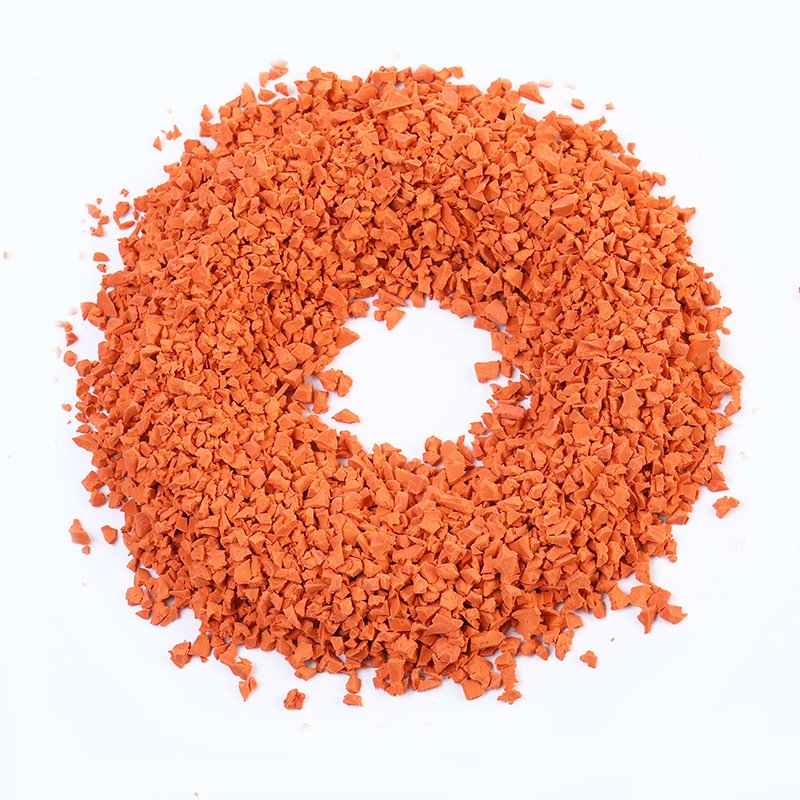
After testing many batches in the lab and seeing them perform (or fail) on real sites, these are the four factors that matter most:
1. Virgin Polymer Content
Higher virgin EPDM content costs more but keeps the material flexible and elastic for many years. Heavily recycled or filler-heavy granules often become brittle much faster.
2. UV Stabilization & Pigment Quality
Good stabilizers and inorganic pigments (like cobalt blue or chromium oxide) are expensive, but they prevent rapid fading and chalking. I’ve seen cheap colored surfaces turn gray in less than two summers in hot, sunny regions.
3. Chemical Compliance (REACH / Low PAH)
Proper testing and processing for PAHs and other restricted substances add real cost. Suppliers who skip or fake these tests can offer lower prices, but they carry serious safety and legal risks for schools and public projects.
4. Granule Consistency & Cleanliness
Clean, well-calibrated granules (low dust) reduce the amount of binder needed and improve the final surface quality. Dusty or inconsistent granules waste expensive polyurethane and create weak spots.
Real-World Example from Last Year
One client chose a very low-price supplier to save budget. Within 18 months the surface started chalking badly and lost most of its shock absorption. The cost to repair and replace it was almost double what they would have spent on better material from the beginning. Projects that used properly specified mid-to-premium grades are still performing well after 4–5 years with almost no maintenance.
Practical Advice for 2026 Procurement
1. Always request batch-specific lab reports (Certificate of Analysis) and 2000-hour Xenon-Arc UV test data.
2. Compare Total Cost of Ownership (TCO), not just the invoice price.
3. If a quote seems too good to be true, treat it with caution and verify the technical details before committing.
4. For critical projects (especially schools and playgrounds), consider independent third-party testing of the delivered material.
The goal is not to buy the most expensive rubber — it’s to buy a surface that stays safe, flexible, and good-looking for the full life of the project. If you have current quotes and want a second opinion based on real field experience, feel free to share the details. I’m happy to review them and point out any potential risks — no obligation.
Li Wei
Senior Materials & Sourcing Engineer
JFLYSPORTS Technical Team