

They’ve shared job sites for decades. They look vaguely similar. And yet, confuse them in a procurement spec — just once — and you’ll spend the next eighteen months explaining why the surface is fading, cracking, or failing a certification audit. EPDM and SBR are not rivals. But they are very, very different characters.
Picture two workers showing up to the same sports surface project. One arrives in a crisp, color-coded jacket — meticulous, UV-proof, built for the spotlight. The other rolls in wearing worn overalls — cheaper to hire, reliable in the right role, but absolutely not suited to every job on site. That’s EPDM vs SBR in a nutshell. And if you’re sourcing rubber granules at volume for sports flooring, playgrounds, running tracks, or artificial turf systems, understanding which character belongs where — and why — is the difference between a successful installation and an expensive mistake.First, Know Who You’re Dealing With
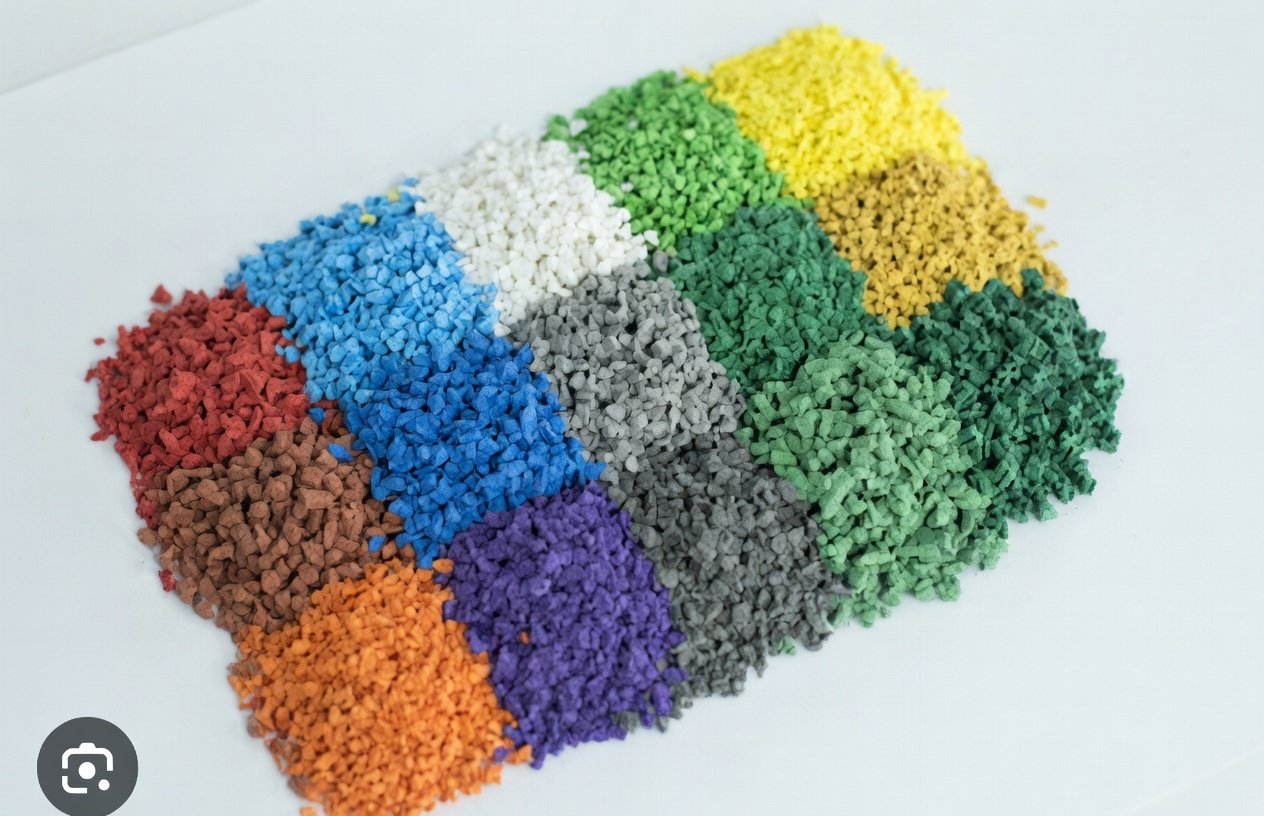 SBR (Styrene-Butadiene Rubber) is the industry’s workhorse. Born from recycled end-of-life tyres — shredded, processed, cleaned — it’s a material with genuine sustainability credentials and a price point that makes procurement managers smile. It’s been the foundation of sports surfaces for decades, and it still earns its keep.
EPDM (Ethylene Propylene Diene Monomer) is a different animal entirely. Manufactured from virgin synthetic rubber, it’s engineered from the ground up for outdoor performance. Its highly saturated polymer chain — the absence of double bonds that makes SBR vulnerable to UV and ozone — is what gives EPDM its career-defining edge. Research confirms that this molecular structure makes EPDM dramatically more resistant to oxidative degradation over time.
SBR (Styrene-Butadiene Rubber) is the industry’s workhorse. Born from recycled end-of-life tyres — shredded, processed, cleaned — it’s a material with genuine sustainability credentials and a price point that makes procurement managers smile. It’s been the foundation of sports surfaces for decades, and it still earns its keep.
EPDM (Ethylene Propylene Diene Monomer) is a different animal entirely. Manufactured from virgin synthetic rubber, it’s engineered from the ground up for outdoor performance. Its highly saturated polymer chain — the absence of double bonds that makes SBR vulnerable to UV and ozone — is what gives EPDM its career-defining edge. Research confirms that this molecular structure makes EPDM dramatically more resistant to oxidative degradation over time.
The Science Behind the Difference
This isn’t marketing language — it’s polymer chemistry. SBR’s structure contains unsaturated bonds in its main chain, which makes it reactive to ozone and UV radiation. Leave it exposed outdoors without protection, and it will crack, fade, and lose elasticity faster than the project timeline permits. EPDM’s terpolymer structure — ethylene, propylene, and a diene monomer — eliminates those vulnerable double bonds from the backbone. The result: a material that performs reliably from −40°C to 120°C, shrugs off ozone exposure, and holds its color under years of direct sunlight. A peer-reviewed study published in PMC / National Institutes of Health tested both materials for shock absorption, tensile strength, abrasion resistance, and slip resistance under variable conditions — and confirmed EPDM’s decisive technical advantage for top-layer outdoor applications.EPDM granule market value reached $4.19 billion in 2024, projected to hit $8.53 billion by 2033 at a CAGR of ~8.5%. The SBR market, by comparison, sits at approximately $1.3 billion — significant, but serving a fundamentally different role in the supply chain. (Source: Grand View Research, 2024)
Same Job Site. Very Different Job Descriptions.
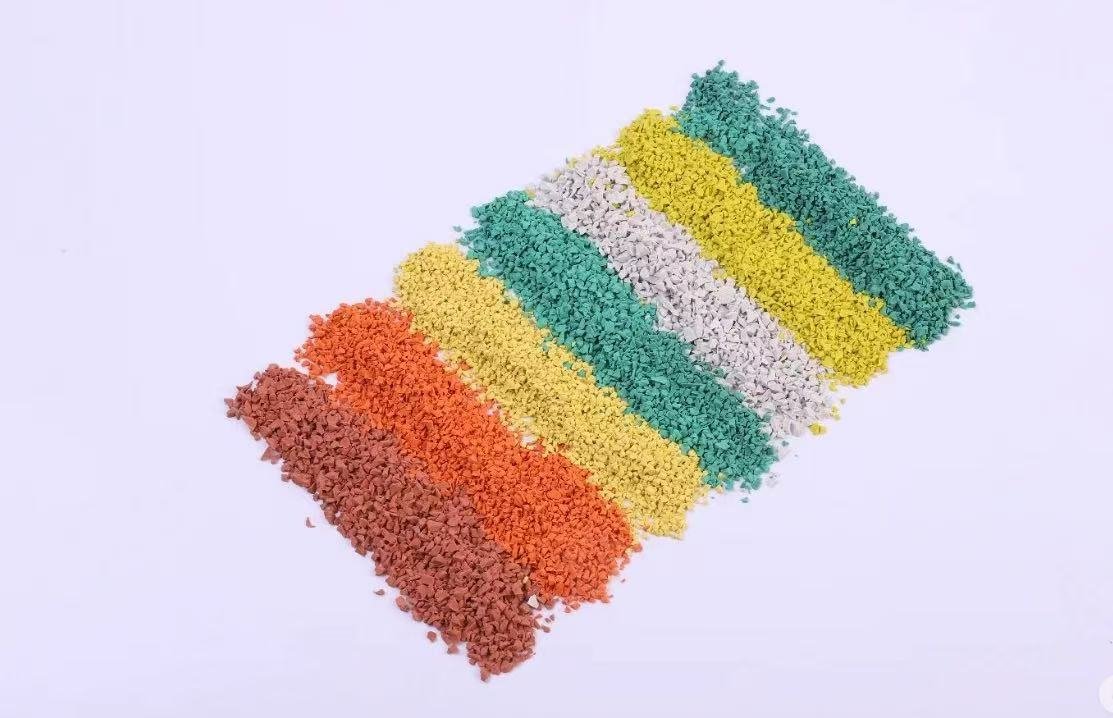 Here’s where the confusion gets costly: buyers who treat EPDM and SBR as substitutes are misreading the script. These two materials aren’t competing for the same role — they’re designed for different layers of the same system.
| Layer / Application | Right Material | Why |
|---|---|---|
| Base / cushion layer (wet-pour system) | SBR | Cost-effective shock absorption, structural density |
| Top / wear layer (outdoor) | EPDM | UV stability, color retention, surface durability |
| Colored playground surface | EPDM | EN 1177 impact attenuation + pigment permanence |
| Artificial turf infill (budget) | SBR | Volume economics, adequate cushioning |
| Artificial turf infill (premium) | EPDM or blend | Lower PAH risk, better longevity, cleaner profile |
| IAAF-certified athletics track | EPDM | Performance consistency, certification compliance |
| Indoor gym flooring | SBR or EPDM | UV less critical indoors; EPDM preferred for color/feel |
SBR and EPDM aren’t rivals — they’re the best double act in sports surface construction. Confuse their roles, and the whole performance falls apart.
The Cost Conversation Buyers Need to Have
SBR wins on upfront unit price — always. But procurement teams focused purely on cost-per-tonne are measuring the wrong thing. The right metric is total cost of ownership over the surface lifespan.Source: Industry estimates; Grand View Research, 2024
A surface built with SBR on top may cost less on day one, but it will fade, crack, and lose certification compliance faster — triggering resurfacing cycles that quickly erase the initial saving. The clients and procurement managers who understand this aren’t choosing EPDM despite the price. They’re choosing it because of the math.The Safety and Certification Line in the Sand
For buyers sourcing materials destined for child-facing environments — school playgrounds, kindergarten surfaces, public parks — there’s a non-negotiable dimension to this comparison: chemical safety. SBR, as a recycled tyre derivative, carries a risk of PAH (polycyclic aromatic hydrocarbon) content. Modern quality SBR meets REACH Regulation (EC) No 1907/2006 standards, but this requires verification — and not every supplier provides it. EPDM, manufactured from virgin compounds, presents no PAH risk and complies cleanly with EN 71-3 (toy safety standards) and REACH requirements from the outset.EN 1177 (playground impact attenuation) · IAAF (athletics tracks) · EN 71-3 (toy safety) · REACH compliant · No PAH risk
ASTM F1292 (impact attenuation) · REACH compliant (if verified) · PAH content must be confirmed per batch · Not suitable for EN 71-3 applications
What Sophisticated B2B Buyers Ask Before Ordering
The buyers who never get burned aren’t necessarily smarter — they just ask the right questions before committing to volume. Here’s the short list worth borrowing:1. Is this virgin EPDM or a blend? Request the material composition certificate. 2. What is the sieve analysis / particle size distribution for this batch? 3. Can you provide PAH test results (for SBR) or REACH compliance documentation? 4. What certifications does this material support — EN 1177, IAAF, EN 71-3? 5. What is the UV stability rating and expected color retention period for outdoor applications? 6. Is the density and Shore A hardness consistent across the order volume?
The Verdict — And the Smarter Question to Ask
EPDM doesn’t win because it’s more expensive. It wins because it was designed to do a job that SBR simply wasn’t built for. And SBR isn’t inferior — it’s just at its best when it’s doing what it does: absorbing impact in base layers, filling turf systems economically, building the foundation that EPDM performs on top of. The real question for B2B buyers isn’t “EPDM or SBR?” It’s “Which layer am I specifying, and who is going to use this surface?” Answer that, and the material choice makes itself. At JFLY Sports, we supply both — and more importantly, we help procurement teams spec the right combination for their exact project. Whether you’re building a dual-layer stadium track, a school playground requiring EN 1177 compliance, or a high-volume artificial turf installation, we bring both materials and the technical knowledge to match them correctly.Tell us your application, required certifications, and order volume — we’ll give you a straight answer and a competitive quote.