Surface Integrity & Granule Migration: The 2026 Field Protocol for EPDM Restoration
Table of Contents
Field Protocol · 2026 Technical Report
Surface Integrity & Granule Migration:
The 2026 Field Protocol for EPDM Restoration
We stopped doing simple patch-up repairs years ago. After watching too many surfaces fail again within 12–18 months, we completely changed how we approach granule migration and binder failure — here is our full updated protocol.
Senior Field Restoration Engineer Joy Jiang · JFLYSPORTS 12 years on-site across China, Middle East & Southeast Asia
“The surface was installed less than three years ago — why is it already shedding?”
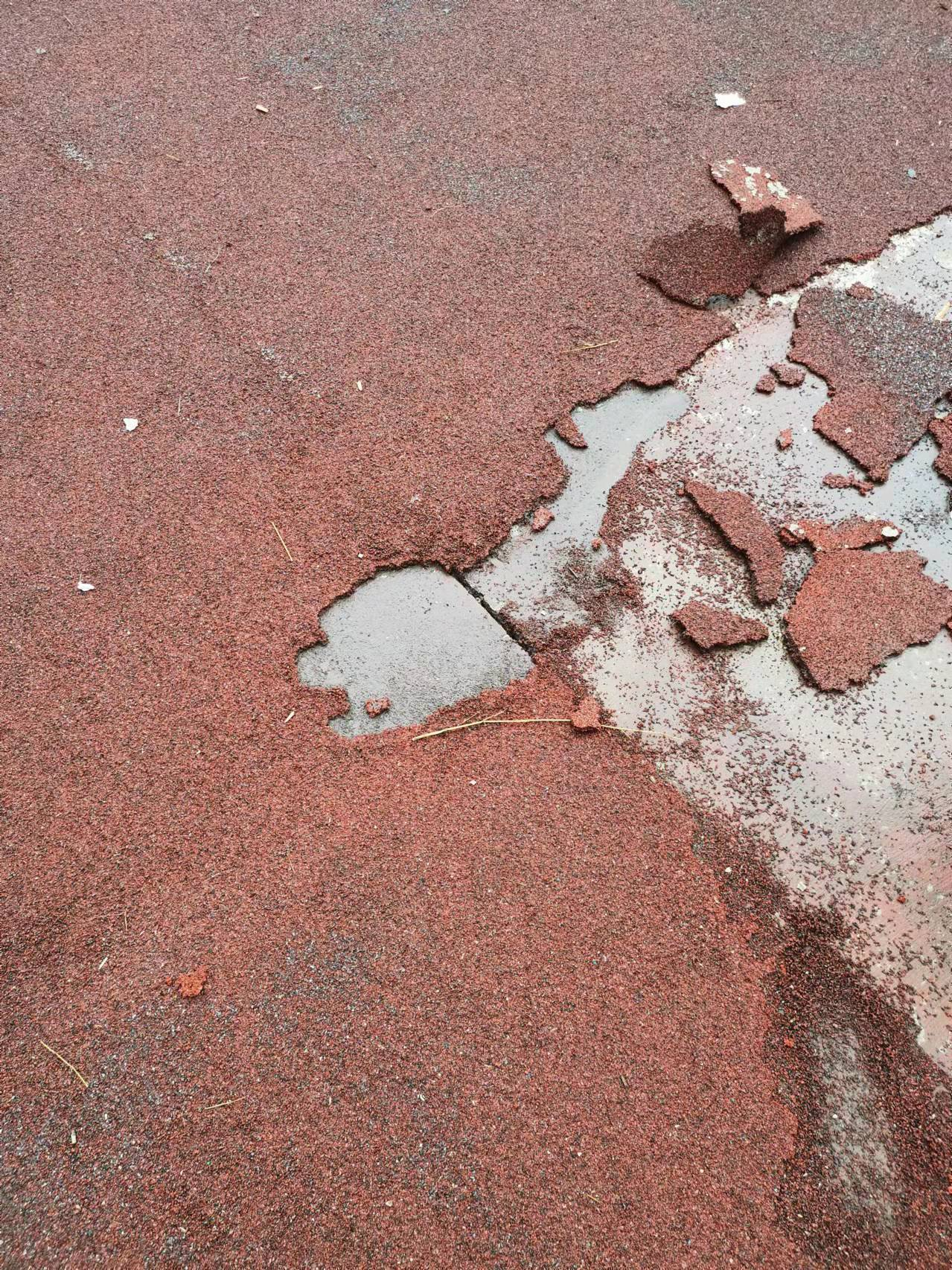
Last November, we received an urgent call from an international school outside Shanghai. Their rubber running track and playground were shedding granules badly — kids were constantly kicking up rubber pieces while running, creating a clear safety hazard. After inspecting the site, it was obvious this wasn’t just normal wear and tear. It was a classic case of molecular-level binder failure.
Over the past few years, my team and I have handled restoration on more than 70 EPDM surfaces. What I’ve learned is that restoration work in 2026 is completely different from what it was in 2018–2020. Increased climate volatility, stricter Critical Fall Height (CFH) safety requirements, and faster material aging have made the old “just patch it” approach no longer acceptable.
1. First, Understand Why Your Surface Is Shedding
Most repair teams make the biggest mistake right at the beginning — they jump straight into re-pouring rubber. We now insist on a proper diagnosis first. Here are the three most common root causes we see in real projects:
⚗️ Binder Glassification
The polyurethane binder continues secondary cross-linking under UV and temperature cycles. It becomes brittle, then shatters under foot traffic — causing widespread granule migration across the surface.
🪨 Low-Quality Granule Fillers
Many cheap EPDM granules contain excessive calcium carbonate. Under UV light, this creates a white chalky layer and progressively weakens the polymer-to-binder bond until the surface fails.
🔧 Poor Original Installation
Incorrect binder ratio, insufficient mixing, or failure to properly clean the oxidized old surface before installation. Problems that were invisible on Day 1 become catastrophic failures by Year 2–3.
🧪
Quick Field Diagnostic Test
Blow compressed air at 0.6–0.8 bar across the surface. If granules come loose easily, the bond has already failed and loose material must be completely removed — not just covered over. Skipping this step is the single most common reason restorations fail a second time.
2. Our Actual 2026 Restoration Process
We no longer chase “48-hour quick fixes.” The goal is to fix it once and make it last. Here is the exact four-step process my team uses on every restoration project in 2026:
1
Complete Removal of Failed Material
Remove all loose granules and degraded binder down to a solid, stable base. Many teams only clean the surface and regret it six months later when the problem returns. There are no shortcuts here.
2
Surface Activation (Priming)
This is the most critical step. We apply a specialized penetrating primer that reactivates the oxidized old binder, creating a much stronger mechanical and chemical bond with the new material. Without this, even high-quality granules will delaminate within 18 months.
3
New Infill Installation
We use high-purity, high-elasticity EPDM granules with a carefully calculated polyurethane binder ratio — typically 1:5.2 to 1:5.8 by weight, adjusted for local climate. Material is installed in layers and thoroughly compacted to ensure uniform density.
4
Curing and UV Protection
Allow at least 48–72 hours of undisturbed curing. Protect from direct sunlight and rain during this period. In high-UV regions, we strongly recommend a UV-protective top coat after curing — it dramatically extends the surface lifespan.
3. 2026 Restoration Material Specification Matrix
Not all replacement granules are equal. This is the comparison matrix we use internally when selecting materials for restoration projects. The differences between tiers are not cosmetic — they determine whether a restoration lasts 3 years or 12.
Specification
J-Pro REACH Plus (Recommended)
Standard Grade
Budget / Unknown Source
Virgin Polymer Content
✓ 25%+ Virgin EPDM
△ 10–15% Blended
✗ Undisclosed / Recycled
UV Stability (Xenon-Arc 2000h)
✓ Gray Scale 4.5 Certified
△ Self-Declared
✗ No Data
PAH / Chemical Safety (ECHA)
✓ Non-Detected (ND)
△ Within Limits
✗ Untested
Granule Sizing Consistency
✓ 1.0–4.0mm, ISO Calibrated
△ Manual Sampling
✗ Visual Only
Binder Ratio (PU)
✓ 1:5.2–5.8 (climate-adjusted)
△ Fixed ratio, no adjustment
✗ Unknown
Expected Restoration Lifespan
✓ 10–12 Years
△ 4–6 Years
✗ 1–3 Years
Full CoA Documentation
✓ Batch-specific CoA
△ Partial Data
✗ None
4. Climate-Specific Maintenance Recommendations
Restoration is not the end — it’s the beginning of proper long-term care. After working across China, the Middle East, and Southeast Asia, I can tell you that the same material behaves very differently in different climates. Here is what we recommend for each zone:
❄️
Cold Northern Regions
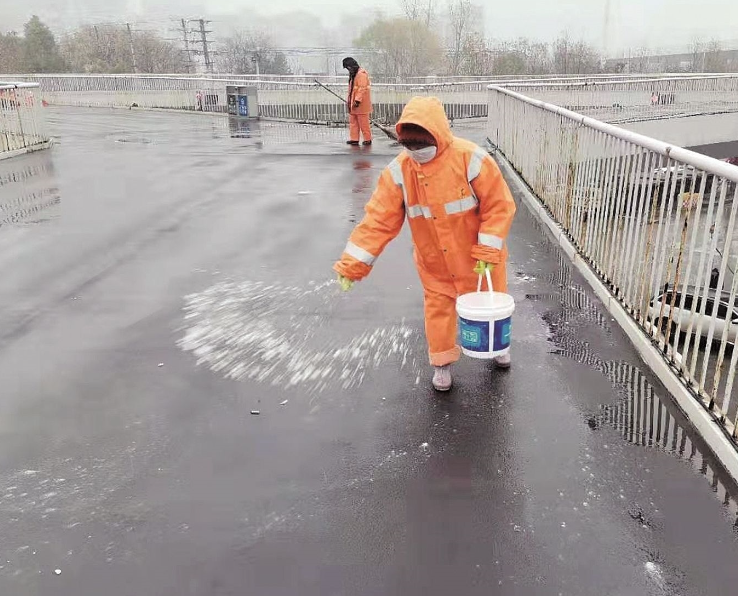
Never use metal shovels for snow removal — they create micro-tears that trigger shedding the following spring. Use plastic shovels with rubber wear strips. Avoid aggressive chemical de-icers. Choose hydrolysis-resistant aliphatic PU binders for all freeze-thaw environments.
☀️
High-UV Regions (Middle East, South China, Australia)
UV exposure is the biggest enemy in these zones. Apply a UV-shield top coat every 3–4 years to slow down chalking and maintain polymer elasticity. Without this, even high-quality surfaces will degrade significantly faster than the rated lifespan.
💧
High-Humidity & Water Play Areas
Standard binders absorb moisture over time and lose adhesion. Always specify hydrolysis-resistant aliphatic polyurethane binders for pools, splash pads, and coastal installations. The cost premium is 8–12% but the lifespan impact is significant.
5. Real Project Results (2024–2025)
Numbers matter more than theory. Here are two recent restorations where following this protocol made a measurable difference:
Case Study · Dubai Community Playground
Surface failing after less than 3 years in a high-UV desert environment
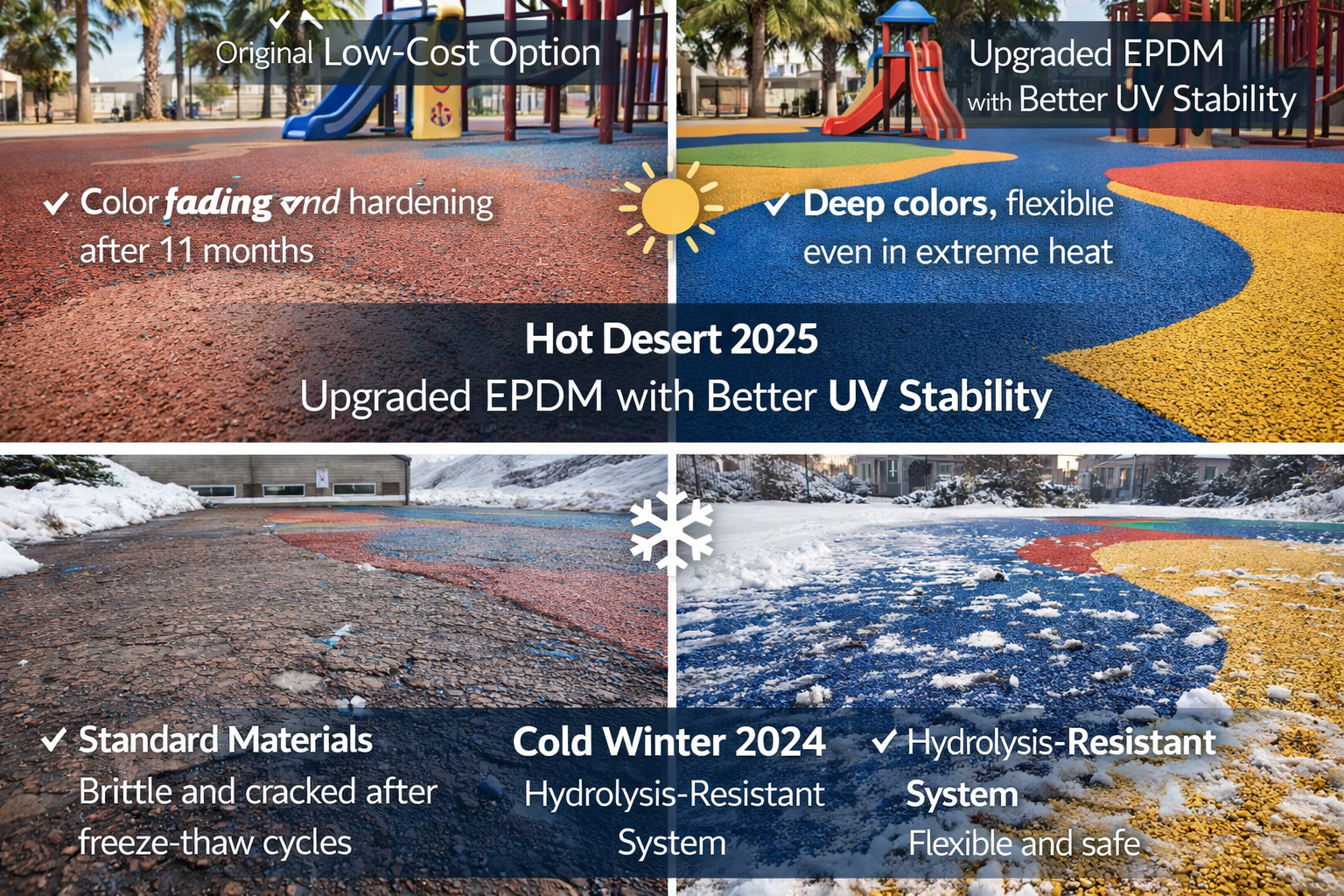
The original installation used standard-grade granules without UV stabilization. After complete removal, primer reactivation, and installation of J-Pro REACH Plus with UV top coat, the surface has remained stable for over 14 months with almost zero new shedding and safe impact attenuation values throughout.
Severe binder aging after repeated freeze-thaw cycles over 4 winters
By focusing on proper removal and surface reactivation instead of a full replacement, we saved the client nearly 40% in material and labor costs. The key was identifying that the base layer was still structurally sound — only the top 8mm needed full replacement with hydrolysis-resistant material.
✓ Result: 40% cost saving vs. full replacement. Surface performing well after 2 winters post-restoration.
6. Frequently Asked Questions
Use the compressed air test (0.6–0.8 bar). If only the top layer is loose but the base is solid, restoration is viable. If the base layer is also crumbling or delaminated from the substrate, full replacement is usually more cost-effective in the long run. We can assess photos remotely — send us images of the worst affected areas.
For a standard 500–1,000 sqm playground, allow 3–5 working days for removal and installation, plus 48–72 hours for curing. High-UV regions require an additional 24 hours before the UV top coat can be applied. Total: typically 5–8 days from start to open.
Polyurethane binders require a minimum ambient temperature of 5°C (41°F) to cure properly. Below this, curing slows dramatically and bond strength is compromised. In cold climates, plan restoration work between April and October.
Partial restoration is possible, but there are two risks: color matching between old and new granules is rarely perfect, and if the root cause is systemic (poor original binder or low-quality granules throughout), the “good” areas will follow the same failure pattern within 1–2 years. We always recommend a full surface diagnostic before deciding on scope.
“EPDM surface restoration in 2026 is no longer simple manual labor — it requires a real understanding of how these materials behave at the molecular level. Chasing speed and low cost usually leads to repeated failures. The projects that succeed are the ones where the client gave us time to do it right.”
— Joy Jiang, Senior Restoration Engineer, JFLYSPORTS Field Engineering Team
Dealing with granule shedding or surface chalking?
Send us photos of your site and we’ll give you an honest assessment — including whether restoration or replacement makes more sense for your budget. No obligation, just real field experience.