

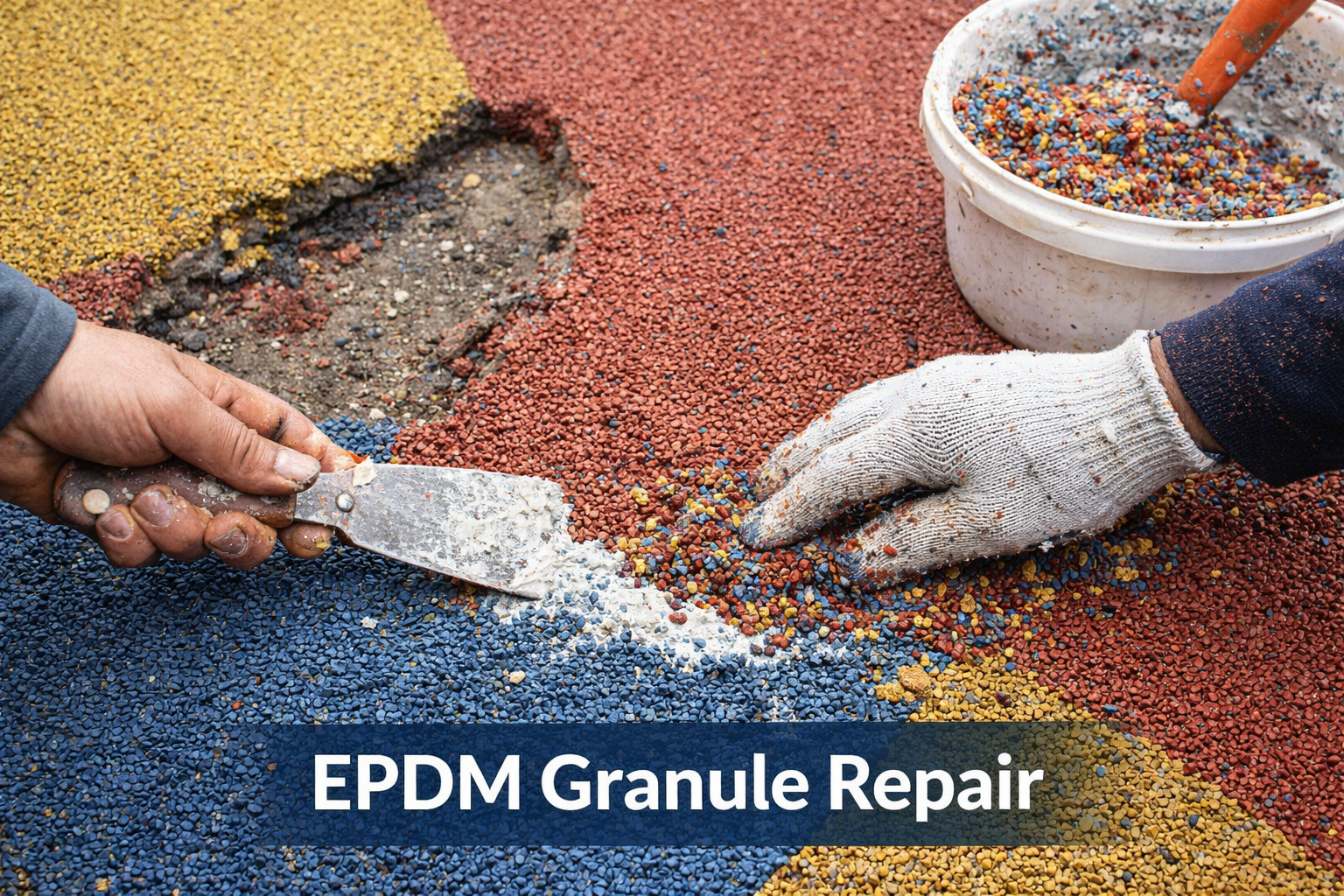
The contractor did everything right. Good binder, decent weather, clean install — this was a municipal project outside Chengdu, 400-meter standard track, opened on time. Six months later the client is calling because athletes are complaining the surface feels inconsistent and a couple of sprinters have slipped coming out of lane 4.
Nobody could figure it out until someone pulled the delivery records and actually looked at what granules shipped versus what was specified.
Stated spec: 1–4 mm EPDM. What arrived was distributed across that full range with no grading. Technically compliant. Not fit for purpose on a competition surface.
I’ve seen this same situation — different city, different contractor — probably four or five times over the years. The frustrating part isn’t that it’s complicated. It genuinely isn’t. It’s that it’s so avoidable once you understand what you’re actually specifying.
The granules aren’t filler
Most buyers reviewing a track spec treat the granule line like a commodity purchase. Bag of rubber bits, priced per ton, move on. But the granules are the structure — they’re what delivers shock absorption, energy return, and the texture athletes feel underfoot. The polyurethane binder’s only job is to hold them in place. Get the granule wrong and you’ve built a compromised matrix that no amount of good binder work can compensate for.
A dusty granule — and some product has genuinely high fines content — absorbs binder before the matrix can form. A granule with low actual EPDM content doesn’t bond cleanly and breaks down faster under repetitive load. Neither problem is visible when the surface goes down. Both show up two or three years later as cracking, granule pullout, or patchy hardness. By then the project is closed, invoices are paid, and nobody wants the call.
The 1–4 mm problem
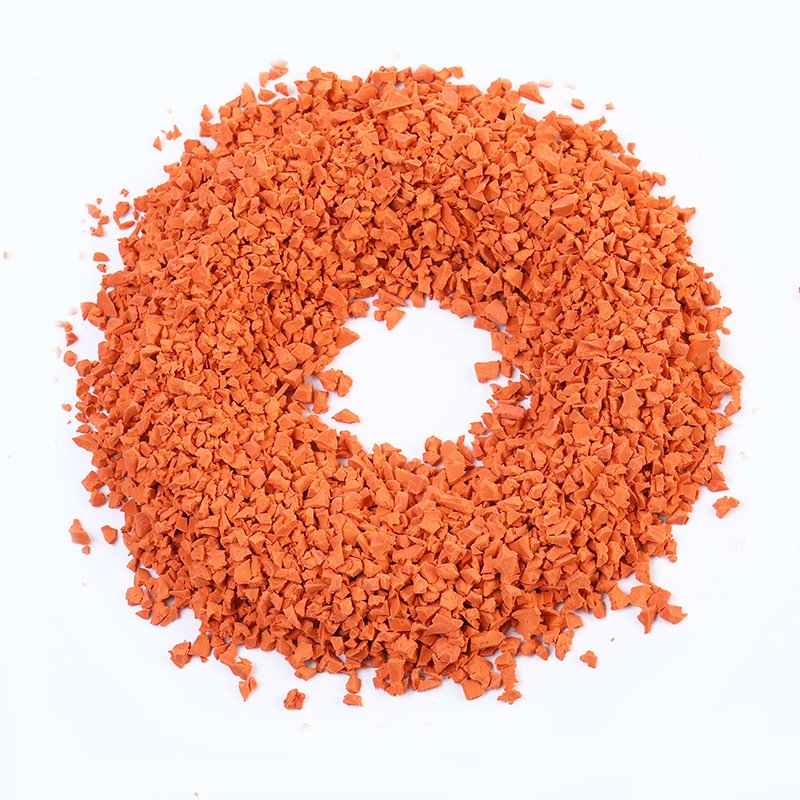
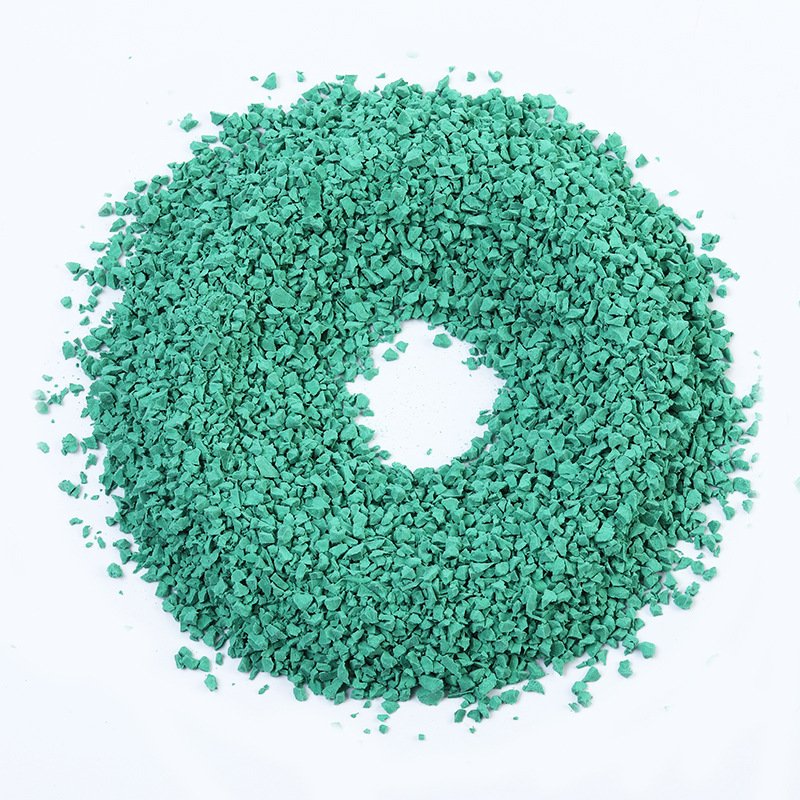
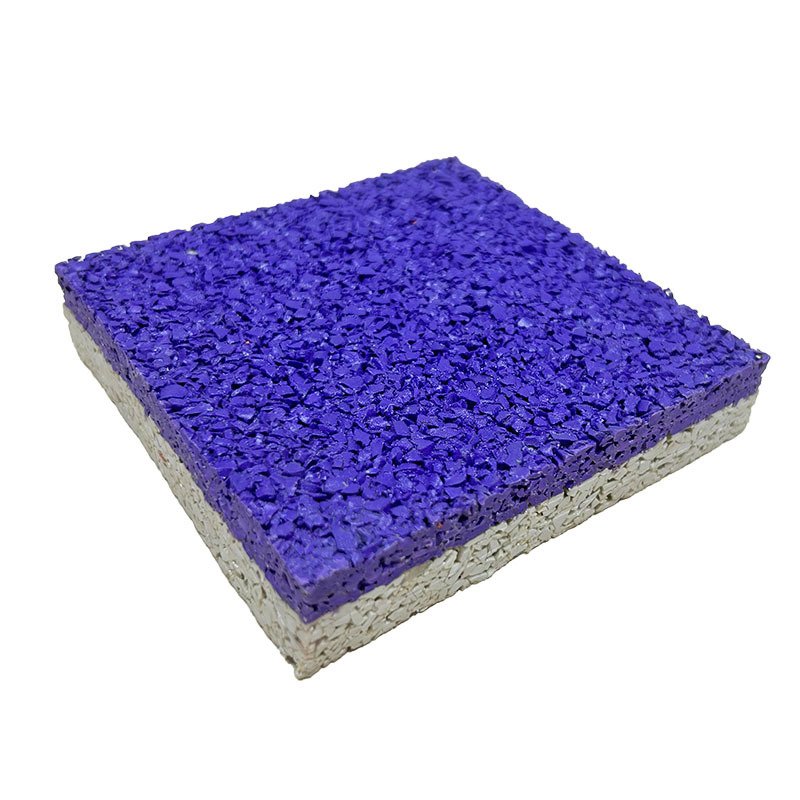
IAAF-certified track wear layers typically run 1–2.5 mm. That window gives you the right surface texture for spikes and training flats, proper binder coating on each particle, and drainage performance that holds through heavy rain. Go coarser — 3–4 mm range — and you get a rougher surface that’s harder to install uniformly, and the binder matrix ends up stressed unevenly across the pour.
The problem is “1–4 mm” has been in enough standard spec templates that buyers copy it without thinking about what it actually means in practice. Suppliers ship material distributed across that window — technically correct — and the result is a wear layer with texture and hardness variation across lanes. Not dramatic. Just enough to register in impact attenuation testing: 15–20% variance between lane 1 and lane 8. On a facility where lane uniformity is literally the point, that’s a failure.
For competition tracks: specify 1–2.5 mm and require a particle size distribution certificate. Not a stated range — an actual grading curve showing the proportion of material at each size level. For school or community tracks with wider tolerances and shorter resurfacing cycles, the full 1–4 mm range is workable. Just go in knowing what you’re accepting.
Virgin vs. recycled
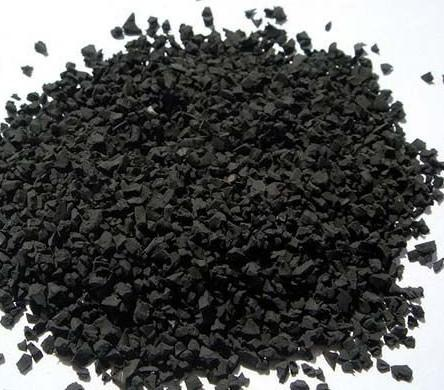
Recycled EPDM gets written off too fast by people who’ve only encountered bad product, and it gets bought too carelessly by people who stop evaluating once the price looks good. Both are mistakes.
Virgin granules — manufactured new, polymer content usually sitting around 55–70% EPDM by weight — give you controlled chemistry, consistent sizing, and physical properties you can predict. Tensile strength, elongation at break, UV performance: all documented, all repeatable. For certified competition facilities or installations going into high-UV environments, the cost premium is straightforward to justify.
Quality recycled EPDM made from clean manufacturing offcuts, with documented polymer content, performs close enough to virgin for most school and community applications. The issue is that “recycled EPDM” covers an enormous range. Clean offcuts from a rubber products factory and mixed post-consumer material with unclear contamination history are both sold under the same label, sometimes at similar prices.
One question cuts through most of it: what’s the source material, and what is the EPDM content by percentage? A supplier who answers that directly, with documentation, is worth continuing the conversation with. One who gives you a vague range or deflects entirely — there’s your answer.
Color and UV
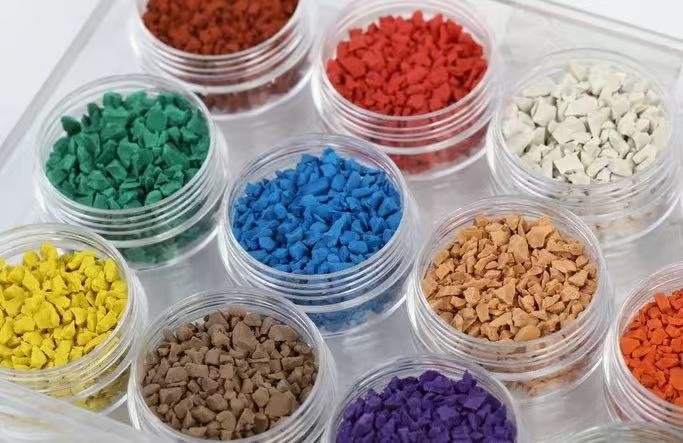
A running track is usually the most visible outdoor asset a facility operates. When it fades to a chalky, uneven surface two years post-installation, it reflects badly on the contractor regardless of warranty language, and it tends to become a recurring topic in client conversations that nobody enjoys.
Color stability in EPDM granules is mostly a function of two things: EPDM content and the quality of the pigment system. Higher EPDM content correlates directly with better UV and ozone resistance — a granule at 60% EPDM holds color longer than one at 40%, and this holds across suppliers and product lines. Pigment also needs to be process-embedded, not surface-applied; surface coating wears off under foot traffic and UV exposure faster than you’d think.
Ask suppliers for grey-scale rating test data per ISO 105-A02 or equivalent — color retention results after 1,000 hours or more of UV exposure. Any manufacturer doing real quality control runs these tests regularly and has current data. If they can’t produce it, factor a shorter effective lifespan into your cost modelling. The cheaper granule rarely stays cheaper once you account for earlier replacement.
What to request before placing an order
Any supplier worth using should hand over all of this without being asked more than once:
- Particle size distribution certificate — grading curve, not a stated range
- EPDM content by percentage, with virgin or recycled clearly noted
- Physical property data sheet covering tensile strength and elongation at break
- UV and color stability test results (ISO 105-A02 or equivalent)
- Dust content data
That last item gets overlooked more than any other. High fines content means the granule absorbs binder before the matrix forms properly. On a mid-size track project, that can mean burning through 15–20% more binder than the spec assumed — a cost that shows up as a line item nobody budgeted for and everyone argues about. A cleaner granule costs more per bag. Per installed square meter, it’s usually cheaper.
Before you finalize the spec
Three questions worth settling before the purchase order goes out.
What is this track actually for? A regional competition facility, a school PE oval, and a community recreation track have different performance requirements, different budget constraints, and different resurfacing timelines. The spec should reflect what the surface actually needs to do, not what the last project used.
What’s the climate situation? High UV load, freeze-thaw cycling, and heavy seasonal rainfall each stress a track surface in different ways. In demanding environments — coastal, high altitude, Middle East, northern regions with hard winters — virgin EPDM with UV documentation earns its price premium. In temperate, moderate conditions that argument is weaker.
How long does this surface need to perform? A track on a planned 6–8 year resurfacing cycle can use quality recycled EPDM and come out ahead economically. A surface expected to run 10–12 years without major intervention needs the best input materials from day one. You can’t retrofit better granules once the surface is poured.
Request samples before committing to volume. On projects above a certain scale, independent lab testing at specification stage costs very little relative to what an early resurfacing costs — financially and in terms of the conversation with a client who thought they were buying a 10-year surface and are now looking at replacement in year 4.