

EPDM rubber granules have become the foundational material for high-performance sports surfaces, playground safety flooring, running tracks and multi-sport courts worldwide. As global demand for durable, UV-stable and non-toxic surfacing materials continues to grow, facility owners, contractors and distributors increasingly choose EPDM granules over conventional SBR or recycled rubber crumbs. This comprehensive buyer’s guide explains what EPDM rubber granules are, how they are manufactured, which performance properties matter most, and how to specify a high-quality product that delivers years of reliable service across outdoor and indoor applications.
What Are EPDM Rubber Granules?
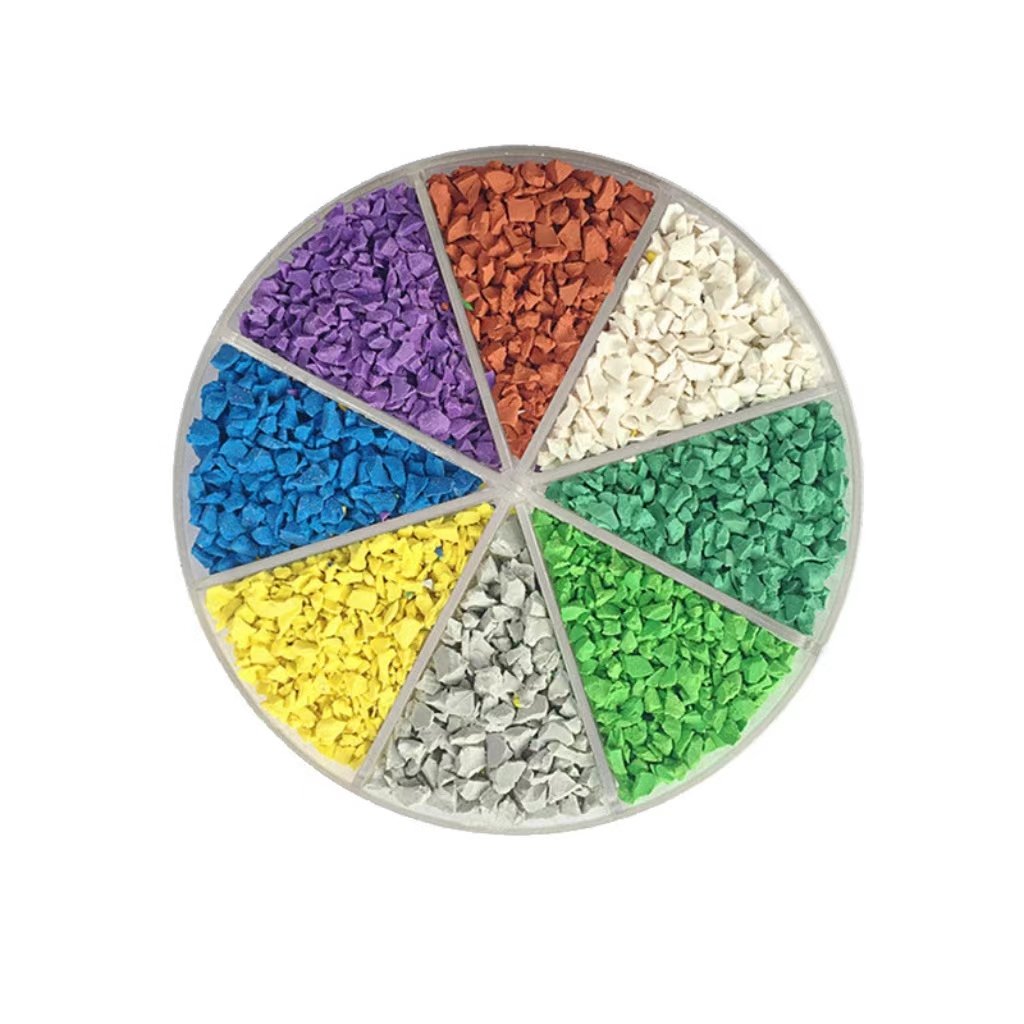

EPDM (Ethylene Propylene Diene Monomer) rubber granules are small, uniformly shaped particles of synthetic rubber engineered specifically for resilience, weathering resistance and color stability. Unlike recycled tyre crumb (SBR), which is reclaimed from end-of-life vehicle tyres, EPDM is a virgin synthetic rubber manufactured from carefully controlled petrochemical feedstocks. This fundamental difference in origin determines nearly every performance advantage EPDM holds over SBR in demanding surface applications.
The manufacturing process begins with the polymerisation of ethylene, propylene and a diene monomer to produce raw EPDM rubber. This rubber is then compounded with fillers, plasticisers, curing agents and — for colored granules — high-performance pigments. The compound is shaped, vulcanised (cross-linked), and cryogenically or mechanically granulated into particles of defined size ranges, typically from 0.5 mm to 4.0 mm depending on the target application.
The result is a granule that combines excellent elasticity, outstanding resistance to UV radiation and ozone, strong colour retention, low odour and chemical stability across a wide temperature range. These properties make EPDM granules the material of choice for applications where long-term appearance, safety compliance and consistent performance under harsh outdoor conditions are non-negotiable.
Why EPDM Granules Have Become the Global Standard for Sports and Safety Surfaces
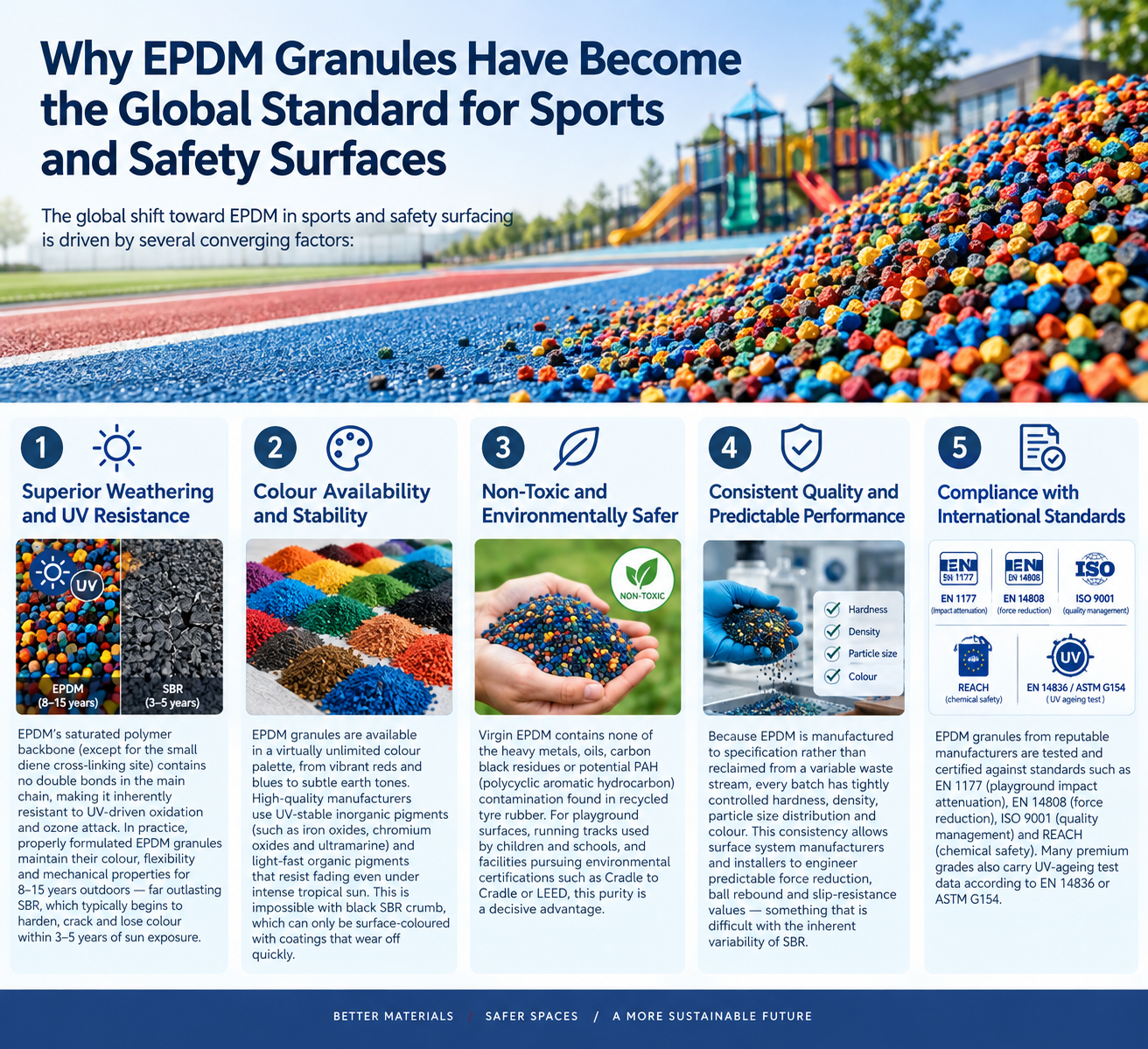
The global shift toward EPDM in sports and safety surfacing is driven by several converging factors:
1. Superior Weathering and UV Resistance
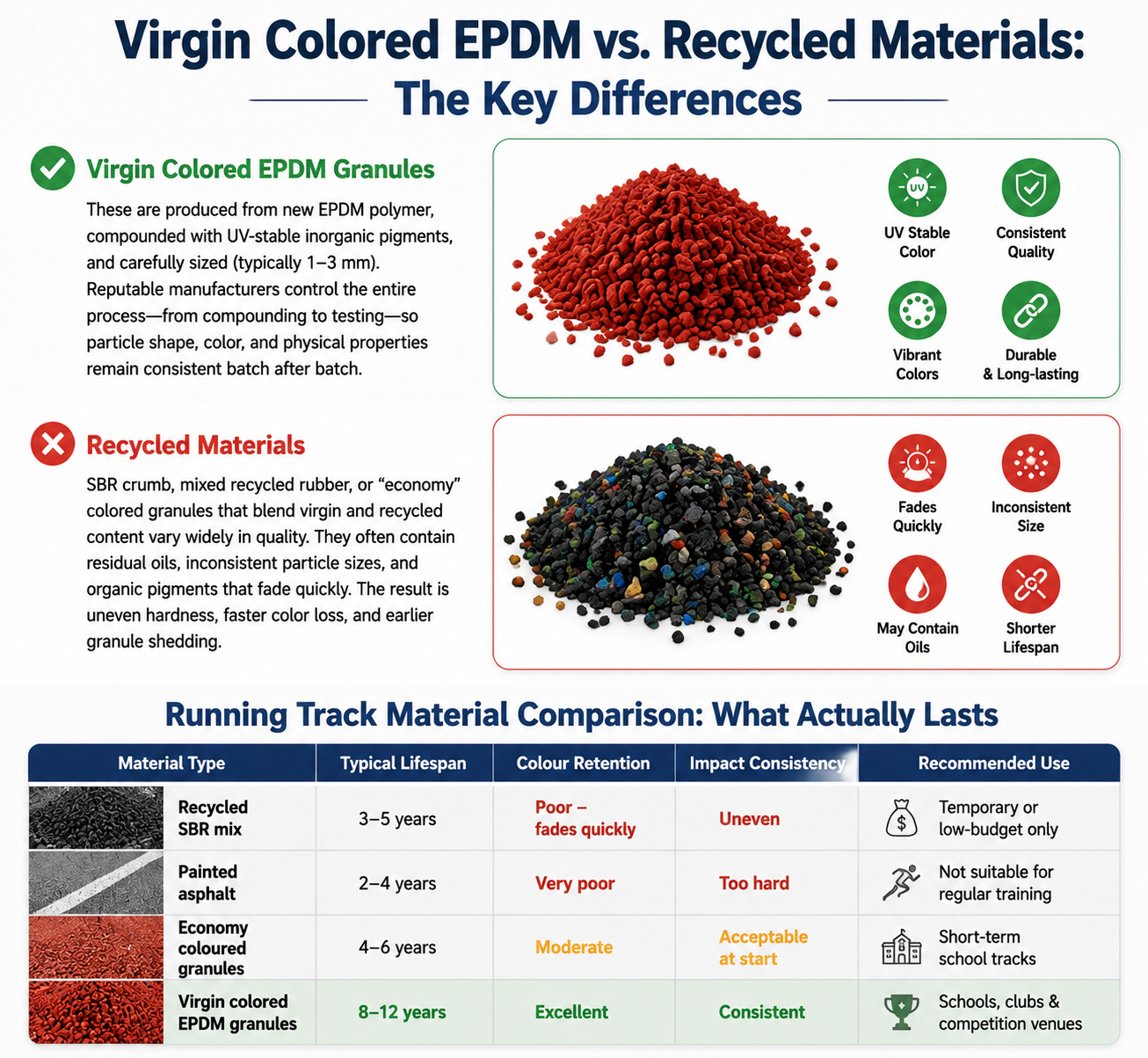
EPDM’s saturated polymer backbone (except for the small diene cross-linking site) contains no double bonds in the main chain, making it inherently resistant to UV-driven oxidation and ozone attack. In practice, this means properly formulated EPDM granules maintain their colour, flexibility and mechanical properties for 8–15 years outdoors — far outlasting SBR, which typically begins to harden, crack and lose colour within 3–5 years of sun exposure.
2. Colour Availability and Stability
EPDM granules are available in a virtually unlimited colour palette, from vibrant reds and blues to subtle earth tones. High-quality manufacturers use UV-stable inorganic pigments (such as iron oxides, chromium oxides and ultramarine) and light-fast organic pigments that resist fading even under intense tropical sun. This is impossible with black SBR crumb, which can only be surface-coloured with coatings that wear off quickly.
3. Non-Toxic and Environmentally Safer
Virgin EPDM contains none of the heavy metals, oils, carbon black residues or potential PAH (polycyclic aromatic hydrocarbon) contamination found in recycled tyre rubber. For playground surfaces, running tracks used by children and schools, and facilities pursuing environmental certifications such as Cradle to Cradle or LEED, this purity is a decisive advantage.
4. Consistent Quality and Predictable Performance
Because EPDM is manufactured to specification rather than reclaimed from a variable waste stream, every batch has tightly controlled hardness, density, particle size distribution and colour. This consistency allows surface system manufacturers and installers to engineer predictable force reduction, ball rebound and slip-resistance values — something that is difficult with the inherent variability of SBR.
5. Compliance with International Standards
EPDM granules from reputable manufacturers are tested and certified against standards such as EN 1177 (playground impact attenuation), EN 14808 (force reduction), ISO 9001 (quality management) and REACH (chemical safety). Many premium grades also carry UV-ageing test data according to EN 14836 or ASTM G154.
EPDM vs SBR vs TPV: Key Performance Differences
Facility owners and specifiers evaluating rubber granule materials typically focus on six main criteria. The table below summarises the practical differences between the three most common rubber granule types on the market.
| Property | SBR (Recycled Tyre Crumb) | EPDM (Virgin Synthetic) | TPV (Thermoplastic Vulcanisate) |
|---|---|---|---|
| Material Origin | Reclaimed from end-of-life vehicle tyres | Virgin, purpose-manufactured synthetic rubber | Engineered blend of EPDM rubber and polypropylene |
| UV & Ozone Resistance | Poor — hardens, cracks and fades within 3–5 years outdoors | Excellent — maintains properties for 8–15+ years | Very good — engineered for outdoor durability |
| Colour Options | Black only; surface coatings fade quickly | Full colour palette with long-lasting UV-stable pigments | Full colour palette, slightly less vibrant than EPDM |
| Elasticity & Resilience | Good initially, but degrades over time | Excellent and stable over service life | Good, but slightly firmer feel than EPDM |
| Chemical Purity | Variable — may contain heavy metals, oils, PAHs | High — virgin material, REACH-compliant | High — controlled formulation |
| Odour | Strong rubber/tyre odour, especially when heated | Very low odour | Very low odour |
| Cost | Lowest | Higher, but best lifecycle value for outdoor use | Medium — positioned between SBR and EPDM |
| Best Suited For | Indoor or budget base layers beneath coloured top layers | Outdoor sports surfaces, playgrounds, coloured top layers | Cost-sensitive outdoor projects needing colour and UV stability |
How EPDM Granule Specifications Affect Real-World Performance

Typical granule size range, selected by application and surface type
Standard hardness range for sports and safety surface EPDM granules
Typical specific gravity for EPDM granules (vs ~1.15 for SBR)
1. Granule Size and Particle Distribution
The size of EPDM granules directly affects the texture, porosity and mechanical interlocking of the finished surface. Common size ranges include:
- 0.5–1.5 mm: Fine texture, ideal for top wear layers of running tracks and multi-sport courts where smooth finish and consistent ball bounce are required.
- 1.0–2.5 mm: Medium texture, the most versatile range for playground safety surfaces and general sports surfacing. Balances cushioning with durability.
- 2.0–4.0 mm: Coarse texture, used for base or structural layers where maximum thickness and impact absorption are needed.
Tightly controlled particle size distribution is essential. Granules that are too uniform can reduce mechanical interlocking, while overly broad distributions can create an uneven surface texture and inconsistent density. Reputable manufacturers provide sieve analysis data for every batch.
2. Hardness (Shore A) and Density
EPDM granule hardness is typically specified between 50 and 70 on the Shore A scale. Softer granules (50–55 Shore A) provide more cushioning but may wear faster under heavy traffic. Harder granules (60–70 Shore A) offer better abrasion resistance and are preferred for competitive sports surfaces where ball response and footwork precision matter.
Specific gravity for EPDM granules is usually 1.2–1.5 g/cm³, noticeably higher than SBR (~1.15 g/cm³). This higher density contributes to better compaction, improved mechanical strength and a more solid feel underfoot. It also means EPDM surfaces tend to resist displacement and rutting better than SBR surfaces of equivalent thickness.
3. Colour Pigment Quality and UV Stability
The colour of EPDM granules is determined by pigments added during compounding — not applied as a surface coating. This means the colour runs throughout the entire granule, so even if the surface wears, the colour remains consistent.
However, pigment quality varies enormously between manufacturers. Premium producers use UV-stable inorganic pigments (iron oxides for reds, yellows and browns; chromium oxide for greens; ultramarine for blues; titanium dioxide for white) and light-fast organic pigments for colours that cannot be achieved with inorganics alone. Lower-grade producers may use cheaper organic pigments that fade rapidly under UV exposure.
4. Binder Compatibility and Curing Performance
EPDM granules are bound together in surface systems using polyurethane binders (usually aromatic or aliphatic MDI-based prepolymers). The compatibility between the EPDM compound and the binder determines the structural integrity and longevity of the surface.
Key factors include:
- Surface energy and wetting: EPDM granules must be sufficiently wettable by the binder to ensure positive adhesion at every contact point.
- Cure kinetics: The binder must achieve full cross-linking at the granule interface within the specified pot life and curing window.
- Plasticiser migration: Excess plasticisers in low-grade EPDM can migrate into the binder, causing softening, tackiness or delayed cure.
Premium EPDM granule manufacturers provide compatibility data sheets specifying recommended binder types, ratios and curing conditions. Using mismatched binders is one of the most common causes of granule loss, surface softening and premature failure.
Ideal Applications for EPDM Rubber Granules

EPDM granules excel wherever long-term durability, colour stability, safety compliance and consistent performance are required:
- Running tracks and athletics surfaces — Full-depth EPDM or EPDM wear layer over SBR base for IAAF/World Athletics compliant surfaces with consistent force reduction and weather resistance.
- Playground safety flooring — Wet-pour EPDM surfaces achieving critical fall height ratings per EN 1177 or ASTM F1292, with bright colours that engage children and resist fading.
- Multi-sport courts (tennis, basketball, pickleball) — Cushioned acrylic surfaces with EPDM cushion layers for reduced joint impact and consistent ball response.
- Artificial turf infill — EPDM infill granules for premium football and landscape turf, offering lower surface temperatures and no rubber odour compared to SBR crumb.
- Gym and fitness flooring — EPDM rubber tiles and roll goods for shock absorption, noise reduction and durability under heavy equipment.
- Pool surrounds and wet-deck surfaces — UV and chlorine-resistant EPDM surfaces with textured finishes for slip resistance in wet environments.
- Walkways, pathways and architectural surfaces — Decorative EPDM-binder surfaces for landscape architecture, plazas and urban design projects.
Specification Checklist for Sourcing High-Quality EPDM Granules
Before approving any EPDM granule supply, specifiers and purchasing managers should confirm the following:
- Material declaration: 100% virgin EPDM rubber (for coloured top layers) or clearly stated blend ratio with SBR (for base layers)
- Granule size distribution: Sieve analysis report showing particle size range and tolerance
- Hardness: Shore A value (typically 50–70) with test method reference
- Specific gravity: Typically 1.2–1.5 g/cm³ for EPDM
- Colour fastness data: UV-ageing test results per EN 14836 or ASTM G154 (minimum 1,000 hours, ideally 2,000+ hours)
- Pigment type declaration: Confirmation that inorganic or light-fast organic pigments are used
- Chemical compliance: REACH SVHC compliance certificate, heavy-metal test report (Pb, Cd, Cr⁶⁺, Hg, As)
- PAH content: Test report confirming PAH levels below applicable limits (especially important if the product may be confused with recycled rubber)
- Binder compatibility data: Recommended binder type, mixing ratio and curing conditions
- Batch-to-batch consistency: Quality control plan and sampling protocol
- certifications: ISO 9001 (quality management), and where applicable EN 1177 (playground), World Athletics (track surfaces)
- Reference projects: List of installed projects with surface age and current condition
Manufacturing Quality Control and International Standards
The quality of EPDM granules is determined not only by the raw materials but by the manufacturing process and quality control system behind them. Leading manufacturers maintain tightly controlled processes at every stage:
Compound Formulation and Mixing
The EPDM compound formulation — including polymer grade, filler type and loading, plasticiser content, curing system and pigment package — is the single largest determinant of final granule quality. Reputable manufacturers use fully automated, enclosed mixing lines with computerised dosing to ensure batch-to-batch consistency. They also maintain formulation records that allow traceability of every batch back to its raw material lot.
Vulcanisation and Granulation
Proper vulcanisation (cross-linking) is critical. Under-cured EPDM will have poor elasticity, dimensional stability and chemical resistance. Over-cured EPDM becomes brittle. Manufacturers should verify cure state through rheometer testing and maintain documented cure parameters.
Granulation — whether by cryogenic or mechanical methods — determines particle shape, size distribution and surface morphology. Cryogenic granulation produces smoother, more uniform particles with cleaner fracture surfaces, which improves binder wetting and surface finish. Mechanical granulation is more economical but may produce more fines and irregular particles.
Testing and Certification
A robust quality control programme should include, at minimum:
- Particle size distribution (sieve analysis) — every batch
- Hardness (Shore A) — every batch
- Specific gravity — every batch
- Colour consistency (spectrophotometric ΔE measurement) — every batch
- UV ageing (accelerated weathering) — periodic qualification
- Heavy metals and PAH screening — periodic qualification
- Force reduction and ball rebound (when tested as a complete system) — system qualification
International standards relevant to EPDM granules and their surfaces include:
| Standard | Title | Relevance |
|---|---|---|
| EN 1177 | Impact attenuating playground surfacing | Critical fall height performance for playground surfaces |
| EN 14808 | Surfaces for sports areas — determination of force reduction | Shock absorption of sports surfaces |
| EN 14836 | Surfaces for outdoor sports areas — accelerated weathering | UV ageing and weathering resistance |
| ASTM F1292 | Impact attenuation of surfacing materials | North American playground safety standard |
| World Athletics | Track and Field Synthetic Surfacing Specifications | Performance requirements for competition tracks |
| REACH | EU chemical safety regulation | SVHC compliance and chemical safety declaration |
| ISO 9001 | Quality management systems | Manufacturing process consistency |
Specify EPDM Granules as a System — Not Just a Material
EPDM rubber granules are the single most important material determinant of long-term performance, colour stability and safety compliance in modern sports and playground surfaces. But granules alone do not make a surface. The best results come from specifying EPDM granules, compatible polyurethane binder, engineered base construction and proven installation methodology as one integrated system.
Facility owners, contractors and distributors who source 100% virgin EPDM granules with documented UV-ageing data, verified chemical compliance and consistent batch-to-batch quality consistently achieve surfaces that look better, perform better and last longer. In a global market where low-cost alternatives and misleading labelling are increasingly common, this disciplined approach to specification is the most reliable way to protect both your project investment and your reputation.
For technical data sheets, colour charts, system recommendations or project-specific advice on EPDM rubber granules, contact our team today.
Source Premium EPDM Rubber Granules Engineered for Performance and Longevity
Our EPDM granules are manufactured from 100% virgin polymer, coloured with UV-stable pigments and tested to international standards — ideal for running tracks, playgrounds, sports courts, turf infill and safety flooring worldwide.
Request Technical Data & Quotation
View Full Product Range →