

The Pattern We See Over and Over
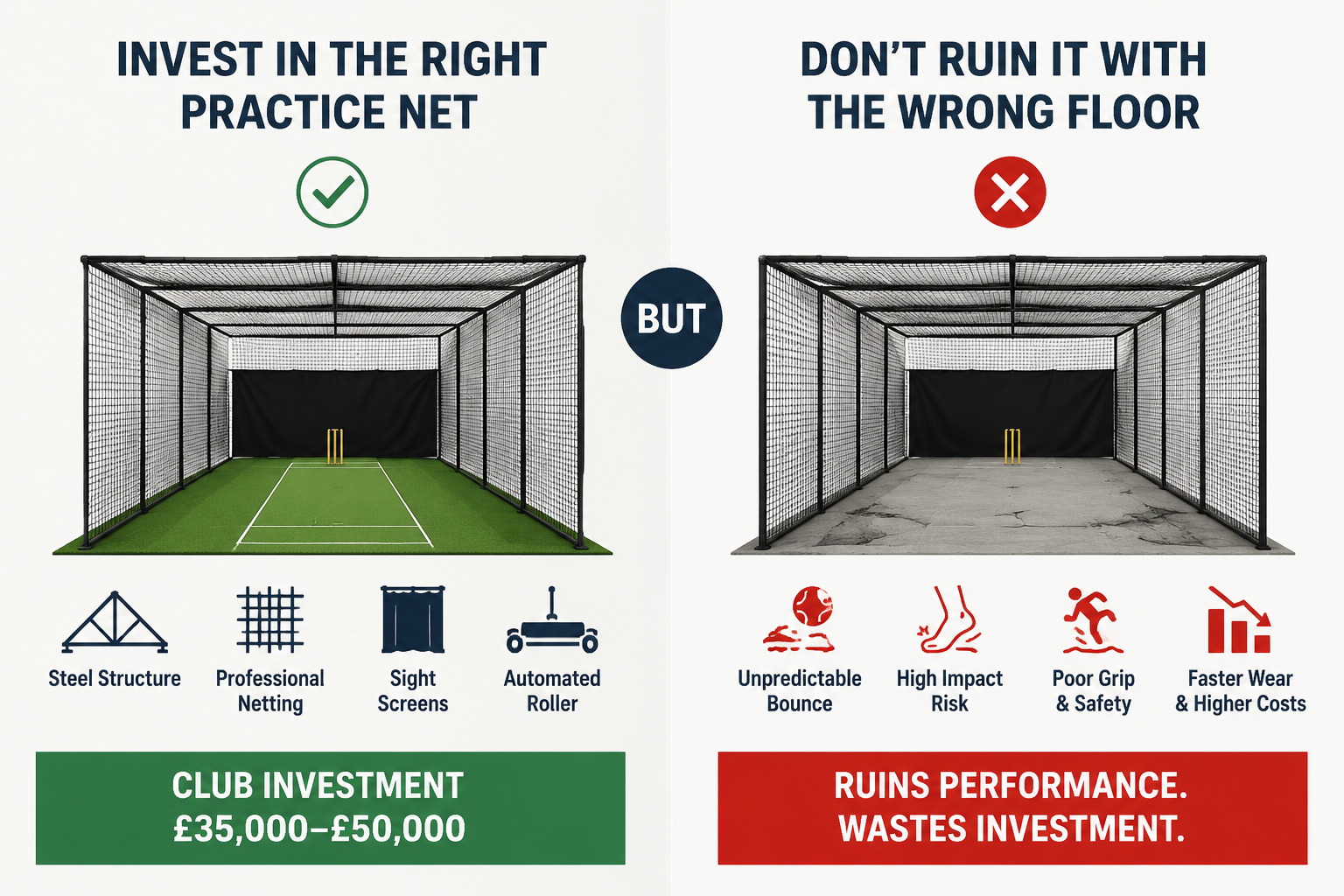
Most cricket clubs don’t set out to sabotage their own practice nets. They care about player development. They care about injury rates. They care about getting value from the money the committee has finally agreed to spend.
The problem is structural. When the conversation about a new net facility starts, the visible items dominate the budget discussion: the frame, the netting, the lighting, the screens. The floor is treated as the thing those items sit on rather than a piece of training equipment in its own right.
By the time the structure is ordered, the floor decision has usually been reduced to one of three cheap options:
– leftover artificial turf pulled from a football pitch
– existing concrete left bare
– the original tarmac that has been cracking since the 1990s
All three look acceptable on paper. All three fail the actual job the net is supposed to do.
What Actually Goes Wrong
For the Batter
The ball pitches on the net floor and rises. That rise — its pace, height, and consistency — is the single most important feedback the batter gets in a practice session.
A concrete floor produces a fast, low skid that forces batters to play late and keep their weight back. Useful if you’re preparing for a hard, dry county pitch. Actively damaging if you’re trying to teach players to drive through the line on typical English medium-paced surfaces.
Old football turf does the opposite. Soft pile and inconsistent compression create slow, high, loopy bounce. Batters start playing expansively and early. The first time they face genuine pace on a proper pitch, the timing falls apart.
Neither surface is honest. Both teach habits that only work inside that specific net.
For the Bowler
A fast bowler’s front foot lands with roughly 7–9 times body weight on every delivery. On concrete or cracked tarmac that force travels straight into the knee and ankle with almost no attenuation. Across 60–80 balls in a session, three sessions a week, the cumulative load becomes a genuine injury risk.
Clubs often notice the injuries. They rarely connect them back to the surface the bowler has been landing on for the previous two seasons.
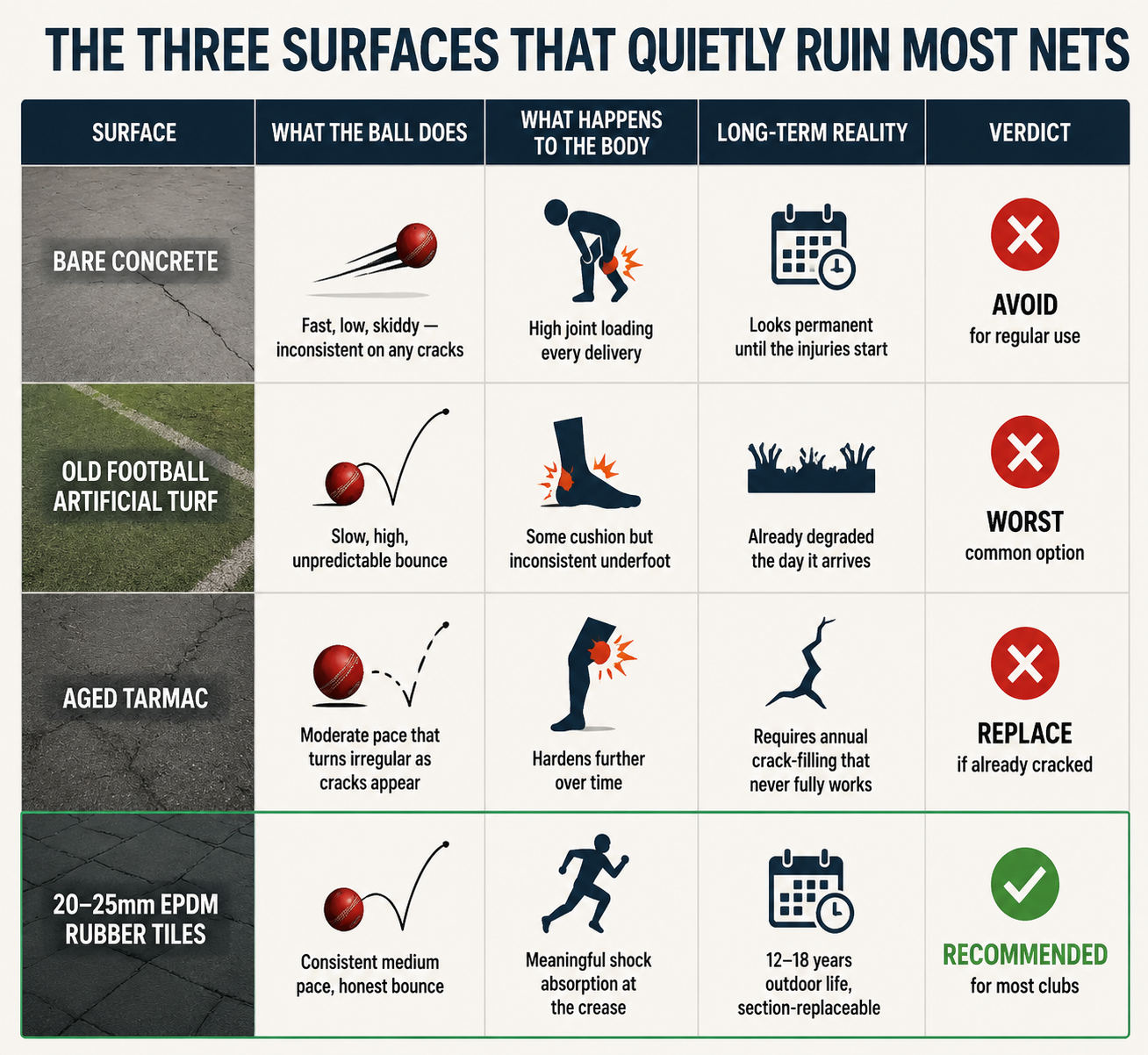
The Three Surfaces That Quietly Ruin Most Nets
| Surface | What the Ball Does | What Happens to the Body | Long-term Reality | Verdict |
|---|---|---|---|---|
| Bare concrete | Fast, low, skiddy — inconsistent on any cracks | High joint loading every delivery | Looks permanent until the injuries start | Avoid for regular use |
| Old football artificial turf | Slow, high, unpredictable bounce | Some cushion but inconsistent underfoot | Already degraded the day it arrives | Worst common option |
| Aged tarmac | Moderate pace that turns irregular as cracks appear | Hardens further over time | Requires annual crack-filling that never fully works | Replace if already cracked |
| 20–25mm EPDM rubber tiles | Consistent medium pace, honest bounce | Meaningful shock absorption at the crease | 12–18 years outdoor life, section-replaceable | Recommended for most clubs |
The first three options are chosen because they feel cheap or already exist. The fourth option is chosen when a club finally treats the floor as equipment rather than substrate.
Why the Wrong Floor Keeps Getting Chosen
Three practical reasons keep repeating:
1. **Budget timing.** The frame and netting get approved first. By the time the floor is discussed, the remaining money feels tight.
2. **Visibility bias.** Committees can see the steel and the netting. They cannot easily see the difference between a good and bad surface under the ball.
3. **Assumption that “any surface is fine for nets.”** This is the most damaging one. Nets are not just containment. They are the primary training environment for most players throughout the week.
Once the wrong surface is down, the cost of fixing it later is higher. You are now working around fixed frame bases, cutting tiles to fit existing anchors, and dealing with a structure that was never planned around a proper floor.
What a Proper Net Floor Actually Needs to Deliver
A good practice net surface has three non-negotiable jobs:
– Produce consistent, medium-paced bounce that rewards correct footwork and bat path
– Absorb enough impact at the bowling crease to reduce cumulative joint stress
– Survive the real abuse of a cricket facility — bowling machines, kit bags, studs, and occasional machinery — while remaining easy to repair in sections
20–25mm interlocking EPDM rubber tiles meet all three at a cost most clubs can absorb without blowing the project budget. Cricket-specific artificial turf systems can go further on pure ball behaviour, but they cost more, need professional installation, and are usually over-specified for standard club nets.
Recommended EPDM thickness for net floors
Best colour for UV stability and visual reference
Spare tiles for future section repairs
- Thickness: 20mm is the practical standard. 25mm is worth the upgrade if fast bowlers are heavy users of the facility.
- Format: 500×500mm interlocking tiles are easier to handle and cut around frame bases than larger formats.
- Base: Existing concrete or tarmac is fine if it is structurally sound and major cracks are filled first.
- Edges: Ramp strips on all exposed edges. A batter moving back to a short ball should never catch a heel on a raised tile edge.
- Certification: PAH and REACH as minimum. Confirm child-safe certification if juniors use the nets regularly.
The Cost Reality Most Committees Miss
A typical three-lane outdoor net covers roughly 100–150m². Proper 20mm EPDM interlocking tiles for that area, ordered direct and delivered to the UK or Europe, usually land in the £1,800–£3,500 material range depending on colour and volume.
Two people can install the full area in a day. No adhesive, no specialist tools, no contractor day-rate.
Compare that figure to:
– one fast bowler’s knee investigation and rehab
– the annual crack-filling and temporary repairs on deteriorating concrete or tarmac
– the lost development value of a season spent training on a surface that teaches the wrong bounce
The “cheap” floor is rarely the economical one once you look past the initial invoice.
The clubs that contact us after the nets are already built almost always say the same thing: they wish the floor had been in the original conversation. Retrofitting around an existing frame is still possible and still worth doing, but it is slower, involves more cutting, and costs more labour than getting the specification right at the planning stage.
What It Comes Down To
Most cricket clubs do not ruin their practice nets because they don’t care. They ruin them because the floor is treated as substrate instead of equipment.
The structure, the netting, and the screens matter. But the surface under the ball decides what every batter learns and how every bowler’s body feels at the end of a session. Get that wrong and the rest of the investment under-delivers.
The fix is not exotic or prohibitively expensive. It is simply deciding that the floor belongs in the same conversation as the frame — before the order is placed.
If you are planning nets or already living with a surface that feels wrong underfoot, start with samples. Feel the difference. That short practical step prevents the most common and most expensive mistake clubs make with practice facilities.
Full specifications, current pricing, and free samples: jflysports.com/contact-us
Free Samples for Your Net Floor Decision
We supply 20mm and 25mm virgin EPDM interlocking tiles in dark green and the full standard colour range, with PAH, REACH, and material documentation as standard. Free samples dispatched within 5 business days. No minimum order for samples.
Request Net Floor Samples
Cricket Ground Flooring Overview →