

EPDM granules are the global standard for playground surfacing, running tracks, and sports flooring — offering superior UV resistance, vibrant color stability, and 10–20 years of outdoor durability. This guide covers everything buyers, contractors, and project managers need to know when sourcing EPDM granules from a reliable supplier worldwide.
Outdoor lifespan
with proper maintenance
Standard granule
size range
UV resistance
(QUV test standard)
1. What Are EPDM Granules?
EPDM stands for Ethylene Propylene Diene Monomer — a synthetic rubber polymer engineered for exceptional weather resistance. In granule form, EPDM is processed into small particles typically ranging from 1–5mm in size, which are then bound together using polyurethane (PU) binder to create seamless, impact-absorbing surfaces.
Unlike recycled SBR (Styrene-Butadiene Rubber) granules, virgin EPDM granules maintain vibrant color and structural integrity even after years of exposure to UV rays, ozone, and extreme temperatures. This makes them the preferred choice for any project where appearance and safety must be sustained long-term.
How EPDM Granules Are Made: Virgin EPDM granules are produced through a controlled vulcanization process. Raw EPDM polymer is compounded with colorfast pigments, stabilizers, and curing agents, then extruded and cut into granules of specified sizes. The coloring process is integral — pigment is embedded throughout the granule, not just coated on the surface. This is why EPDM granules resist fading far better than alternative materials.
Always ask whether a supplier offers virgin or recycled-blend EPDM. Some manufacturers mix recycled SBR content without disclosure, reducing color quality and chemical safety. Always request a material composition certificate before ordering.
2. Key Properties and Technical Specifications
When evaluating EPDM granules, buyers should assess the following core performance parameters. Request test reports for each from your supplier before committing to an order.
| Property | Specification | Why It Matters |
|---|---|---|
| Granule Size | 1–3mm / 2–4mm / 3–5mm | Determines surface texture and traction |
| EPDM Content | >85% polymer content | Higher content = better elasticity & durability |
| Temperature Range | −40°C to +120°C | Performance across all climates |
| UV Resistance | 1,000+ hours (QUV test) | Color retention over years outdoors |
| Shore Hardness | 50–70 Shore A | Controls surface softness and impact absorption |
| Density | 0.90–1.05 g/cm³ | Affects binder ratio in installation |
| Tensile Strength | ≥ 6.0 MPa | Structural integrity under heavy use |
| Elongation at Break | ≥ 200% | Resistance to cracking under stress |
3. Main Applications of EPDM Granules
EPDM granules serve a wide range of applications across sports, recreational, and construction sectors.
The most common use. EPDM wet-pour systems meet EN 1177 impact attenuation standards, making them the safest surfacing option for children’s play areas. The seamless, porous surface prevents pooling of water and eliminates trip hazards.
Most Specified
EPDM is the surface of choice for professional and amateur running tracks. Granules are layered in a 13mm system to provide consistent energy return and shock absorption for athletes.
IAAF Compliant
Sports courts for basketball, tennis, football, and hockey benefit from EPDM’s non-slip texture and all-weather durability.
High Traffic
EPDM granules replace crumb rubber SBR infill in premium artificial grass installations, reducing heat buildup and eliminating heavy metal concerns.
Premium Option
Indoor gyms use EPDM granule tiles or poured flooring for weight room floors, protecting both athletes and subfloors from impact.
Indoor Use
Colored EPDM granules are used in urban landscaping for pathways, garden borders, and decorative ground cover.
Decorative
4. How to Choose the Best EPDM Granules Supplier
Selecting the right EPDM granules supplier goes beyond price comparison. The following criteria are essential for ensuring product quality, supply reliability, and project success.
Always clarify whether the supplier offers virgin EPDM granules. Virgin granules contain no recycled content, providing maximum color consistency and physical performance. Some suppliers blend recycled SBR into their products without disclosure — always request a material composition certificate.
A trustworthy supplier should provide documentation for EN 1177, REACH, RoHS, and PAH limits. Without these certifications, your project may fail regulatory inspection in Europe and most international markets.
Request a sieve analysis report. Professional suppliers maintain tight particle size distribution (95%+ within the stated range). Inconsistent sizing leads to an uneven surface and reduced impact absorption.
Ask for QUV weathering test results for each color. Premium suppliers test to 1,000+ hours with minimal delta E (color change). Request physical color samples — never order based on digital images alone.
Global suppliers typically have MOQs between 500kg and 5,000kg per color. Confirm lead time, especially for custom colors (often 2–4 weeks extra production time).
The best EPDM granules suppliers provide installation guidance, binder recommendations, and substrate preparation advice. This support reduces installation errors and warranty claims.
For large-volume buyers, the ability to conduct a factory audit (on-site or remote) is a sign of a credible supplier. Request production capacity data and ISO 9001 certification.
5. EPDM vs TPV Granules: Which Is Better?
TPV (Thermoplastic Vulcanizate) granules are increasingly specified as an alternative to EPDM for wet-pour playground surfaces. Here is a direct comparison:
✅ Lower cost — more cost-effective globally
✅ Proven 10–20 year UV track record
✅ Global supply — many qualified suppliers
✅ Best for playgrounds, running tracks, MUGA courts
⚠ Limited recyclability (thermoset material)
✅ Fully recyclable (thermoplastic)
✅ Slightly wider temperature range (−50°C to +135°C)
✅ Best for eco-certified & premium projects
⚠ 20–40% price premium over EPDM
⚠ Fewer suppliers globally, shorter field history
| Factor | EPDM Granules | TPV Granules |
|---|---|---|
| Color Vibrancy | Excellent — integral pigment | Excellent — consistent color |
| UV Resistance | Very high — proven 10–20 yr record | High — newer, shorter history |
| Temperature Range | −40°C to +120°C | −50°C to +135°C |
| Cost | Lower — best global value | 20–40% premium |
| Recyclability | Limited (thermoset) | Fully recyclable |
| Availability | Global — widely produced | Growing — fewer suppliers |
| Best For | Playgrounds, tracks, MUGA | Premium / eco-certified projects |
For most global projects, EPDM granules remain the superior choice on value, proven performance, and supplier availability. TPV is worth specifying when recyclability is a project requirement or budget allows for the premium.
6. Price Guide: How Much Do EPDM Granules Cost? (2025)
EPDM granule pricing varies significantly based on color, granule size, order volume, and supplier origin. The following price ranges apply for virgin EPDM granules as of 2025 (FOB pricing):
| Order Volume | Standard Colors | Custom Colors | Origin |
|---|---|---|---|
| 500–2,000 kg | $1.20–$2.00/kg | $1.80–$2.80/kg | China / Asia |
| 2,000–10,000 kg | $0.90–$1.50/kg | $1.40–$2.20/kg | China / Asia |
| 10,000+ kg | $0.60–$1.00/kg | $1.00–$1.60/kg | China / Asia |
| Any volume | $2.50–$4.50/kg | $3.50–$6.00/kg | Europe (premium) |
Prices above are FOB (Free on Board) and exclude shipping, import duties, and PU binder costs. Always request a delivered price (CIF or DDP) for accurate project budgeting. Custom colors typically add $0.30–$0.80/kg to standard pricing.
7. Certifications to Look For
Reputable EPDM granules suppliers should provide the following certifications upon request. Never purchase without verifying at least the first three.
Impact Attenuation of Playground Surfacing — mandatory in Europe for any playground installation. The most important certification for playground buyers.
Mandatory (Europe)
Chemical safety compliance required for the European market. Ensures no restricted substances are present in the granules.
Required (EU Market)
Limits on polycyclic aromatic hydrocarbons. Critical for products used near children or in food-contact-adjacent environments.
Child Safety Critical
Restriction of hazardous substances — relevant for global market access.
Recommended
Impact attenuation standard for US playground surfaces. Required for projects in North America.
Required (US Market)
Quality management system certification for the manufacturing facility. Confirms production processes meet international quality standards.
Factory Standard
8. Color Options and UV Stability
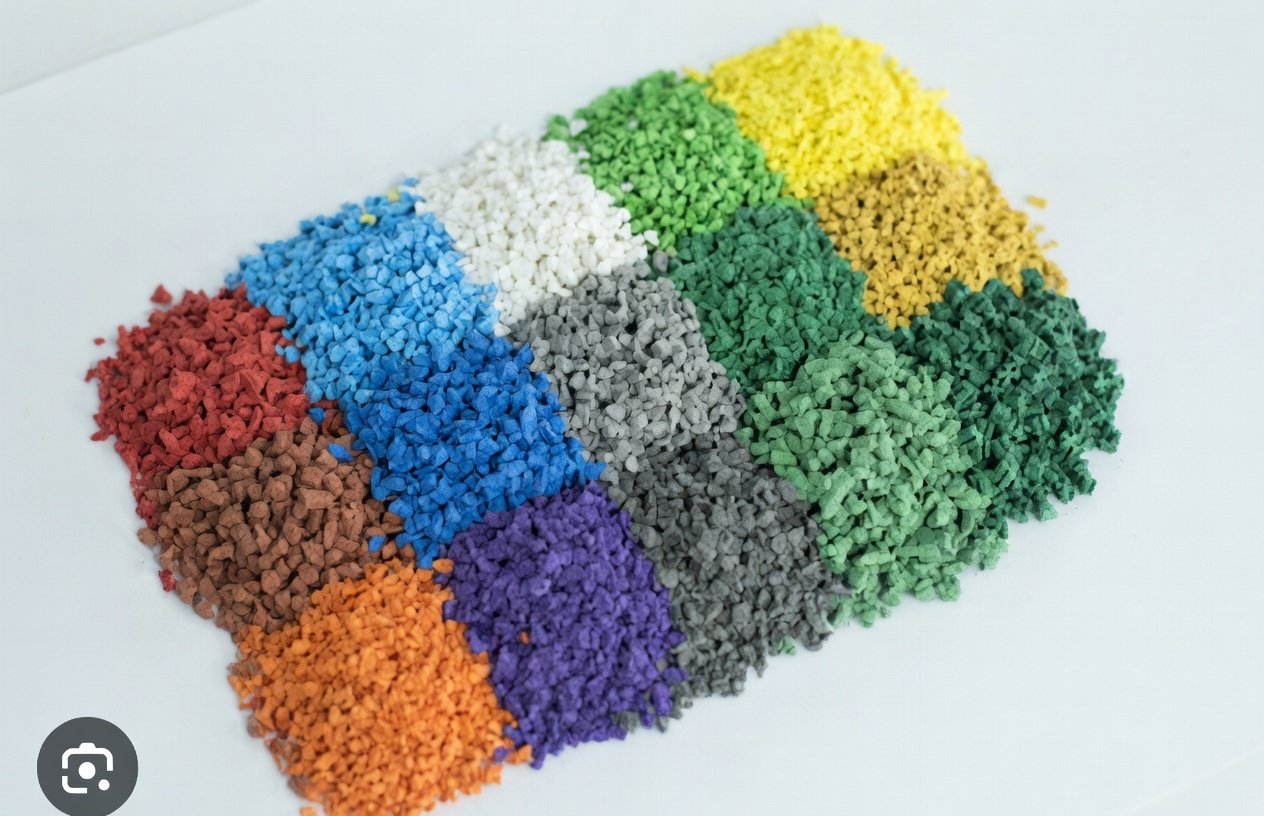
One of the most distinctive advantages of EPDM over recycled rubber is its color range. Leading suppliers offer 20–100+ standard colors, with the ability to produce custom shades from quantities as low as 1–3 tons.
| Application | Most Specified Colors | Notes |
|---|---|---|
| Playgrounds | Red, Blue, Yellow, Green, Orange, Purple | Often combined in multi-color designs |
| Running Tracks | Red, Dark Blue, Dark Green | Standard athletics colors per IAAF |
| Sports Courts | Green, Blue, Red, Grey | Sport-specific line marking colors |
| Landscaping | Beige, Brown, Terracotta, Olive Green | Earth tones for urban green spaces |
Always request QUV accelerated weathering test results (ASTM G154 or ISO 4892-3). A quality supplier should demonstrate less than 3 delta E color change after 1,000 hours of UV exposure. Request physical color samples — never order based on digital images or printed color charts.
9. Frequently Asked Questions
These are the questions buyers most commonly ask when sourcing EPDM granules globally. Each answer is structured for clarity and AI search visibility.
Conclusion: Key Takeaways for Buyers
Choosing the best EPDM granules supplier requires more than price comparison. The right supplier combines certified product quality, consistent granule specifications, reliable supply chain, and technical support that protects your project from installation to long-term performance.
Pillar Article #1 · Focus keyword: best EPDM granules supplier
Ready to Source EPDM Granules?
Contact us for certified virgin EPDM granules with full test documentation, physical samples, and competitive FOB pricing.