

For a standard 13 mm EPDM wear layer, you need approximately 7–8 kg of EPDM granules per square meter. For a 10 mm layer, allow 5.5–6.5 kg/m². These figures assume a granule density of 0.55–0.65 g/cm³ and a 22% PU binder ratio. Always add 5–8% as a waste allowance for cutting, edges, and mixing losses.
EPDM Granule Quantity Reference Table (by Thickness)
The table below gives the standard EPDM granule quantity per square meter at each common installation thickness. These values are based on a granule bulk density of 0.60 g/cm³ and a 22% PU binder mix ratio — the most widely used specification for playground and sports surfacing.| Thickness | EPDM kg / m² | EPDM kg / 100 m² | Typical Application | Standard |
|---|---|---|---|---|
| 8 mm | 4.5 – 5.0 kg | 450 – 500 kg | Indoor gym, light-use areas | — |
| 10 mm | 5.5 – 6.5 kg | 550 – 650 kg | Community park paths, jogging tracks | EN 14877 |
| 13 mm | 7.0 – 8.0 kg | 700 – 800 kg | School playground, kindergarten (standard) | EN 1177 |
| Top layer only (over SBR base) | 7.0 – 8.0 kg | 700 – 800 kg | Competition track wear layer, two-layer systems | IAAF / EN 14877 |
Important: These figures are for the EPDM wear layer only
If your project uses a two-layer system (SBR cushion base + EPDM top), you need to calculate SBR and EPDM quantities separately. SBR base layers typically use 14–16 kg/m² at 20 mm thickness. See the two-layer calculation section below.
The Formula: How to Calculate EPDM Granule Quantity
Use this straightforward formula to calculate the exact EPDM granule quantity needed for any project size and thickness:EPDM QUANTITY FORMULA
EPDM (kg) = Area (m²) × Thickness (mm) × Density (g/cm³) × 1.10
— where 1.10 = 10% waste factor (adjust to 1.05–1.08 for experienced installers)
Standard density for EPDM granules: 0.55–0.65 g/cm³ (use 0.60 as default)
Worked Examples
Below are three fully calculated examples covering the most common project types. Use these as templates for your own quantity estimate.Example 1 — School Playground (500 m², 13 mm EPDM only)500 m² × 13 mm × 0.60 g/cm³ × 1.10 = 4,290 kg EPDM (≈ 172 bags × 25 kg). Budget approximately 4,300–4,500 kg to allow for edge variation and mixing losses.
Example 2 — Two-Layer System: SBR Base 30 mm + EPDM Top 13 mm (200 m²)SBR base: 200 m² × 30 mm × 0.65 g/cm³ × 1.08 = 4,212 kg SBR
EPDM top: 200 m² × 13 mm × 0.60 g/cm³ × 1.10 = 1,716 kg EPDM
Total order: ~4,200 kg SBR + ~1,750 kg EPDM
Example 3 — Running Track Wear Layer (400 m × 8 lanes ≈ 10,000 m², 13 mm EPDM)10,000 m² × 13 mm × 0.60 g/cm³ × 1.08 = 84,240 kg EPDM (≈ 84.2 tonnes). At market price of USD $1.20–$1.80/kg, this EPDM wear layer costs approximately USD $101,000–$152,000 in material alone.
Two-Layer System: SBR Base + EPDM Top — Combined Quantities
 Most playgrounds with fall heights above 1.5 m, and all certified running tracks, use a two-layer system. Here is the combined material quantity reference for the most common two-layer configurations:
| System | SBR Base | EPDM Top | SBR kg/m² | EPDM kg/m² | Application |
|---|---|---|---|---|---|
| Standard playground | 25 mm | 13 mm | 14–16 kg | 7–8 kg | School, park (fall height up to 1.5 m) |
| High-fall playground | 35 mm | 13 mm | 20–22 kg | 7–8 kg | Under climbing frames (fall height up to 2.4 m) |
| Competition track | 35 mm | 13 mm | 20–22 kg | 7–8 kg | IAAF-compliant athletics track |
| Community jogging path | 20 mm | 10 mm | 12–13 kg | 5.5–6.5 kg | Park paths, low-intensity use |
Estimated Material Cost Per Square Meter (2025)
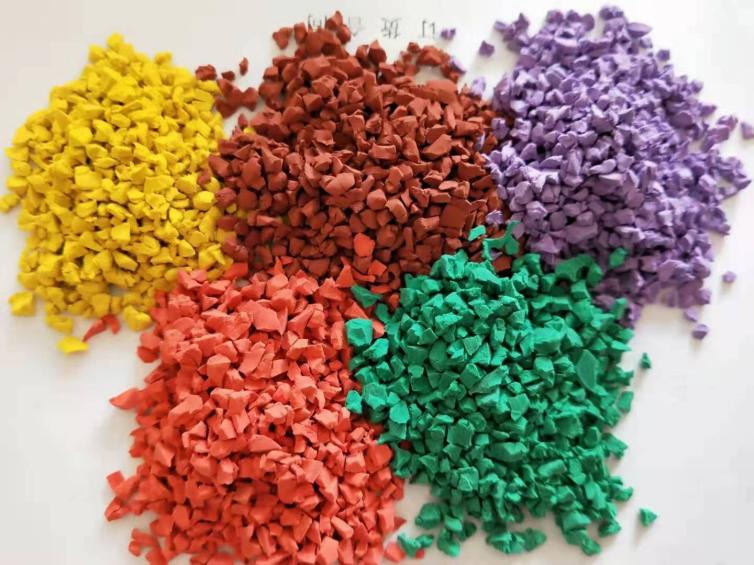 Once you know the kg/m² quantity, multiply by the current EPDM granule price to estimate total material cost. The following price tiers reflect typical 2025 export pricing from Chinese manufacturers at different order volumes.
Budget / Bulk
$8–$12 / m²
EPDM at $0.90–$1.20/kg × 8 kg. Order volume 5,000+ kg. Recycled or economy-grade EPDM. Suitable for community parks.
Mid-Range
$12–$20 / m²
Virgin EPDM at $1.20–$1.80/kg × 8 kg. Most common for schools and public playgrounds. Includes SGS certification.
Premium
$20–$30 / m²
High-UV virgin EPDM at $2.00–$2.50/kg × 8 kg. Competition tracks, IAAF projects. Full EN 1177 + TÜV documentation.
Frequently Asked Questions
For a standard 13 mm EPDM wear layer, allow 7–8 kg per m². For a 10 mm layer, allow 5.5–6.5 kg/m². These figures include a 10% waste factor. If you are an experienced installer with low waste, you can reduce the waste factor to 5–8%.
Use the formula: EPDM (kg) = Area (m²) × Thickness (mm) × 0.60 (density) × 1.10 (waste factor). For example, a 300 m² playground at 13 mm thickness needs: 300 × 13 × 0.60 × 1.10 = 2,574 kg — round up to 2,600 kg for your order.
No. The PU binder is ordered and calculated separately. At a standard 22% binder ratio by weight, you need approximately 1.8–2.0 kg of PU binder per m² for a 13 mm EPDM layer. Always order binder from the same supplier as the granules to ensure compatibility.
For a 25 mm SBR base layer, allow 14–16 kg of SBR granules per m². For a 35 mm base, allow 20–22 kg/m². SBR granule density is slightly higher than EPDM at approximately 0.65–0.70 g/cm³. Use the same formula: SBR (kg) = Area × Thickness (mm) × 0.65 × 1.08.
For a 13 mm EPDM layer over 100 m²: 100 × 7.5 kg (average) = 750 kg total ÷ 25 kg per bag = 30 bags. For a 10 mm layer: 100 × 6 kg = 600 kg ÷ 25 = 24 bags. Always round up to the nearest full bag.
Variations occur due to differences in granule density (0.55–0.65 g/cm³ range), binder ratio, surface texture, and installer waste rate. A dense granule mix with high binder content uses less material by volume but more by weight. Always ask your installer to confirm the granule density spec and their waste allowance before finalizing the order quantity.
Need an Exact Quantity Estimate for Your Project?
Send us your project area, thickness requirement, and application type — we will calculate the exact EPDM and SBR quantities, provide a material cost estimate, and arrange samples before your order.
Get a Free Quantity Estimate
Download Spec Sheet