


It’s one line on a spec sheet. It gets less attention than color, less debate than price, and less scrutiny than certification. And yet, more sports surface projects run into real trouble because of a wrong granule size spec than almost any other single procurement decision.
Here’s what that trouble looks like in practice: a surface that drains poorly after the first rain season. Binder costs that overrun the budget mid-installation. A texture that feels wrong underfoot for the application. Or — in the worst case — a finished playground surface that fails its EN 1177 compliance test and sends the project back to square one, with a client who has already moved up the opening date.
None of that is dramatic. All of it is avoidable. This guide covers the EPDM granule size chart in practical terms — what the numbers mean, which size works for which application, and how to verify what you’re actually receiving before the surface goes down.
Why Granule Size Shapes Everything Downstream
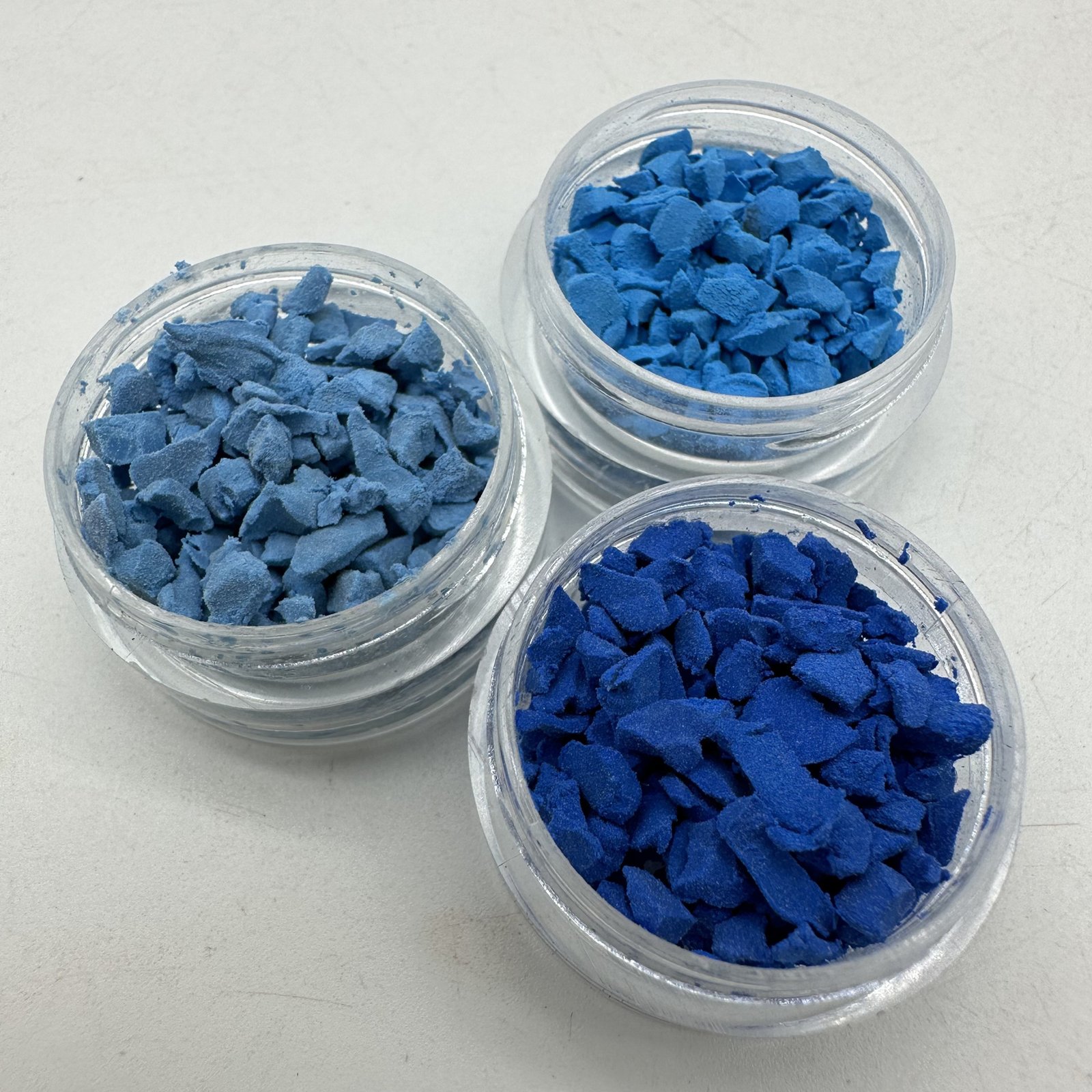
Think about granule size the way an engineer thinks about aggregate in concrete. It doesn’t just fill space — it governs behavior. It controls how particles pack together, how much binder they absorb, how water moves through the layer, and how the surface performs under repeated athletic load.
Smaller granules create denser packing with smoother texture and richer color expression. But they also expose significantly more total surface area — which means your PU binder consumption increases. Switch from a 2–4mm spec to a 1–2mm spec on a large-area project without adjusting your material budget, and the cost difference lands as a surprise during installation, not before it.
Larger granules do the opposite: more void space, better drainage, more impact absorption. In high-rainfall climates across Southeast Asia — or high-UV, high-temperature environments across the Gulf where surface temperatures can exceed 70°C in summer — that void structure isn’t a trade-off. It’s a design feature.
Source: Industry field data; EN 1177 European Standard for Playground Impact Attenuation
Reading the Size Chart: What the Numbers Actually Mean
Most spec sheets express rubber granule mesh size in one of two ways: a millimeter range (e.g., 2–4mm) or a mesh number. Mesh number describes how many sieve openings fit per linear inch — the higher the mesh number, the finer the particle. The two systems are related but not interchangeable, and it’s worth knowing both when comparing quotes across suppliers.
| Granule Size (mm) | Mesh Equivalent | Surface Density | Primary Application |
|---|---|---|---|
| 0.5–1.5mm | 12–35 mesh | High | Fine top coat, color-rich indoor surfaces |
| 1–3mm | 7–18 mesh | Medium-High | Children’s playgrounds, indoor gym flooring |
| 2–4mm | 5–10 mesh | Medium | Running tracks, multi-use sports courts |
| 3–6mm | 3–6 mesh | Low-Medium | Artificial turf infill, drainage base layers |
| 4–8mm | 2–5 mesh | Low | Heavy-duty sub-base, permeable paving systems |
These ranges aren’t arbitrary preferences — each reflects engineering logic behind a specific application requirement. Understanding why a playground needs 1–3mm and a running track needs 2–4mm is what separates a buyer who knows their specification from one who’s copying numbers from the last project and hoping nothing changes.
Granule size distribution is among the top three variables affecting mechanical performance of poured-in-place rubber surfaces — alongside binder ratio and layer thickness.— European Rubber Journal, Technical Review
Four Applications. Four Size Profiles. One Chance to Get It Right.
Three Size Mistakes That Catch Buyers Off Guard
Assuming the spec sheet matches what’s in the bag. A supplier writing “2–4mm” on a data sheet and shipping a mixed 1–5mm batch is more common than it should be. Inconsistent particle size causes uneven compaction, irregular drainage, and surface wear patterns that appear within months — not years. The fix is simple and non-negotiable: always request a sieve analysis / PSD report before confirming bulk volume.
Using top-coat spec granules in the base layer. Fine granules (1–2mm) in a sub-base layer waste material, increase total cost, and reduce drainage performance. The correct two-layer logic — coarser for the base (3–6mm), finer for the wear surface (1–3mm) — applies to most playground and sports court specifications. It’s where inexperienced contractors make the most expensive errors.
Switching size mid-project without adjusting binder ratios. If your project was specced for 2–4mm and your supplier substitutes 1–2mm due to stock availability, your binder consumption increases by 15–25%. That’s a budget hit that arrives during installation — exactly when it’s hardest to absorb. Lock in your granule size specification before you lock in your material order.
Single Size vs. Blended Gradation: A Practical Call
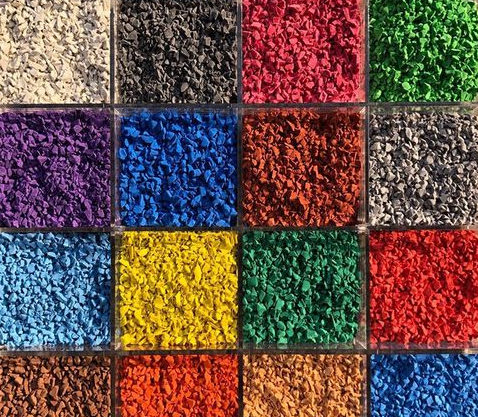
Some suppliers offer blended or graded mixes — for example, a 1–4mm gradation rather than a uniform 2–3mm product. Blended gradations improve particle packing density and can reduce binder consumption slightly. On large-area projects, that saving is real.
The trade-off: blended mixes make quality control harder across production batches. If particle distribution drifts even slightly between deliveries, surface performance can vary between sections — an issue that becomes visible on phased projects. For specification-driven projects — government parks, school facilities, certified sports complexes across the Middle East and ASEAN — a defined single size range with per-batch PSD documentation remains the more defensible procurement choice.
What to Request Before Any Bulk Shipment Moves
Granule size verification isn’t something you do after a problem surfaces. By then, the installation is complete and the conversation has shifted from quality control to claims dispute. These three documents should be on your desk before material ships:
1. Sieve analysis / Particle Size Distribution (PSD) report — confirms the batch matches your ordered size spec within acceptable tolerances (typically ±0.5mm, with no more than 5–10% of particles outside the stated range). 2. Third-party test certificate (SGS, Intertek, or Bureau Veritas) — independently validates size and material composition. A supplier’s own QC data is not a substitute. 3. Physical sample bag — do a basic visual check on arrival. A 1–3mm product should feel fine and uniform in your hand, with no visible oversized particles or powdery fines. If it doesn’t look consistent, it isn’t.
If a supplier hesitates to provide a PSD report, that hesitation isn’t a minor administrative gap. Suppliers running controlled production lines have this data available as standard output from their QC process. The ones who can’t produce it are telling you something important about how their factory operates.
The Size Decision Is Made Before the Project Starts
Granule size isn’t a procurement afterthought. It’s an engineering input that should be fixed at the specification stage — before you request quotes, before you compare suppliers, and well before any material ships to a project site in Dubai, Kuala Lumpur, or Jakarta.
Get the size right for your application, verify what you receive, and your surface has the foundation it needs to perform. Get it wrong — even by one size category — and you’re managing consequences for years. The athletes, children, and facility users who use these surfaces every day will never think about granule size. That’s exactly the point.
FAQ: EPDM Granule Size
What size EPDM granules are best for playgrounds?
1–3mm granules are commonly used for playground surfaces…
Does smaller granule size increase binder consumption?
Yes, smaller granules increase surface area and require more binder…
Can I mix different EPDM granule sizes?
Blended gradation can improve packing but requires strict QC…
At [JoyJiang], we supply certified EPDM rubber granules across the full size range — with sieve analysis reports, third-party certifications, and technical guidance matched to your specific application and regional compliance requirements.
Tell us your application, required certifications, climate conditions, and order volume — we’ll recommend the right size, layer system, and binder ratio and send you a verified sample.