


EPDM rubber granules are widely used in playgrounds, running tracks, sports courts, and safety flooring because of their excellent elasticity, UV resistance, and long life span.
However—not all EPDM granules are the same.
The global market includes many quality levels, from high-purity virgin EPDM to low-grade recycled fillers that may fade, crack, or release odor after installation.
If you want your project to last 6–10 years, quality evaluation before purchasing is essential.
This article breaks down 10 critical parameters to check before buying EPDM granules. With these criteria, you can avoid low-grade materials and choose a reliable supplier.
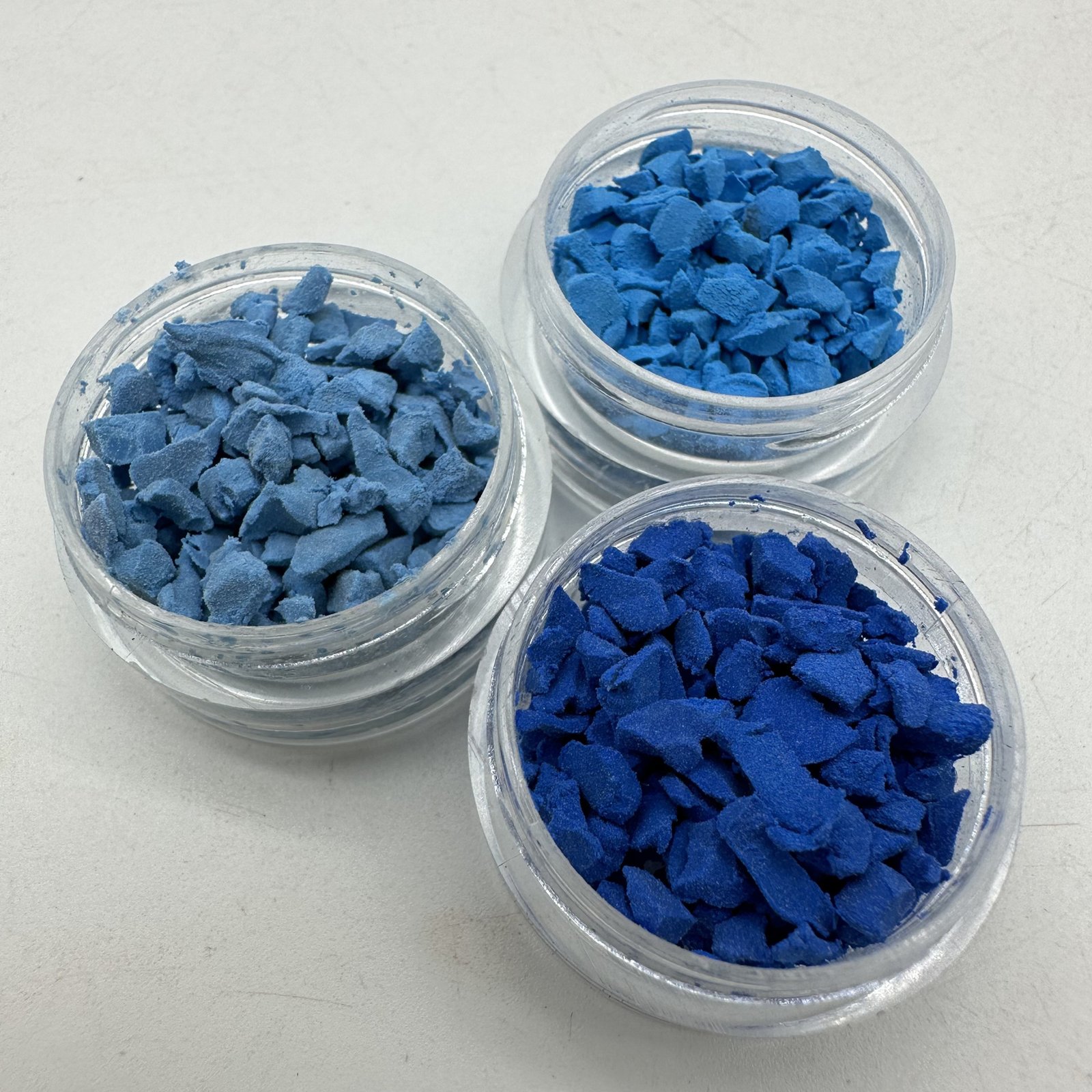
1. Purity Level: Virgin EPDM vs. Recycled Mixed Material
The most important factor is whether the granules are made from virgin EPDM or mixed with recycled rubber fillers (SBR powder, waste rubber, or EVA scraps).
High-quality EPDM granules should be:
Made from pure virgin EPDM
Free from odor
Consistent in elasticity
Resistant to ultraviolet aging
Low-quality granules often:
Contain recycled black rubber
Release a strong smell
Fade quickly
Harden and crack after 1–2 years
If the purity is below 15–20% EPDM content, the color will fade within months.
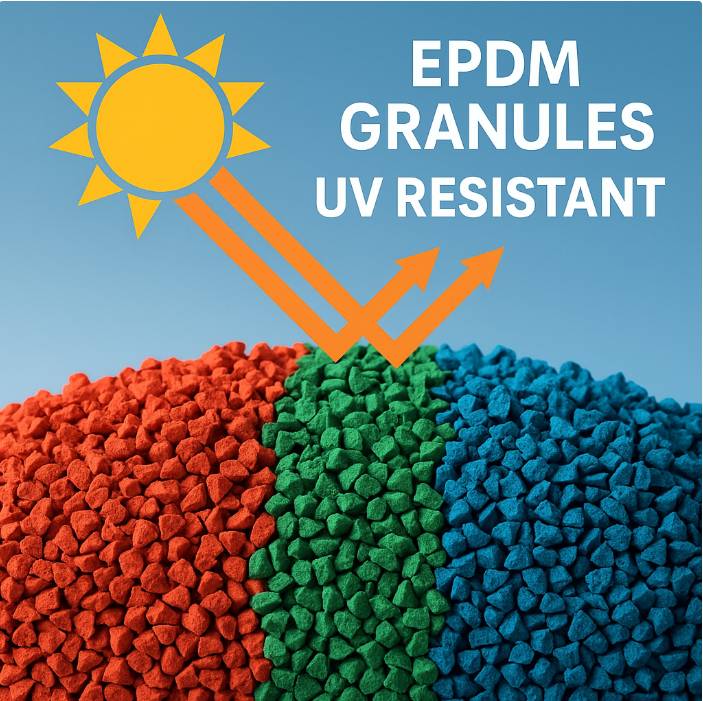
2. UV & Weather Resistance
Outdoor playgrounds and sports surfaces face intense sunlight and rain.
Quality EPDM granules must include UV stabilizers and anti-aging additives.
Check the following:
UV resistance test report
Colorfastness grade (minimum ≥ Grade 4)
Outdoor weathering performance
Granules with weak UV resistance will fade to white or grey after short exposure.
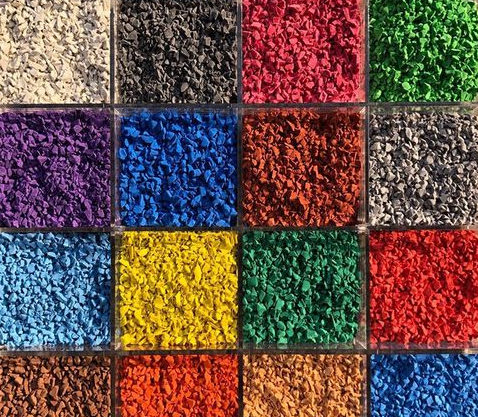
3. Color Stability & Color Uniformity
For colorful surfaces—especially in playground flooring—color quality directly affects the look and longevity of the project.
Inspect these:
-
Color uniformity from batch to batch
-
Granule surface smoothness
-
No visible black spots or mixed impurities
High-quality granules use high-purity pigments, ensuring smooth and vivid colors for years.
4. Particle Size Consistency (0.5–4.0 mm)
EPDM granules are usually available in:
-
0.5–1.5 mm (fine rubber)
-
1–3 mm (standard flooring)
-
2–4 mm (playground, running tracks)
If the particle size is inconsistent, the installation will become uneven, affecting:
-
Surface flatness
-
Impact performance
-
Wear resistance
Quality factories use precision screening machines to guarantee uniform particle sizes.
5. Granule Density & Elasticity
Density directly affects shock absorption and lifespan.
Good EPDM granules:
-
Have higher density
-
Provide better resilience
-
Absorb impact more effectively
-
Maintain long-term elasticity
Low-density granules usually contain fillers, making them brittle and prone to cracking.
6. Tensile Strength & Durability
A crucial performance indicator is tensile strength—it determines resistance to tearing and long-term mechanical stress.
Look for:
-
Tensile strength ≥ 3.5 MPa
-
Good elongation performance
-
Strong resistance to compression
These parameters ensure the flooring stays stable even under heavy traffic.
7. Odor Level & VOC Emissions
Premium EPDM granules are environmentally friendly and safe for children.
Low-emission granules should:
-
Have almost no smell
-
Pass EN71 / EN1177 / RoHS tests
-
Show low VOC levels
A strong rubber smell usually means recycled content or low-grade raw materials.
8. Surface Finish & Cleanliness of Granules
Visually inspect the granules:
-
Are they smooth and evenly cut?
-
Do they contain dust or powder?
-
Are there black impurities or hard chunks?
High-quality EPDM granules are washed, dust-free, and uniform in shape.
9. Heavy Metal & Safety Certifications
For schools, playgrounds, and public facilities, safety certification is non-negotiable.
Recommended certifications include:
-
EN1177 (Impact attenuation)
-
CE / RoHS (Safety compliance)
-
ASTM F1292 (Playground safety)
-
EN71-3 (Toy safety for children)
If the supplier cannot provide test reports, the granules may not be suitable for playground applications.
10. Real Outdoor Performance & Supplier Background
Finally, evaluate the supplier—not just the product.
Check:
-
Factory background & production capacity
-
How many years they have been producing EPDM granules
-
Real project photos (schools, parks, stadiums)
-
Customer feedback
-
Export history
A supplier with stable production and real cases ensures consistent quality for long-term partnerships.
How to Perform a Simple On-site Quality Test
Even without laboratory tools, buyers can identify basic quality issues:
① Kneading test
Good granules remain flexible when pinched; poor-quality granules break easily.
② Fire resistance check
Virgin EPDM burns slowly and does not produce black smoke.
Recycled fillers burn faster and emit strong odor.
③ Color rub test
Rub a handful of granules with a white cloth.
If color comes off easily, pigment or UV care is poor.
Common Problems Caused by Low-quality EPDM Granules
Low-grade granules may lead to:
Color fading in 3–6 months
Cracking surfaces
Particle shedding
Bad smell in hot weather
Short lifespan (2–3 years instead of 8–10 years)
Quality issues not only increase maintenance costs but also damage brand reputation.
Buying Checklist: 10 Essential Questions for EPDM Suppliers
Before purchasing, ask your supplier:
What is the EPDM purity percentage?
Are your granules virgin EPDM or recycled mixed material?
Can you provide UV resistance and weathering test reports?
What pigment brand and colorfastness level do you use?
What are your standard particle sizes?
What is the density and tensile strength of your granules?
Do your products meet EN1177/ASTM/RoHS standards?
Can you provide a sample for real surface testing?
What is your annual production capacity?
Do you have real project cases or export records?
A professional supplier should be able to answer all ten questions clearly.
Conclusion: Choose High-quality EPDM for a Longer-lasting Surface
EPDM granules play a critical role in the safety, durability, and appearance of playgrounds and sports surfaces. By evaluating the 10 parameters above—purity, UV resistance, density, elasticity, certifications, and more—you can avoid inferior materials and ensure long-term performance.
If you’re sourcing EPDM granules for playground flooring, running tracks, gyms, or commercial projects, choosing a trustworthy manufacturer is the key to success.